


EtherCAT vs CAN vs ISOBUS: The Field Protocol War of Modern Machines
Why these three keep colliding in real projects
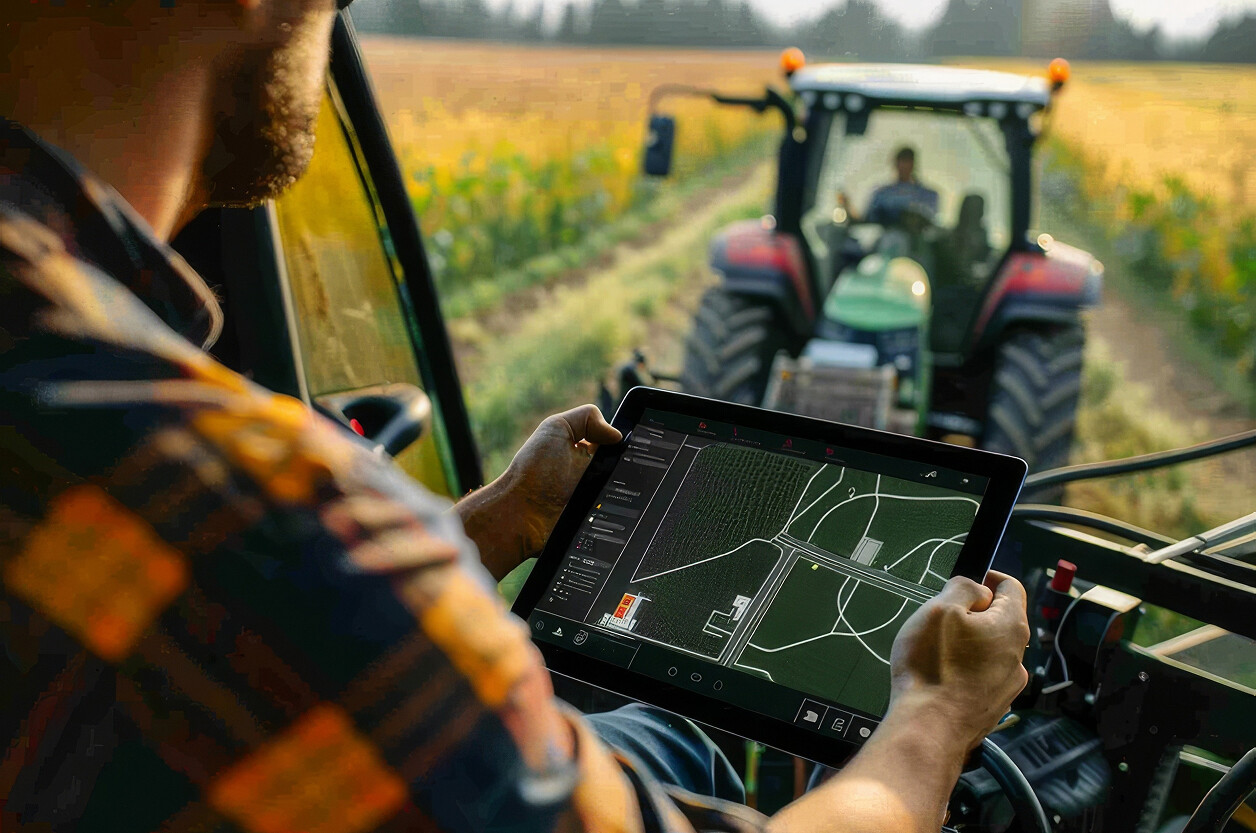
If you spend time around machine builders, robotics teams, or off-highway OEMs, you’ll notice a pattern: protocol discussions rarely end with a single winner. What actually happens is that the machine architecture forces multiple “field” worlds to collide. One part of the system needs ultra-tight cyclic control for drives and I/O. Another needs rugged, low-cost messaging over long harnesses. A third needs cross-vendor interoperability for implements and terminals, often under a standard that assumes farming realities rather than factory floors.
That is why EtherCAT, CAN, and ISOBUS keep showing up in the same conversations. They are not interchangeable technologies competing for the same job. They are optimized for different constraints, and the “war” is really about boundary decisions: where you draw the line between deterministic control, general machine communication, and standardized interoperability.
The easiest way to make this comparison useful is to treat each protocol as a design philosophy.
EtherCAT is built around hard real-time, short cycle times, low jitter, and synchronized distributed control. EtherCAT’s own technology description explicitly calls out cycle times at or below 100 microseconds and jitter at or below 1 microsecond as design targets.
CAN is built around robust arbitration on a shared bus, simple wiring, and reliable messaging in noisy electrical environments. Classical CAN allows bit rates up to 1 Mbit/s with up to 8 bytes of payload per frame, and CAN FD extends this with higher data-phase bit rates and payloads up to 64 bytes.
ISOBUS is built around agricultural interoperability. It is the ISO 11783 family, based on CAN, and in practice aligned with the “tractor + implement + terminal” ecosystem. Common references describe it as derived from SAE J1939 and focused on plug-and-play integration between tractors and implements across manufacturers.
Once you frame it this way, the comparison becomes less about speed headlines and more about system outcomes.
The battlefield: what each protocol is trying to optimize
EtherCAT’s north star: deterministic cyclic control
EtherCAT was designed so that cyclic process data exchange can happen extremely fast and with tightly bounded jitter. The EtherCAT Technology Group emphasizes short cycle times and low jitter as core goals. In practical terms, this aligns EtherCAT with servo control, synchronized I/O, precise timestamps, and motion-centric automation where “when” a bit flips matters as much as “what” the bit is.
CAN’s north star: robust messaging on simple wiring
CAN’s original promise is deceptively powerful: many nodes share the same two-wire bus, arbitration decides who speaks without bringing the network down, and the electrical layer is tolerant of harsh environments. ISO’s summary of ISO 11898-1 highlights the classical CAN constraints (up to 1 Mbit/s, up to 8 bytes payload) and also the existence of CAN FD as an evolution. CAN is a workhorse because the total system cost can be low, troubleshooting is straightforward, and the ecosystem for transceivers, tools, and stacks is enormous.
ISOBUS’s north star: cross-vendor implement interoperability
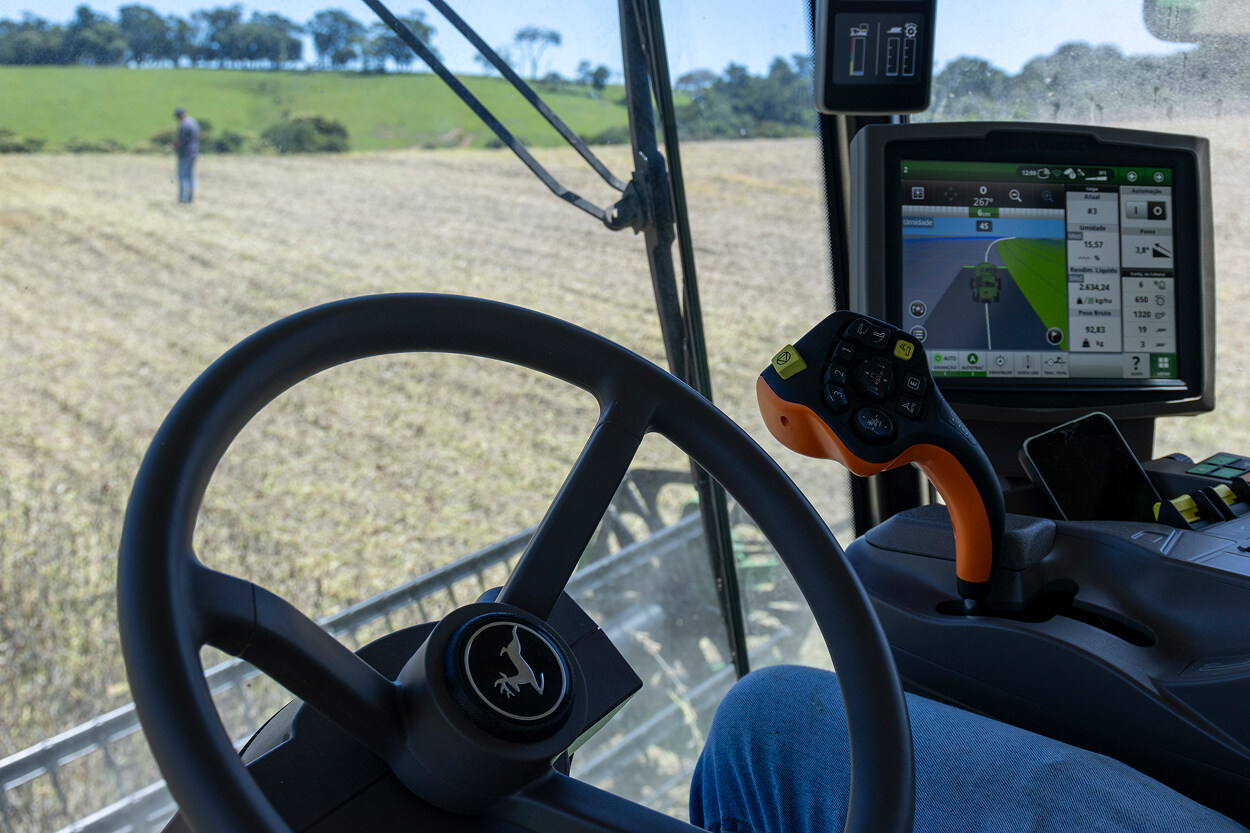
ISOBUS is not “CAN with a different label.” It is an application domain with strong expectations around what functions exist (e.g., Virtual Terminal and Task Controller workflows) and how tractors and implements should cooperate. The AEF (Agricultural Industry Electronics Foundation) positions tooling like the AEF ISOBUS Database specifically to create transparency about supported functionalities and compatibility between products. This is a different value proposition than raw transport performance.
Speed is not one number: bandwidth, payload, and effective throughput
EtherCAT: fixed physical rate, high effective cyclic efficiency
EtherCAT commonly runs on 100BASE-TX Ethernet (100 Mbit/s). The key difference is how it uses frames and how devices process them in-flight, enabling tight cyclic updates. EtherCAT’s own technology overview highlights the emphasis on short cycle times and low jitter.
For engineers, the practical interpretation is: EtherCAT’s “speed” is measured in stable cycle time under load, with synchronized nodes, rather than in raw peak throughput for arbitrary traffic.
Classical CAN and CAN FD: the real payload story matters more than the headline
ISO 11898-1 describes classical CAN as up to 1 Mbit/s with up to 8 bytes payload per frame, and CAN FD as allowing higher bit rates and payloads beyond 8 bytes. CiA’s overview of CAN FD explains the two fundamental improvements: data faster than 1 Mbit/s and payload up to 64 bytes.
The engineering nuance is that CAN FD does not magically turn a CAN system into an Ethernet-class network. Arbitration is still shared, the arbitration phase stays compatible with classic behavior, and the bus physics still constrain how fast you can go at a given harness length. That is why CAN FD often succeeds by reducing message count (because payloads are larger) and by increasing data-phase throughput where the topology allows it, rather than by attempting to carry high-rate streaming traffic.
CAN XL: where CAN is trying to stretch into “bigger data” territory
CAN XL is explicitly described by CiA as introducing payloads up to 2048 bytes and configurable data throughput rates up to 20 Mbit/s. Bosch similarly markets CAN XL with net data rates up to 20 Mbit/s and payload up to 2048 bytes, positioning it as a bridge toward IP/Ethernet integration by enabling tunneling of Ethernet frames.
For the “field protocol war,” CAN XL is a signal: CAN stakeholders are responding to a world where data volumes keep growing, but the industry still values CAN’s robustness and cost structure.
ISOBUS: the 250 kbit/s constraint is a feature and a pain point
AEF’s High Speed ISOBUS activity page makes the current limitation explicit: CAN-based ISOBUS is restricted to 250 kbit/s, and the page argues that higher bandwidth/latency requirements cannot be solved by simply using a faster CAN bus.
This matters because it explains why ISOBUS systems can feel “slow” in modern precision agriculture scenarios where implements want higher update rates, richer data, or more complex coordination, and why the ecosystem is exploring “high speed” evolutions.
Determinism and timing: why EtherCAT dominates motion, while CAN dominates machines that move
EtherCAT: determinism as a first-class property
EtherCAT’s design targets include low jitter and short cycle times, which is exactly what multi-axis motion and synchronized I/O need. If your control loop budget is in sub-millisecond territory and you need many devices aligned in time, EtherCAT’s native strengths are hard to replicate with bus-based messaging without significant architectural workarounds.
But the network is only one term in that timing argument. A bounded EtherCAT cycle can make transport predictable, while sampling alignment, controller scheduling, execution time and actuator dynamics still determine the end-to-end response. That is where a transport bound fits into the wider control-loop budget rather than serving as the budget by itself.
CAN and ISOBUS: determinism by engineering discipline
CAN can be deterministic enough when designed correctly, but it is a different kind of determinism. Arbitration prioritizes frames by ID; the bus is shared; worst-case latency depends on bus load and message priority planning. ISOBUS inherits these characteristics but adds domain behavior and interoperability expectations.
In practice, CAN/ISOBUS determinism is achieved by careful network management: message budgeting, priority design, segmentation (where applicable), and defensive handling for noisy environments and node failures. This can be the right trade-off for mobile machines, where robust operation over long harnesses and mixed-vendor ECUs matters more than microsecond synchronization.
Topology, wiring, and cost: where physical reality decides the winner
EtherCAT: Ethernet-like wiring, industrial real-time behavior
EtherCAT often uses Ethernet physical layers and connectors (depending on implementation), and supports flexible topologies. The economic story is usually about performance per axis or per I/O point: EtherCAT can reduce control latency and simplify the synchronization problem, which can translate into better machine performance and more predictable commissioning.
CAN: the two-wire harness advantage
CAN’s two-wire bus, large ecosystem, and mature electrical behavior continue to make it attractive wherever harness cost, robustness, and long device chains matter. This is one reason CAN persists in off-highway, construction, and many industrial subsystems even as factories move toward industrial Ethernet at higher levels.
ISOBUS: standardized cabling and a domain ecosystem
ISOBUS inherits CAN wiring but adds domain-level expectations and certification. AEF materials describe certification labeling aimed at making supported ISOBUS functionalities transparent and improving compatibility understanding. For OEMs and implement makers, this can reduce field support pain, which becomes a major hidden cost driver in agriculture.
Diagnostics and interoperability: the non-obvious part of the “war”
EtherCAT: strong engineering tooling and consistent cyclic behavior
EtherCAT’s strength is that once your cyclic network is correct, you can often reason about it very precisely. That makes performance debugging more systematic. The downside is that EtherCAT tends to be “inside” the machine automation domain; it is not automatically the right tool for cross-vendor, cross-product interoperability across a broad ecosystem like agriculture.
CAN: mature analysis ecosystem, many higher-layer options
CAN’s tooling ecosystem is deep, and many higher-layer profiles exist (CANopen, J1939, proprietary profiles). CAN FD also spawned higher-layer evolutions such as CANopen FD, which is standardized by CiA and leverages CAN FD’s longer frames (up to 64 bytes).
This matters in practice because “CAN” is rarely alone. Many projects are really deciding between CANopen-style device profiles, J1939-style parameter groups, or proprietary messaging conventions, and the architecture decision becomes partly about long-term maintainability and supplier integration.
ISOBUS: compatibility is the product
AEF positions the AEF ISOBUS Database as a way to maintain transparency regarding supported functionalities and compatibility, so buyers can choose ISOBUS combinations tailored to their needs. This is exactly what you want in a world where tractors, implements, terminals, and software tools often come from different vendors.
In other words, ISOBUS interoperability is not a “nice-to-have,” it is why the protocol exists.
Safety: when functional safety becomes the deciding factor
EtherCAT has a well-known functional safety story through Safety over EtherCAT (FSoE). EtherCAT documentation describes FSoE as TÜV-certified, developed according to IEC 61508, and standardized internationally in IEC 61784-3. For machine builders, this can simplify safety architecture because safety traffic can share the same physical network while remaining logically separate and certified at the communication layer.
CAN-based systems also support safety-oriented approaches (depending on profiles and implementations), but the choice often becomes architectural: do you want safety integrated into the same network domain as motion and I/O, or do you keep safety in its own network/island?
In agriculture, safety is often present but framed differently: the bigger immediate issue may be interoperability and robustness across field conditions, with safety handled at the ECU level rather than through a single industrial safety protocol ecosystem.
Security: the growing pressure point, especially for ISOBUS-like ecosystems
Security used to be “out of scope” for many fieldbus discussions. That is changing as machines connect to cloud services, receive over-the-air updates, and exchange valuable operational data. A 2025 paper discussing ISO 11783 notes that the standard defines machine-to-machine communications via a 250 kbit/s CAN bus but does not define a cybersecurity framework, and highlights risks around unencrypted data and unauthenticated commands.
This does not mean ISOBUS is unusable; it means product teams must design security above the transport and domain standards, often with gateways, secure ECUs, authenticated command paths, and controlled update mechanisms. The “field protocol war” is increasingly fought at the gateway and system-security layer, not only at the bus layer.
What the market trend data is really saying
If you look at connectivity trends in factory automation, the momentum is clearly toward Ethernet-based industrial networks. HMS Networks’ 2025 analysis reports Ethernet-based industrial networks at 76% of new nodes (up from 71% in 2024) and fieldbus technologies at 17% of new nodes (down from 22% in 2024). The same report lists PROFINET at 27%, EtherNet/IP at 23%, and EtherCAT at 17% of newly installed nodes in its Ethernet breakdown.
This is not a declaration that CAN is “losing.” It is evidence that factory-floor architectures increasingly use industrial Ethernet for the automation backbone and motion control networks, while CAN continues to dominate in mobile machines, subsystems, and domains where wiring simplicity and ruggedness win. ISOBUS remains structurally strong in agriculture precisely because it is tied to a standardized interoperability ecosystem rather than to factory automation market share curves.
Real-world architecture patterns: how engineers stop arguing and start shipping
Pattern 1: EtherCAT for motion and I/O, CAN for subsystems
A common architecture in robotics and automation is EtherCAT as the deterministic real-time network for drives, distributed I/O, and synchronized devices, while CAN remains in subsystems such as power management, diagnostics, auxiliary actuators, or vendor-specific modules. The reason is simple: EtherCAT provides the tight loop; CAN provides low-cost, rugged messaging and a convenient boundary for less time-critical functions.
Pattern 2: CAN/J1939 backbone in mobile machines, plus “islands” for higher performance
In construction or off-highway machines, a CAN/J1939-style backbone often coordinates engine, transmission, hydraulics, and body controllers. Where higher bandwidth is needed (vision, high-rate sensing, advanced HMI), OEMs add Ethernet islands and gateways. CAN FD can reduce message pressure and allow richer payloads, but it does not erase the need for an Ethernet-class domain when data volumes become large.
Pattern 3: ISOBUS at the implement boundary, with internal Ethernet inside implements
In agriculture, ISOBUS often defines the tractor-implement boundary, because the interoperability and functionality model matters. Internally, an implement may use faster internal networks, then expose only the standardized ISOBUS-facing behavior at the boundary. The emergence of AEF work on High Speed ISOBUS reflects real pressure to evolve beyond the 250 kbit/s constraint for future needs.
Pattern 4: Gateways as the real decision point
As systems become heterogeneous, gateways become the most important design asset. They translate timing models, filter traffic, enforce security boundaries, and sometimes implement “data contracts” so that a deterministic network is not polluted by bursty traffic.
This is where the “protocol war” becomes productive: instead of trying to crown one bus, the team decides where each protocol’s assumptions are valid, and where translation is required.
A practical selection framework: pick by constraints, not by ideology
Choose EtherCAT when
You need tightly bounded cycle time and jitter, synchronized multi-axis motion, deterministic I/O, and a clear path to integrate functional safety within the same network ecosystem. EtherCAT’s own targets for cycle times and jitter explain why it is so dominant in motion-centric automation.
Choose CAN (Classic/CAN FD) when
You need rugged, low-cost communication over long harnesses, many nodes with prioritized messaging, and a massive component/tool ecosystem. If you need higher payload efficiency and improved throughput within CAN’s physical limits, CAN FD and CANopen FD can be practical evolutions, but they remain messaging-first networks rather than cyclic motion buses.
Choose ISOBUS when
You are building in the tractor/implement ecosystem and interoperability is a product requirement. ISOBUS is a domain standard, and the AEF compatibility and functionality infrastructure is part of the engineering reality. If you need more bandwidth for future precision-ag requirements, track High Speed ISOBUS developments, because the 250 kbit/s limit is already acknowledged as a constraint.
Where the dust settles: how to win this “war” in your architecture
The teams that ship reliably do two things differently.
First, they stop comparing protocols as if they serve the same job. EtherCAT is a deterministic control fabric. CAN is a robust messaging backbone. ISOBUS is an interoperability contract for agriculture. They overlap at the physical layer only enough to confuse meetings, not enough to make them substitutes.
Second, they invest in boundaries. They treat gateways, segmentation, and security as architecture features rather than integration chores. That is increasingly important because connectivity trends show industrial Ethernet dominating new factory nodes, while CAN and ISOBUS remain entrenched where their wiring and ecosystem advantages are structural rather than temporary.
If you want a single “winner,” the honest answer is: the winner is the architecture that assigns each protocol to the domain where its assumptions hold, and isolates it from the domains where they don’t.
AI Overview
EtherCAT, CAN, and ISOBUS are optimized for different machine realities rather than competing as true substitutes. Key Applications: EtherCAT for deterministic motion control and synchronized I/O, CAN for rugged multi-node messaging in industrial subsystems and mobile machines, ISOBUS for cross-vendor tractor/implement interoperability in agriculture. Benefits: EtherCAT delivers tight cycle time and low jitter, CAN delivers low-cost robust wiring and mature tooling, ISOBUS delivers standardized functionality and compatibility transparency via AEF ecosystem mechanisms. Challenges: EtherCAT is best inside automation domains and often requires gateways to broader systems, CAN bandwidth is limited even with CAN FD and still depends on bus physics, ISOBUS is constrained by 250 kbit/s and needs system-level security design. Outlook: Industrial Ethernet continues expanding in factories, CAN evolves via FD and XL, agriculture pushes toward higher-speed ISOBUS concepts while preserving interoperability as the core value. Related Terms: CAN FD, CAN XL, ISO 11783, J1939, FSoE, deterministic networking, gateway segmentation, AEF conformance.
Our Case Studies


FAQ
Is EtherCAT faster than CAN?
Does CAN FD replace EtherCAT for motion control?
Why is ISOBUS limited to 250 kbit/s?
Is ISOBUS basically SAE J1939?
When should I choose ISOBUS instead of “plain CAN”?
Is EtherCAT suitable for functional safety?
Are industrial networks moving away from fieldbus?
Does ISO 11783 define cybersecurity?