Milliseconds That Matter: Embedded AI for Mission-Critical Decisions

When Every Millisecond Counts
In mission-critical environments, delay isn’t just inconvenient — it’s dangerous.
Whether it’s a self-driving car avoiding an obstacle, a drone stabilizing in turbulence, or a robotic arm stopping before collision, real-time decisions define success or failure.
That’s why intelligence is moving to the edge.
Embedded AI is no longer a futuristic idea. It’s the engine that drives autonomous decision-making directly within the device — bypassing cloud latency and enabling systems to act instantly and reliably.
This is the new frontier of engineering: real-time decision making at the edge, where computation, safety, and AI meet.
Why Real-Time AI Matters
Traditional systems rely on predefined logic — a set of conditions and responses.
But modern environments are too complex and dynamic for static rules.
AI-driven systems can interpret context, predict outcomes, and adjust their actions dynamically.
For example:
– A train’s safety system detects an anomaly in sensor readings and adjusts braking force within milliseconds.
– A drone identifies sudden wind shear and recalculates its flight path instantly.
– A power converter stabilizes grid performance after detecting load imbalance.
In all these cases, timing equals safety.
That’s why embedded AI — processing intelligence directly on hardware close to the source — has become the cornerstone of mission-critical design.
The Challenge: Latency vs Intelligence
Running AI models typically requires heavy computational power.
But mission-critical devices can’t afford latency caused by cloud transmission or complex inference chains.
This creates a fundamental trade-off:
– Cloud AI offers depth and learning capacity.
– Edge AI offers immediacy and control.
Real-time AI at the edge bridges that gap — enabling decisions in microseconds while maintaining model accuracy through efficient architectures and hardware optimization.
Engineers achieve this balance by designing AI inference pipelines that fit inside the strict real-time operating constraints of embedded systems.
Hardware Foundations: Where Speed Meets Reliability
Edge AI for mission-critical use doesn’t run on consumer hardware. It requires deterministic performance — predictable, low-latency processing under all conditions.
Common hardware architectures include:
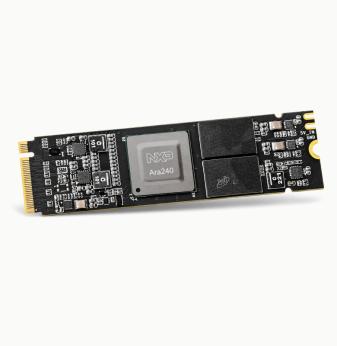
– SoCs with dedicated NPUs for neural inference acceleration (e.g., NXP i.MX, Qualcomm SA, or NVIDIA Jetson).
– FPGAs for parallel signal processing and AI pre-filtering.
– MCUs for deterministic control with integrated DSP blocks.
– ASICs for optimized, safety-certified AI computation.
These platforms provide the foundation for low-latency decision-making that meets the reliability standards of industries like automotive (ISO 26262), aerospace (DO-178C), and industrial automation (IEC 61508).
Software Architecture: Real-Time AI Pipelines
A mission-critical AI system isn’t just about hardware speed — it’s about synchronized intelligence.
The software stack must handle sensor input, inference, and actuation with minimal jitter. Typical architecture includes:
- Data acquisition layer: captures raw signals from multiple sensors (LIDAR, IMU, camera, temperature, etc.).
- Preprocessing layer: filters and normalizes data to reduce noise.
- Inference engine: executes an AI model optimized for low latency (quantized or pruned neural network).
- Decision logic: evaluates inference output and triggers control signals.
- Feedback loop: monitors the effect of the action and updates parameters.
To achieve real-time performance, these layers operate under deterministic scheduling, often managed by RTOS kernels such as QNX, FreeRTOS, or Zephyr.
Real-Time OS and Determinism
Latency isn’t just about speed — it’s about predictability.
A system that responds fast but inconsistently can still fail in critical scenarios.
That’s where real-time operating systems (RTOS) come in.
RTOS ensures that AI inference and control tasks always meet timing constraints. Combined with priority scheduling and hardware interrupts, it guarantees that safety-critical processes never miss their execution window.
For example, in an automotive ECU, driver monitoring may run at a lower priority than brake actuation — but both must execute deterministically.
This combination of embedded AI and RTOS defines the core of trustworthy autonomy.
Mission-Critical Applications Across Industries
- Automotive and Transportation
Edge AI enables instant hazard detection, adaptive cruise control, and predictive maintenance.
When cloud connectivity drops, the system still drives safely — because decisions are local. - Industrial Automation
In robotics and manufacturing, embedded AI monitors torque, vibration, and vision inputs, predicting equipment failure before it occurs.
Milliseconds saved translate directly into uptime and operator safety. - Energy and Power Systems
AI-based control loops regulate voltage, temperature, and phase in real time.
A smart inverter or converter can stabilize microgrid operations during fluctuating load conditions. - Aerospace and Drones
Flight controllers process vision and inertial data on FPGAs or SoCs, maintaining balance and navigation without ground communication.
Edge AI ensures that autonomous flight remains stable even with signal loss. - Healthcare and Medical Devices
Portable diagnostics use local AI inference to detect anomalies instantly, reducing dependency on hospital networks.
Across these sectors, the unifying goal is autonomy without compromise.
Safety and Reliability: Designing for the Worst Case
Mission-critical systems must not only perform under ideal conditions — they must survive failures.
Designers implement safety mechanisms such as:
– Redundant AI pipelines on independent cores.
– Watchdog timers to reset hung processes.
– Fallback logic based on deterministic rules if AI inference fails.
– Secure boot and firmware verification to prevent tampering.
Every algorithm must be explainable and testable, especially under functional safety certification frameworks.
In automotive and industrial contexts, explainability isn’t a buzzword — it’s a compliance requirement.
Balancing Accuracy and Determinism
The most accurate model isn’t always the best one for the edge.
In mission-critical environments, determinism beats complexity.
A smaller, well-trained CNN or decision tree can outperform a giant transformer if it delivers consistent response times.
Optimization techniques include:
– Model quantization to 8-bit or lower.
– Layer fusion to reduce processing steps.
– Fixed-point arithmetic for deterministic behavior.
– Offline calibration to simplify runtime operations.
The goal isn’t maximum intelligence — it’s reliable intelligence.
This becomes especially important when embedded AI is connected to physical actuation. In a drone, mobile robot, or robotic arm, the AI layer does not only classify a scene — it changes what the control system does next. That makes motion-loop determinism in physical AI systems a safety-critical architecture question: inference latency, RTOS scheduling, memory contention, and thermal behavior must be evaluated together with the control loop, not treated as separate optimization tasks.
The Role of FPGA and ASIC Acceleration
When timing constraints are extreme, general-purpose CPUs can’t keep up.
FPGAs and ASICs step in as hardware accelerators for neural inference and signal processing.
They allow parallel execution of multiple AI kernels, processing visual, auditory, or environmental data streams simultaneously.
For example:
– In broadcasting or robotics, FPGA-based AI can analyze multiple camera feeds in parallel.
– In automotive radar systems, it processes waveforms with microsecond precision.
By combining AI logic with deterministic digital design, these chips form the backbone of real-time embedded intelligence.
Edge AI and Cybersecurity
Mission-critical systems are valuable targets.
If compromised, they can cause not just data loss, but physical harm.
Cyber-resilient edge AI includes:
– Hardware root of trust to authenticate firmware and AI models.
– Secure enclaves for key storage and cryptographic operations.
– Runtime anomaly detection that flags unusual inference patterns.
– OTA security for controlled model and firmware updates.
Security isn’t an add-on — it’s designed in from the first schematic.
Human-in-the-Loop vs Full Autonomy
While AI at the edge enables full automation, many industries still rely on human oversight.
In manufacturing or transportation, operators supervise multiple AI-driven systems.
Edge intelligence doesn’t replace them — it enhances decision quality by filtering noise and presenting only actionable data.
The ideal balance is shared autonomy, where humans and machines collaborate seamlessly.
Testing and Validation: Proving Real-Time Reliability
To deploy embedded AI in mission-critical domains, verification is everything.
Testing involves:
– Hardware-in-the-loop (HIL) simulation for real-world timing behavior.
– Stress testing under variable load and temperature.
– Fault injection to simulate sensor failures or corrupted data.
– Lifecycle monitoring to assess long-term drift or degradation.
Validation must confirm that AI decisions remain stable, explainable, and consistent — regardless of external conditions.
The Future: Adaptive, Self-Healing Edge Intelligence
Next-generation mission-critical AI systems will evolve beyond static algorithms.
They will self-calibrate, detect model drift, and recover autonomously from faults.
Advances in federated learning will allow distributed devices — such as vehicles, turbines, or satellites — to share experience without exposing raw data.
Meanwhile, AI-optimized chips will integrate safety controllers, enabling self-healing embedded systems that maintain function under attack or degradation.
In essence, intelligence at the edge will no longer just act fast — it will act wisely.
Why It Matters
Mission-critical AI is where engineering precision meets human trust.
A few milliseconds can decide whether a robot stops in time, a drone lands safely, or a car avoids a collision.
By embedding intelligence directly at the edge, engineers make these decisions faster, safer, and more predictable.
This is the evolution from automated control to autonomous reliability — where systems not only respond but anticipate.
AI Overview
Key Applications: automotive ECUs, drones, industrial robotics, energy converters, aerospace systems, and medical devices.
Benefits: ultra-low latency, autonomy, resilience, and operational safety under real-world constraints.
Challenges: explainability, certification, hardware optimization, and secure OTA model management.
Outlook: real-time edge AI is becoming the foundation of mission-critical autonomy — merging safety, speed, and intelligence into one embedded framework.
Related Terms: RTOS, hardware root of trust, deterministic AI, FPGA acceleration, federated learning, safety-critical inference.
Our Case Studies