


Video Surveillance + Radar: The Sensor Fusion Architecture for Next-Generation Security

Ivan Kuten
Managing Director & Tech Advisor
at Promwad GmbH
Why Video Is No Longer Enough
From Analog to AI: A Brief History
Video surveillance was first introduced in 1942 as a tool for monitoring ballistic missile launches. Over eight decades, the technology has evolved from analog cameras and VCRs to IP networks and neural networks capable of recognizing faces in a crowd.
A modern IP camera with AI analytics is an impressive tool. It can distinguish people from vehicles, analyze behavior, and track virtual line crossings. But it has a fundamental limitation: it only works with what the image sensor can see.
Three Scenarios Where AI Analytics Fails
| Fog over an industrial yard reduces visibility to just a few meters — making recognition impossible for seconds at a time. |
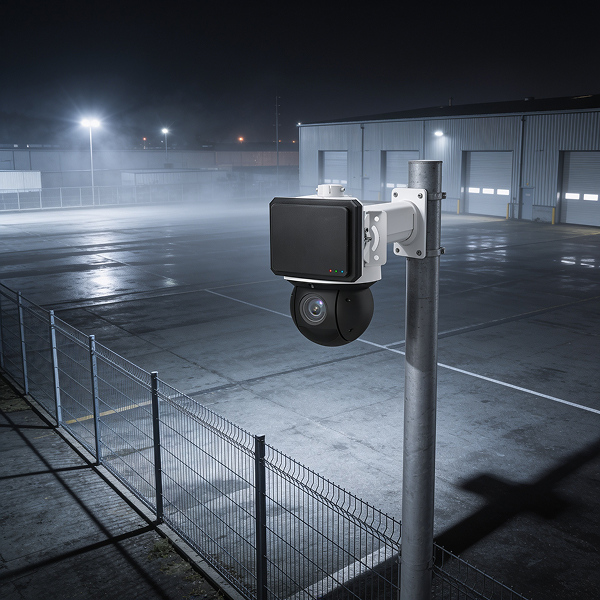
| Camera washout from vehicle headlights in a parking area renders the entire frame useless for the duration of the glare. |
| A drone flying over the perimeter at night is virtually invisible to a lens without the appropriate IR illumination. |
In each of these cases, AI analytics is powerless — not for lack of intelligence, but for lack of input the image sensor can no longer provide.
Another systemic problem is an architectural dead-end with no easy way out. To reduce false alarms purely through software, the camera manufacturer faces a choice: either increase on-device processing — install a more powerful SoC, develop heavier firmware, manage thermal dissipation and field update complexity; or expand the network channel and offload processing to video servers — with corresponding telecom infrastructure costs, dependency on connection quality, and data localization requirements.
Both paths are expensive and scale poorly. Most importantly, neither eliminates the root cause: a video system has no physical measurement of distance or velocity. A tree shadow, grass swaying in the wind, or an insect on the lens look identical to the image sensor as real motion. No amount of computing power can fix this — because the problem is not in the processing, but in the absence of the right measurement.
“The AI in a camera can interpret a scene — but only one it can actually see. Radar gives the system a way to sense space even where the camera is blind.”
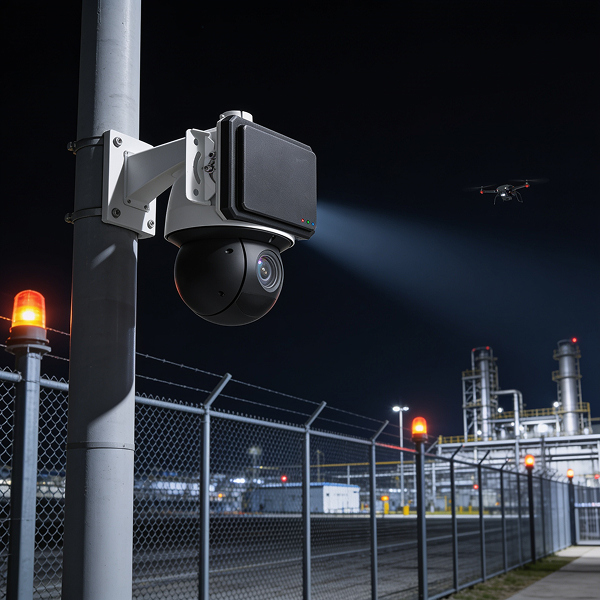
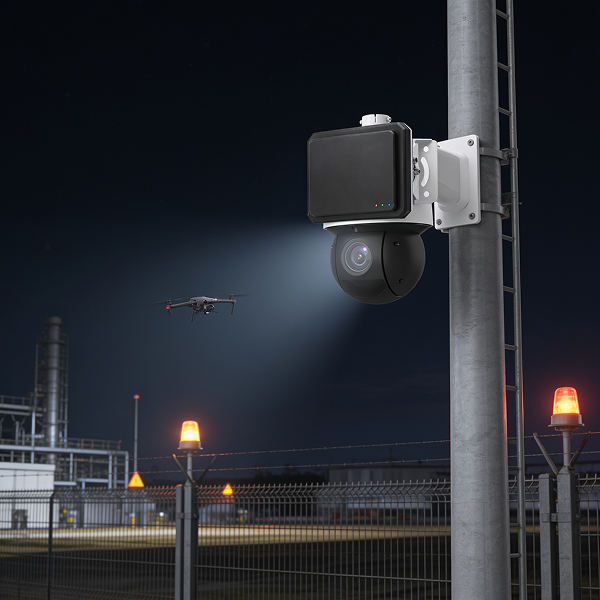
Drone detection for industrial sites with video and radar monitoring
Why Radar Changes the Equation
How It Works TechnicallyAn FMCW radar continuously transmits a frequency-swept signal (a chirp) and analyzes the reflections. The phase difference between the transmitted and reflected signal yields precise range to the target. A MIMO array of multiple transmit and receive antennas adds angular resolution — azimuth, and elevation in some configurations. Doppler analysis extracts radial velocity. Micro-Doppler signatures — subtle modulations in the reflection — enable object classification: a person’s gait, a drone’s spinning rotor, and a bird’s irregular wingbeat each leave a distinct trace, often before the video stream is even queried. Think of it as a second sense: the radar “hears” the space the camera sees. At the algorithm level, the radar’s target coordinates and velocity are projected into the camera’s frame, and a PTZ head locks onto the object exactly where the radar already placed it. |
The millimeter-wave radio band is significantly less sensitive to optical interference compared to conventional cameras. Fog, snow, smoke, and darkness have virtually no effect on the radar channel at the ranges typical for perimeter security systems, while rain attenuation is factored into the link budget at the design stage. In conditions where a camera goes “blind,” the radar continues to reliably detect targets.

Range >100 m
Radar detects movement long before an object approaches the camera or crosses the protected perimeter zone.
All-Weather
Fog, rain, snow, and harsh headlight glare — radar keeps working in conditions where optical systems are already useless.
Speed & Vector
Doppler analysis instantly determines speed and direction of movement, allowing an approaching intruder to be distinguished from a retreating one.
Precise Coordinates
Real-time 3D position data — the foundation for automatically slewing (rotating) a PTZ camera onto the target and plotting objects on a map.
Object Classification
Micro-Doppler signatures enable distinguishing a pedestrian, a vehicle, and a drone before the camera has captured a clear image.
False Alarm Reduction
Two independent channels — radar and video — must agree before an alert fires, so isolated false triggers simply don’t get through.
Special Case: Drone Detection
Tags: Micro-Doppler analysis, Bird vs. drone classification, Auto PTZ slewing, Night detection, Critical infrastructure
Detecting small UAVs is one of the most in-demand tasks at critical infrastructure facilities, airports, and industrial sites. A camera alone cannot handle this: the drone is small, moves quickly, and at night or in glare conditions becomes practically invisible.
An mmWave radar approaches the problem differently: the rotating blades of a drone create a distinctive micro-Doppler signature, fundamentally different from that of a bird or insect. The classification algorithm analyzes the modulation frequency of the reflected signal and identifies the object type with high confidence before the video channel is even activated.
Once detected and classified, the system triggers an automated response: the PTZ camera slews to the detection point, the operator receives visual confirmation, and the system generates an alarm event with coordinates and a timestamp.
Our Case Study: Compact Radar Module for Industrial Perimeter Security
Industrial yard + busy road + frequent fog = unworkable false alarm rate
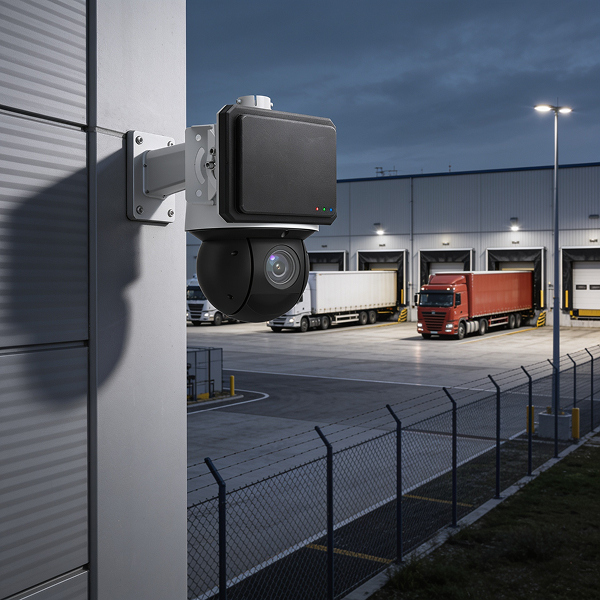
Client brief: We were approached by a developer and supplier of video surveillance systems for small industrial facilities. A typical site in their portfolio is an open industrial yard or company parking lot next to a busy road with heavy traffic. Headlights from passing vehicles washed out the cameras, headlight shadows set off alerts, and animals crossing the yard triggered still more.
Fog was a regular occurrence in the region — on such nights, the false-alert rate spiked. The analytics running on the cameras and the server couldn’t keep up. The client did not want to replace the existing camera fleet or deploy powerful servers — the solution had to be compact, cost-effective, and integrate with existing software.
Development process: We implemented the radar sensor as a standalone compact module that connects to the existing VMS without modifying the cameras. We chose the TI IWR6843 as the foundation: a mature platform with a custom external FR4 antenna array — this allowed us to optimize the beam pattern for the specific site and achieve the required detection range. The rich SDK ecosystem and built-in DSP handle radar data pre-processing directly on the device. The antenna array footprint is comparable to a pencil eraser. Everything fit into a plastic enclosure roughly the size of two matchboxes.
All primary radar data processing runs on-device: motion detection, zone crossing monitoring, and target track generation. The TI IWR6843 built-in DSP computes Cartesian coordinates and radial velocity — delivered to the VMS in display-ready format together with event timestamps for precise correlation with the video stream.
The enclosure required particular attention. The device is intended for year-round outdoor use, so thermal modeling was performed during design — ensuring stable operation in both summer heat and winter frost.
Selecting the radome material and the geometry of the gap between it and the antenna array presented a separate challenge. At millimeter-wave frequencies, even minor deviations in material thickness and dielectric properties cause measurable signal losses. We selected a low-loss dielectric material and calculated the cover thickness based on the wavelength in the material — minimizing reflections and maximizing RF transparency.
Integration with the client’s VMS was implemented via a standard interface — no modifications required on the client’s side.
≈0
100+m
↓70%
0
If you are developing a camera or security system and want to add a radar channel — we are ready to discuss the technical specification.
Read case study: Cutting Video Surveillance False Alarms with Radar →
Three Integration Architectures: Which One to Choose
The way radar and camera are combined determines development cost, time-to-market, and how far the product can ultimately scale. In practice, we work with three approaches; the right choice depends on the client’s requirements.
| Approach 01 External Radar ModuleA standalone sensor installed alongside an existing camera. The radar acts as a smart trigger-detector: it detects motion and transmits an alarm event or target track to the video surveillance system via a standard interface (UART, Ethernet, GPIO). Basic configuration: single antenna, motion detection and range. Extended: MIMO array with azimuth resolution, multi-target tracking, and classification by type (person / vehicle / drone). ✓ Minimal time-to-market When to choose: upgrading existing infrastructure, quick pilot, OEM module for a partner. |
| Approach 02 Unified Platform on NXP i.MX 95The camera, radar module, and NXP i.MX 95 central processor are combined in a single device. The i.MX 95 processes both streams — video and radar — on a single SoC: the built-in NPU (~2 TOPS) is sufficient for real-time inference of lightweight detection and classification models. ✓ Compact form factor ✓ Hardware-level video and radar synchronization ✓ Optimal cost for mid-range products ○ Limited NPU headroom ○ Not suitable for heavy AI workloads with multiple streams
When to choose: IP camera with radar channel, smart doorbell, compact perimeter sensor. |
| Approach 03 NXP i.MX 95 + External NPUThe same i.MX 95 platform enhanced with a powerful external NPU — Kinara Ara-2 (~40 TOPS), Hailo-8 (~26 TOPS), or equivalent. The i.MX 95 handles management, ISP, and radar processing; the neural accelerator handles heavy AI inference: simultaneous multi-stream analysis and complex classification.
✓ Maximum AI performance ✓ NPU scales independently of the SoC ✓ Suited for simultaneous multi-stream analysis ○ Larger form factor and higher cost ○ More complex thermal management
When to choose: complex facilities with dozens of cameras, anti-drone systems, airports, critical infrastructure. |
Chip Selection: Our Perspective
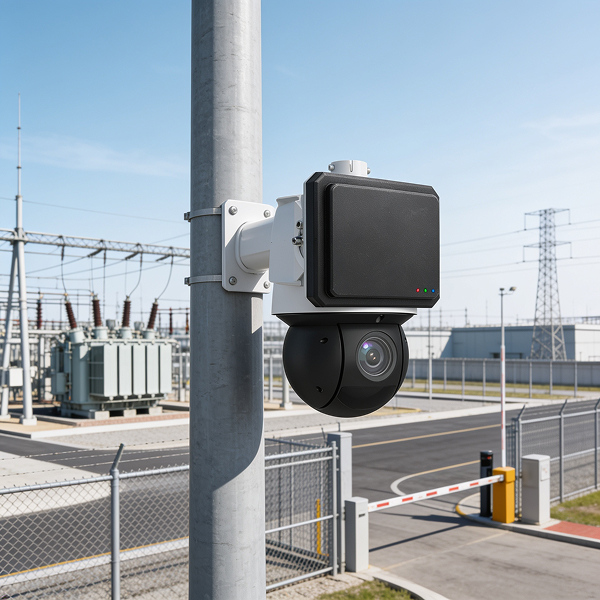
For outdoor perimeter security, the TI IWR6843 is the optimal choice — a balanced combination of range, angular resolution, and ecosystem maturity. For indoor cameras and compact devices such as smart doorbells — the Infineon BGT60TR13C with an on-chip antenna minimizes PCB footprint.
Who Needs This
Radar-plus-video fusion is relevant across several segments — each with different objectives and ways of working together. In every case, we act as an engineering partner: developing the hardware and software to meet the client’s requirements and delivering results ready for mass production or integration.

IP Camera and Video System Manufacturers
You want to add a radar channel to your existing or new product line — but are not ready to maintain an RF engineering team. We will develop the radar module in the required format (standalone sensor, co-located on one board, or integrated inside the camera), including schematics, antenna array, firmware, and manufacturing-ready documentation. Your product gains a competitive differentiator without building radar expertise from scratch.

Security System Integrators and Developers
You design security systems for industrial facilities, logistics centers, or perimeters and need a radar channel developed for a specific task and site. We will develop a hardware solution with the required detection range and coverage, implement data processing algorithms, and ensure the output format integrates with your VMS or server software.

Critical Infrastructure System Developers
Power generation, transportation hubs, ports, water supply facilities — where detection reliability is critical and often regulated. We develop hardware solutions with industrial temperature ratings and outdoor durability, including thermal modeling of the enclosure and component selection to meet the client’s specifications.

Companies Developing Anti-Drone Solutions
You are developing a UAV detection system for airports, critical infrastructure, or industrial sites. An mmWave radar with micro-Doppler analysis is the key sensing component of such a system. We will develop the radar module and UAV classification algorithm to meet your requirements for range, angular resolution, and output data format.
About Promwad
We specialize in full-cycle hardware development: from component selection (chip, antenna array, PCB topology) to firmware, data processing algorithms, and integration with client VMS systems. In radar technologies, our expertise covers mmWave sensor design based on the TI IWR series and Infineon XENSIV, custom FR4 antenna array development for non-standard form factors, and implementation of detection and classification algorithms — from basic motion detection to micro-Doppler analysis.
For tasks requiring high computational performance — cascading multiple radar chips, 4×4 or larger antenna arrays, real-time multi-channel data processing — we apply FPGA-based development. As the number of samples, chirps, and frame rate increases, the radar chip’s built-in DSP can no longer handle the data throughput; FPGA enables scalable MIMO architectures with parallel processing without performance loss.
We work in OEM/ODM and co-development arrangements with video system manufacturers, system integrators, and product developers. We’re always open to a technical conversation.
Already developed — ready to be adapted for your product
Ready to Add a Radar Channel to Your System?
If you are developing a camera, security system, or anti-drone solution and want to add an mmWave radar channel — reach out to us. We will discuss your requirements, propose an architectural approach, and estimate the development scope.