


Broadcast & ProAV Equipment Testing
IP-based broadcast and ProAV devices can fail at scale in real networks. Traffic contention drops frames, PTP drift breaks lip-sync, and multicast routing – these issues are systemic, hard to reproduce, and expensive to fix after deployment.
Promwad engineers validate your product as a complete system — video, audio, network, and control tested together under real load with mixed-vendor systems, multicast delivery, and 24–48h endurance runs — not just lab scenarios.

Our Partners and Companies Employing Promwad Solutions










Why Testing Matters in Broadcast & ProAV
Broadcast and ProAV devices can fail in real IP networks — under real traffic, real synchronization demands, and real load — risking deployments and generating support tickets.
That is why we validate common failure patterns:

That's why we don't run isolated device checks. We validate what actually matters — network behavior under contention, time synchronization and lip-sync accuracy, multicast delivery and discovery, and long-run stability over 24–48 hours or more.
Do you want to ensure predictable behavior in real IP networks: interoperability, timing, and stress scenarios?

Vadim Shilov, Head of Broadcasting & Telecom at Promwad
Business Impact
Where we plug in
We engage at every stage of the product lifecycle: design validation and test strategy setup, pre-production validation, certification and customer acceptance support, field issue reproduction, and scaling when you add more endpoints or move to a new topology.
What this means for your business
Testing at the system level — before your customers do
✓ Reduced support costs and customer-facing risks
✓ Accelerated time-to-market for new features and firmware releases
✓ Prevented failures in live production and fewer escalation tickets
✓ Independent validation and test reports for Tier-1 broadcasters
Who This Testing Is For
This service is built for teams that design, build, and integrate IP-based AV products — and need those products to behave predictably in customer networks:
ProAV product manufacturers, broadcast equipment vendors, and system integrators — particularly CTOs and R&D leaders who need to boost performance, migrate from SDI to IP without breaking schedules, and verify modern standards across mixed-vendor ecosystems.
When it's needed:
Need to launch ST 2110, NMOS, or NDI support but lack the internal test infrastructure?
We close that gap — so you can ship on schedule and show stable demos at NAB or IBC.
What Exactly We Validate
We organize testing around customer-facing capabilities — not raw protocol lists. Six areas cover the full behavior of an IP AV product.
Interoperability
Behavior across different source types, decoders/endpoints, and the full protocol stack — plus switching behavior. We reproduce the integration-killers: EDID mismatches that leave a screen black, color-space incompatibilities (YCbCr vs. RGB), and latency differences between devices.
Result: Confirmed compatibility across mixed-vendor ecosystems with evidence of how your device negotiates and switches in a real pipeline.
Media behavior
Video checked for jitter, packet loss, freeze frames, macroblocking, resync delay, adaptive-bitrate transitions, and resolution/frame-rate changes. Audio checked for dropouts, correct resampling (48 kHz vs. 44.1 kHz), and A/V drift, including lip-sync across synchronized, multi-device environments.
Result: Video and audio quality verified under real conditions, so degradation is caught before it reaches a live channel.
USB, KVM & peripheral interactions
USB validated for HID devices, redirection latency, and isochronous devices (webcams, audio interfaces). KVM validated for switching speed, USB state preservation, and hot-plug behavior. We target the field classics: keyboard lag after a switch, USB reconnect delays, and lost HID state.
Result: Peripheral and KVM paths validated the way operators actually use them, so integrators don't inherit the "keyboard died after I switched users" ticket.
Network readiness
Stream stability in real switching environments with actual traffic. Multicast behavior and predictable delivery under load. Segmentation and prioritization patterns used in production AV networks.
Result: Verified compatibility across mixed-vendor ecosystems — with evidence of how your device behaves in a real pipeline, not just in isolation. Multicast delivery and discovery confirmed under load, so integration issues surface in our lab, not at the customer site.
Performance & stability
Latency and stability under sustained load. Endurance runs of 24–48 hours or longer where required. Power behavior for PoE-powered deployments — including edge cases around power cycling and recovery.
Result: Traffic contention scenarios tested and documented. Line-rate performance validated. Bottlenecks identified under realistic network conditions — before they become field escalations.
Control & UX
Web UI, API, and CLI reliability — the paths integrators depend on daily. Companion apps and control workflows. Control-path stability during extended operation, because a UI that locks up after 12 hours is a deployment risk.
Result: Validated control paths across all interfaces — Web, API, CLI, and companion apps — under real session lengths. Your integrators get a product that stays responsive, not one that needs a workaround after overnight operation.
Device Types & Tools
What we test
- AV-over-IP transmitters, receivers, and video wall endpoints.
- KVM-over-IP extenders.
- Encoders, decoders, and HDMI/SDI gateways.
- PTZ and IP broadcast cameras.
- Managed AV and PoE switches and AV network infrastructure.
- Streaming and recording endpoints.
Deployment scenarios we cover:
- multi-endpoint AV-over-IP distribution
- mixed device ecosystems with different sources, sinks, and endpoints
- control-driven operation through UIs, APIs, and apps in live environments
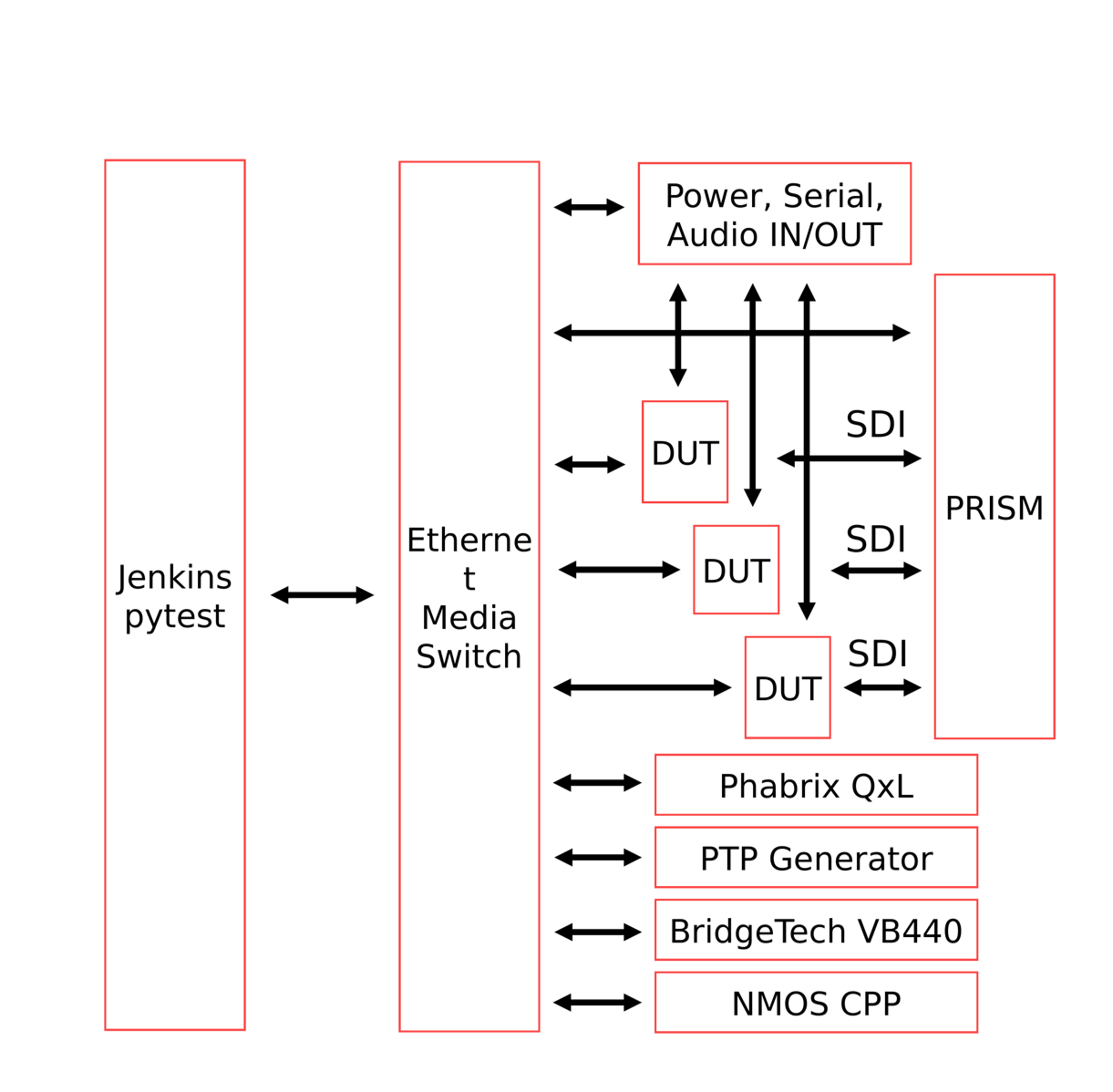
Test Bench Overview
How we test
FFmpeg, nmos-cpp, Wireshark, pytest, Docker, TRex
SDI, power, GPIO, serial, and audio I/O
ST 2110, PTP timing, redundancy, NMOS, IPMX, Dante
- Cameras, encoders, decoders, and endpoints for realistic multi-device setups- AV-grade PoE network switches- Video I/O analysis and capture tooling: PRISM, Phabrix QxL, PTP Generator, BridgeTech VB440, and NMOS CPP- USB emulators for control and peripheral simulation- Thermal monitoring and environmental chambers as needed
test execution orchestrated with Jenkins and pytest — for repeatable, scalable test runs across large device matrices
Case Studies
Long-Run Stress Tests for a Broadcast Video Pipeline
Unattended long runs on top of the existing test suite, aimed at bugs that only surface over time.
Challenge: a broadcast and ProAV equipment vendor had short functional tests for its video pipeline. They caught the obvious bugs, but a five-minute test won't catch a memory leak, or audio slowly drifting out of sync with video, or a glitch that needs dozens of format switches to trigger.
Solution: Promwad added a long-run stress layer on top of the existing test set (Prism, Smart Tag, Multiview 4, keying tests). It runs unattended, cycling format switches, stream reconnects and sustained load through the pipeline. Each run ends with a check that video is still flowing, audio is still in sync, and nothing has quietly leaked.
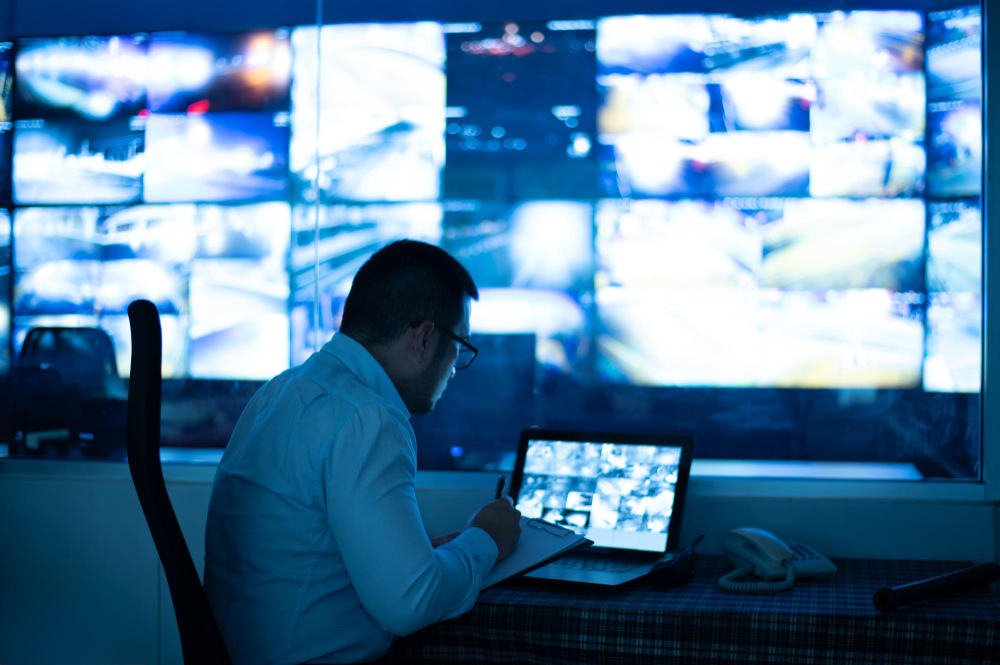
Results: releases can now be qualified against 24/7 stability, not just against a short functional pass. Time-dependent bugs come out in testing instead of in the field.
Reception Testing for an IPTV Platform
Automated playback checks on smart TVs and STBs, with an external camera as ground truth.
Challenge: an IPTV platform vendor had good coverage for playlists and data distribution, but what actually reached the viewer was another matter. Checking audio presence, lip-sync, subtitles and latency meant someone sitting in front of a screen.
Solution: Promwad built a reception rig that plays streams on real target devices — a few smart-TV apps and a handful of STBs — while an external camera watches the screen. The stream carries a known test signal, so audio presence, lip-sync, subtitles and end-to-end latency all get validated against what the platform actually sent. Signal matching is the default check, with an AI-based comparison available when the client wants it. A separate analysis host returns pass or fail per run.
Results: the client can now regression-test reception across the full device matrix, catching the sync, subtitle and latency issues that protocol-level tests don't see.
Functional Test Coverage for an IP Camera Line
Coverage that reaches past the API to what the camera actually captures and streams out.
Challenge: An IP camera manufacturer's tests were built around the API. Press a button, confirm the API responded. That worked for the control plane, but the picture the camera was producing sat outside the test scope. Was the video clean? Was audio in sync? Did Dante still work after parameters changed on the fly? None of that was in the suite.
Solution: Promwad extended the scope across the whole product: deployment, interfaces, modules, firmware updates and stress runs.
The rig records what the camera puts out, downloads the file on its own, and checks it for duration and for real video and audio rather than noise. Several devices attach in parallel to load every output at once, and a second camera outside the rig confirms that a real picture comes through after each switch. Streams also go to a capture server over RTMP and other protocols, which verifies audio and video are present at the network side.
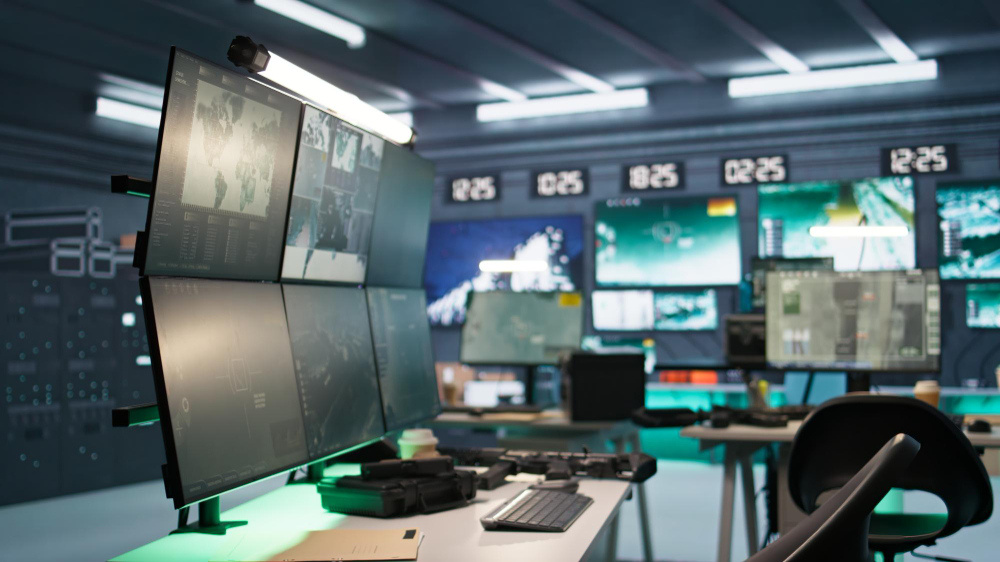
Results:the client's tests used to end at the API layer. Now they cover what actually comes out of each output, so regressions in A/V sync, in integrations like Dante, and in per-output behavior show up in the suite.
Why Promwad
We validate broadcast equipment as systems — video, audio, network, and control — all four layers tested together, under realistic conditions, on real infrastructure.
Why companies choose our engineering & QA team:

Let's Plan Your Testing Project
Whether you're preparing a product launch, reproducing a field issue, or scaling to a new topology — we'll help you validate system behavior before your customers do.
FAQ
What types of broadcast and ProAV devices do you test?
What standards and protocols does your testing cover?
How is system-level testing different from standard QA?
How long does a typical testing engagement take?
At what stage should we engage Promwad for testing?