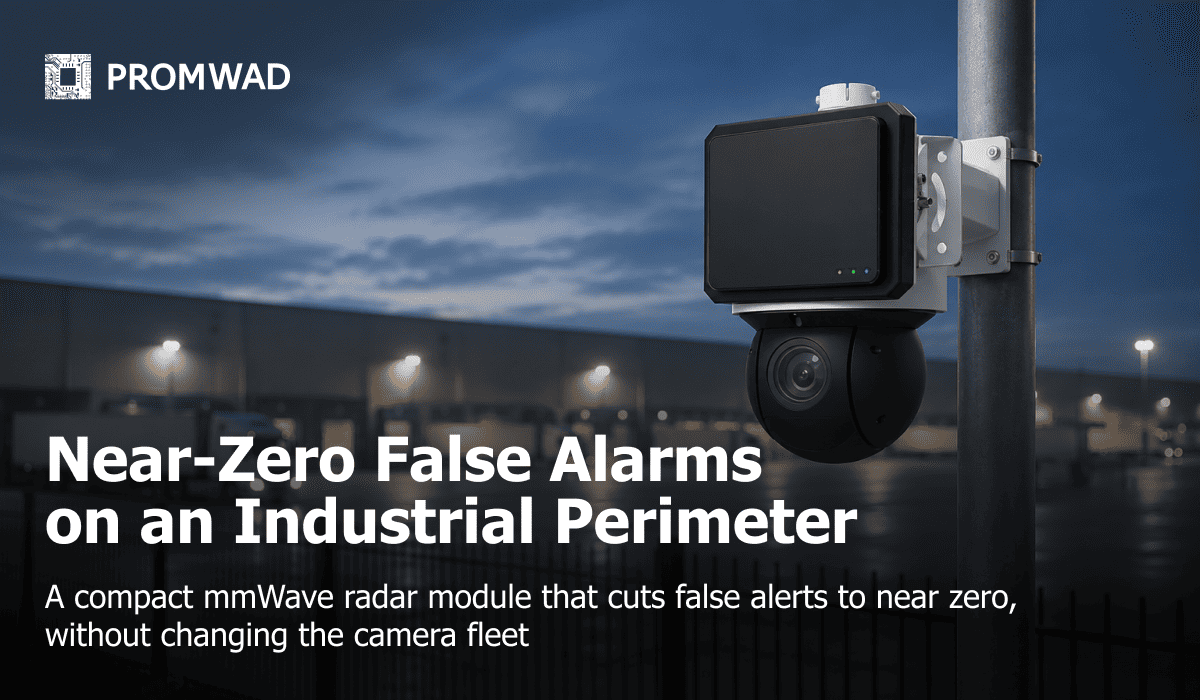

Cutting Video Surveillance False Alarms to Near Zero With an mmWave Radar Module
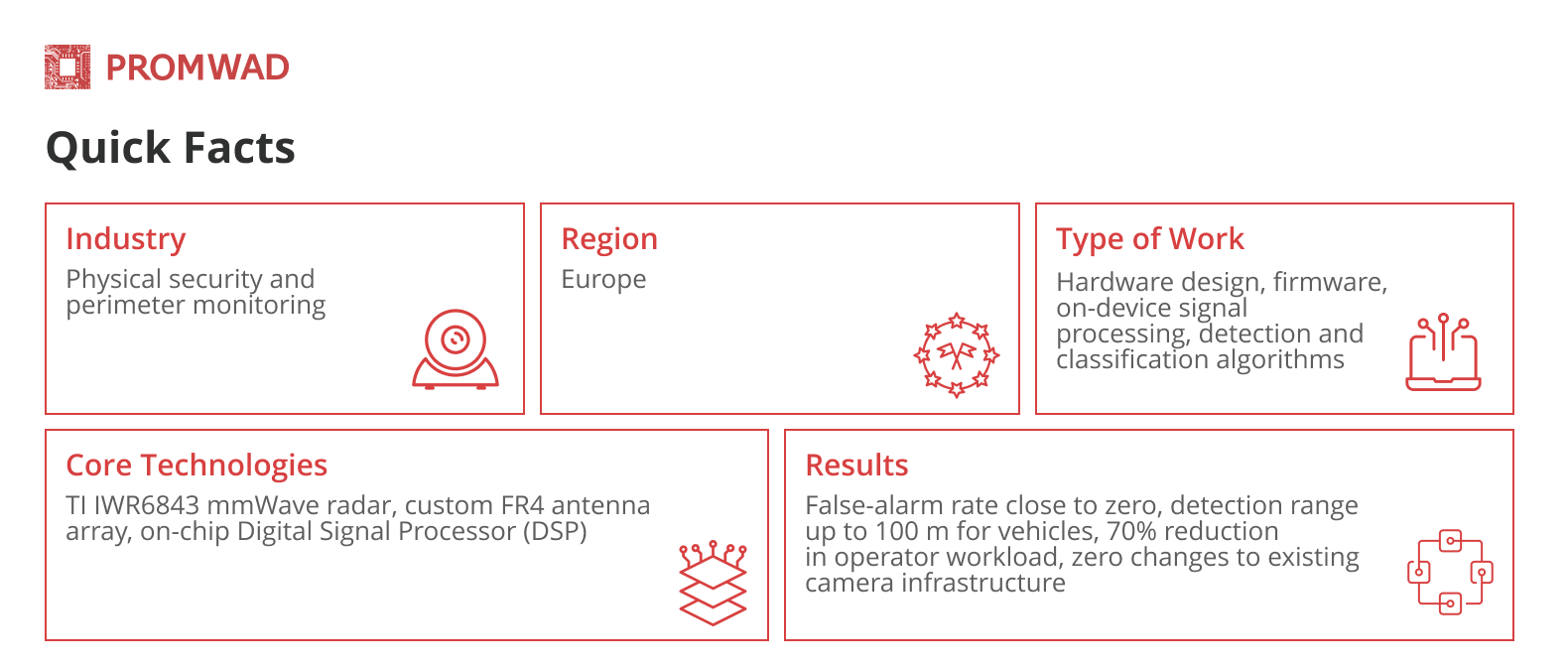
Project in a Nutshell: We developed a compact millimetre-wave radar module for a European supplier of video surveillance systems serving small industrial sites. The device runs on the TI IWR6843 with a custom FR4 antenna array, processes radar data on-board, and plugs into the client's existing Video Management System (VMS) through a standard interface, with no changes to the camera fleet.
In fusion with the cameras, the module resolves the class of false alerts that fog, headlight glare, and animal movement had made unmanageable.
Client & Challenge
Our client is a European supplier of video surveillance systems for small industrial sites. A typical installation in their portfolio is an open industrial yard or company parking lot adjacent to a busy road with constant traffic.
On these sites, the optical channel runs into its physical limits. Vehicle headlights wash out the cameras and their shadows on the asphalt set off motion alerts. Animals crossing the yard generate still more. In fog, the false-alarm rate spikes further. Operators reviewed alert after alert, the bulk of them false, and real events risked being missed in the noise.
The client did not want to replace the camera fleet, push more compute into the cameras, or add back-end servers. Any solution had to plug into the existing VMS. Building the radar channel in-house would have meant hiring a dedicated RF team for what is, in their product roadmap, a single feature, so the client looked for an engineering partner who could cover mmWave design, on-device processing, outdoor enclosure, and software integration as one delivery.
Solution
We added a sensing channel independent of optical conditions, packaged as a compact standalone module that integrates with the existing VMS through a standard interface.
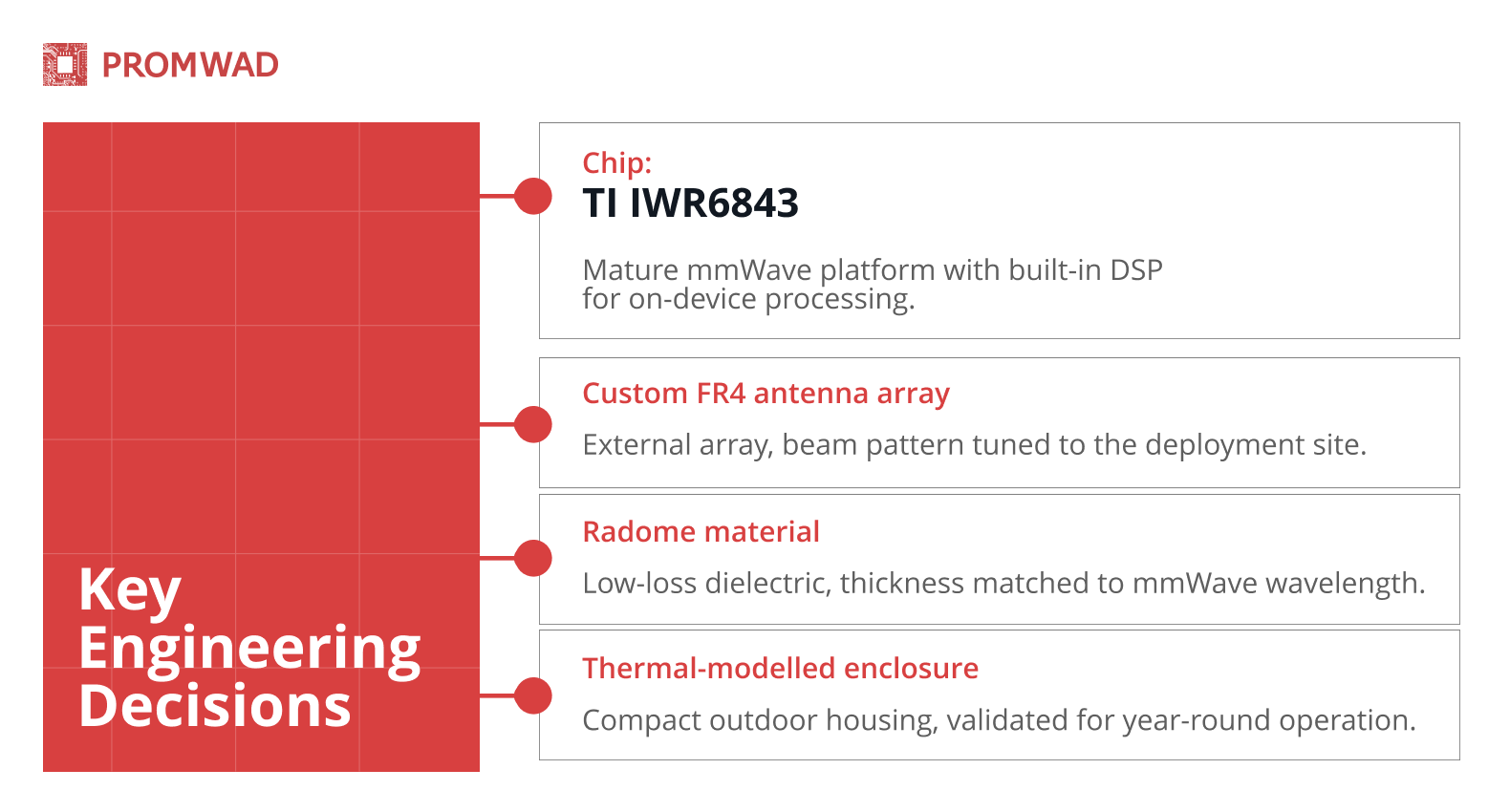
The radar is built around the TI IWR6843 with a custom external FR4 antenna array. The external array let us shape the beam pattern to match the geometry of a typical industrial yard and reach the detection range the client needed. The full assembly fits into a plastic enclosure roughly the size of two matchboxes, and the antenna array footprint is comparable to a pencil eraser.
On-device processing is split between two processors on the module. Primary radar signal processing (motion detection, zone-crossing logic, target track generation) executes on the IWR6843 built-in DSP. Additional post-processing and communication with the external server run on a companion general-purpose processor from an off-the-shelf module. The output reaches the VMS in a form the operator console can render directly: Cartesian coordinates, radial velocity (how fast the object is moving toward or away from the radar), and an event timestamp aligned with the video stream for clean correlation between channels.
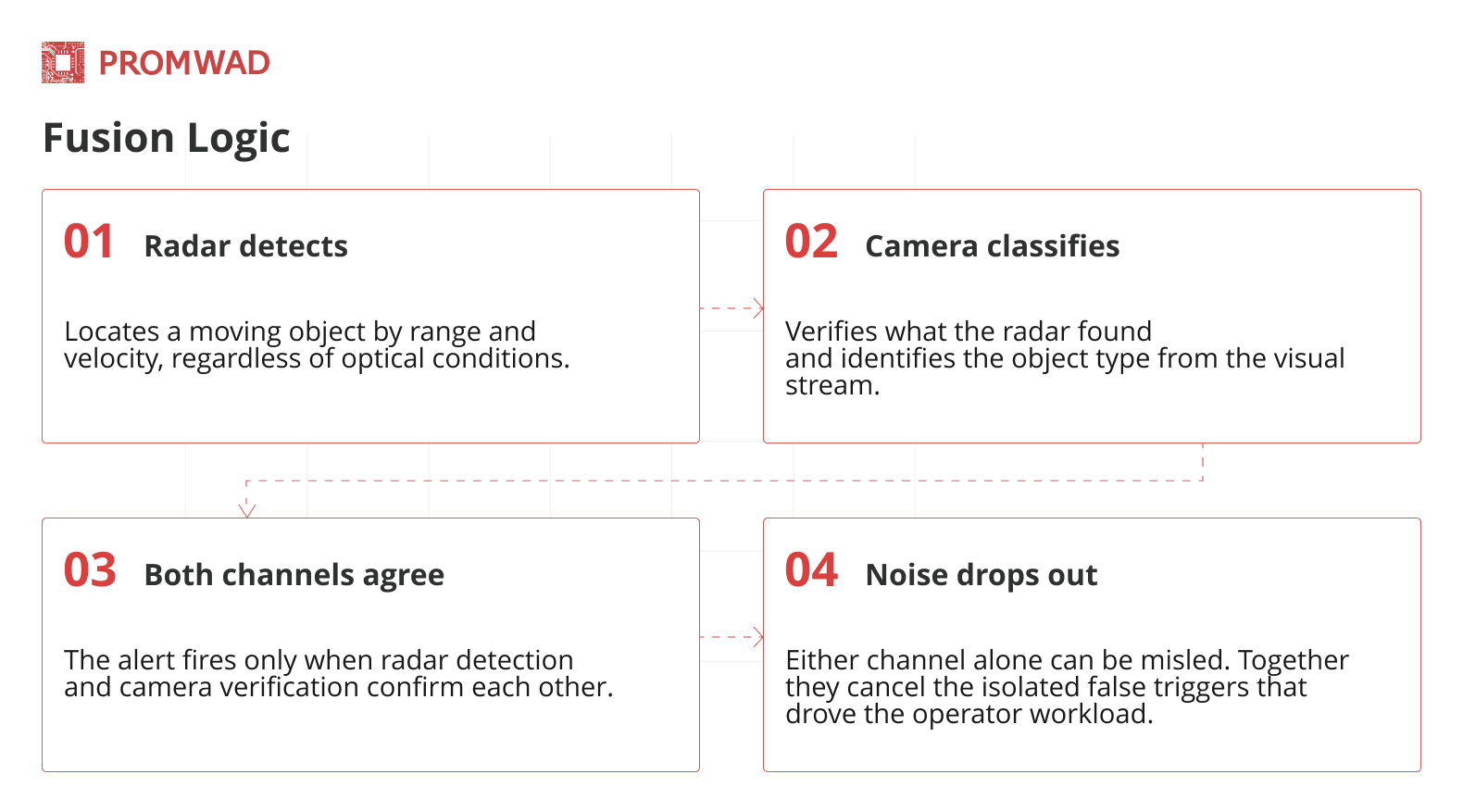
The fusion logic itself is simple by design: each channel does what it does best, and an alert fires only when both agree.
Architecture and Key Decisions
The compact form factor and the unforgiving physics of millimeter-wave radar shaped every important decision on this project. Four of them defined the result.
Results
The solution brings the false-alarm rate close to zero on sites that had previously been unusable for the client's analytics. Detection range reaches up to 100 metres for vehicles, which gives the security team time to react before an object reaches the camera or crosses the protected zone Operator workload drops by 70%, because the radar and the camera must agree before an alert fires, and isolated optical noise stops generating events. Deployment requires no changes to the existing camera infrastructure: the module connects to the VMS through a standard interface, with no software modifications needed on the client's side.
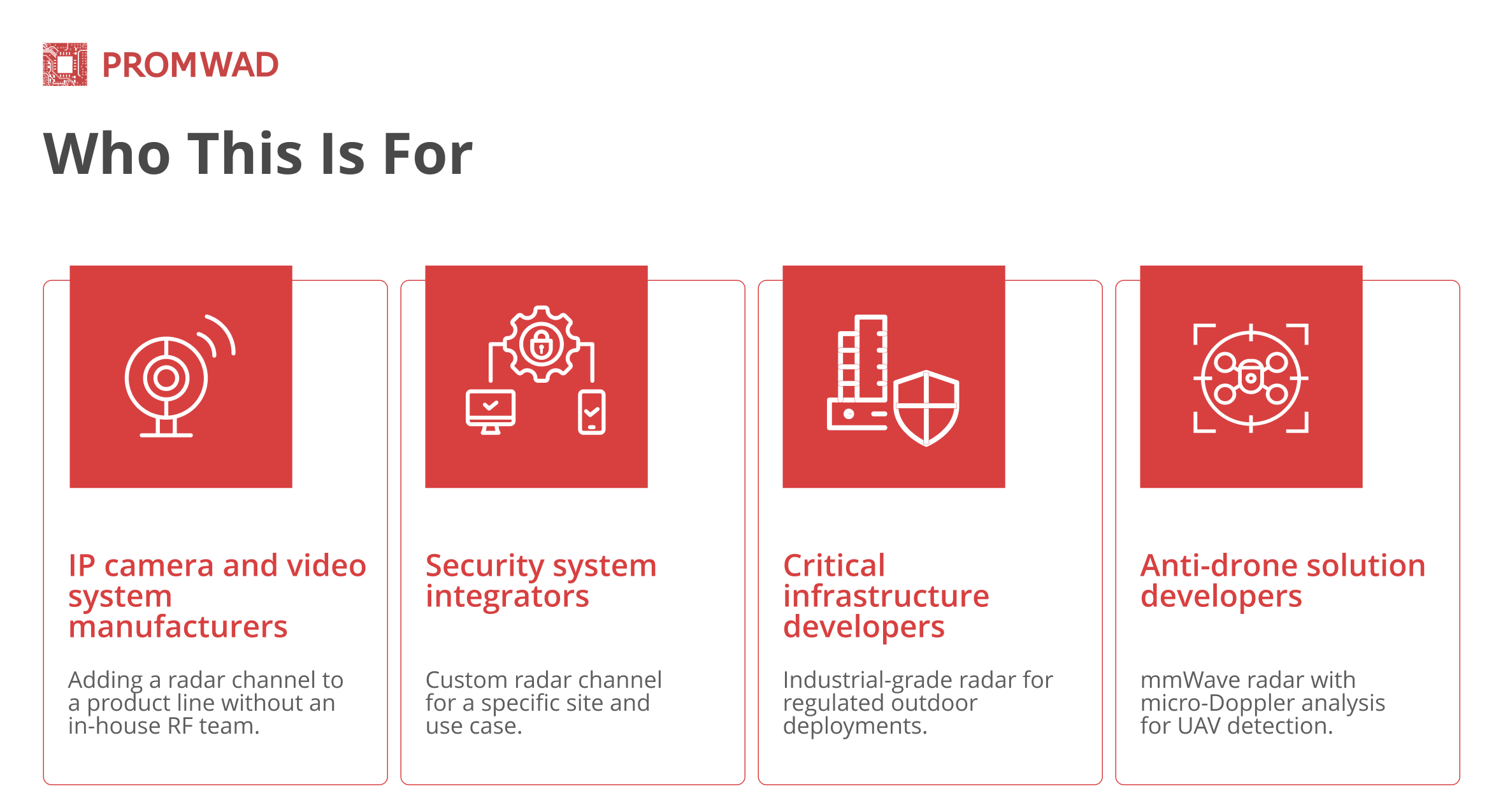
For the client, the business outcome is a new addition to the product portfolio that addresses a specific class of sites competitors cannot serve well: open industrial yards, parking lots, and small perimeters adjacent to busy roads. The radar channel becomes a feature their sales team can sell on top of the existing camera platform, with no team rebuild required and no need to grow an in-house RF engineering capability.
Where This Fits in the Bigger Picture
The compact external module described here is one of three architectures we work with for radar-plus-video fusion. The other two suit different product profiles and AI workload budgets.
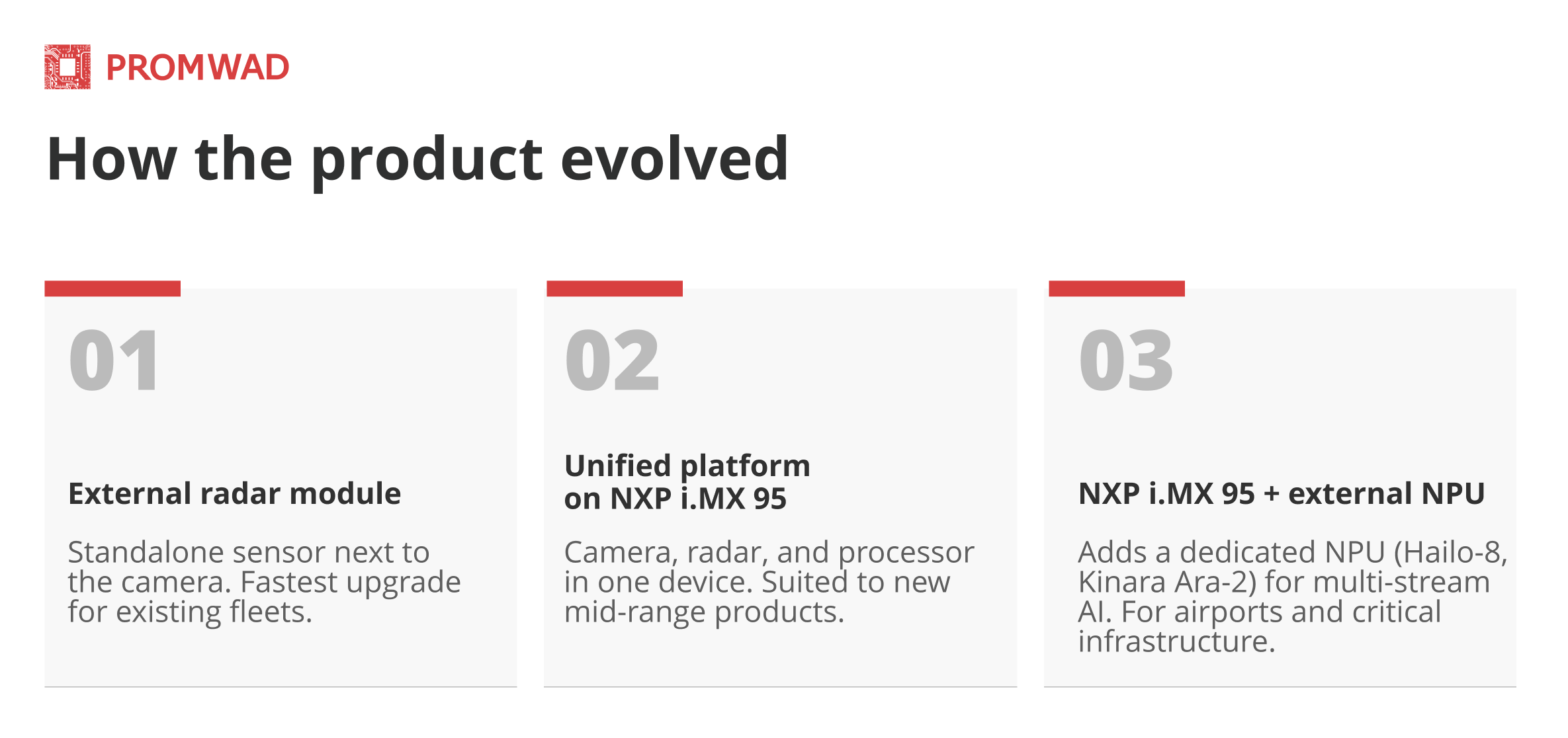
For the full comparison and selection criteria, see our article on sensor fusion for next-generation perimeter security.
More of What We Do for Sensor Development & Edge AI
- Custom Industrial Sensor Development: our full-cycle approach to designincustom sensors, from hardware and firmware to enclosure and certification.
- Adapter Board Development for Automotive Radar: a related radar project where we built an FPGA-based adapter board to transfer high-speed sensor data for an AI and automotive perception company.
- Edge AI Video Analytics on the SCAiLX Platform: how we developed a neural model for real-time on-device object detection on a US partner's compact edge AI platform.
FAQ
Can the detection range be adjusted for our site geometry?
Yes. The antenna array and its geometry are designed per project based on the required field of view and angular resolution, and the detection range and sensitivity are tuned to the deployment conditions. The up-to-100-metre figure in this case reflects the site profile for vehicle-sized targets. Other configurations cover shorter, denser areas or longer linear perimeters.
How do you work with a client who does not have an in-house RF team?
We provide the full engineering stack for a project like this as a single contractor: chip and antenna selection, PCB and firmware development, enclosure with thermal modelling, and integration with the client's software. Cooperation is set up as a dedicated engineering team with a tech lead and project management, working alongside the client's product team. The client does not need to hire RF specialists or coordinate several external suppliers for one product line.
Does the module work with any video management system?
The integration uses a standard interface (UART, Ethernet, USB, or Wi-Fi, depending on the deployment) and a documented output format. No modifications to the VMS are required on the client's side. We cover the full development chain — from chip selection and PCB to firmware, enclosure, and integration — as a single contractor.
Can the module classify objects, for example distinguish a person from a drone?
Yes, with the appropriate algorithm layer. The IWR6843 captures the micro-Doppler signature needed for classification (subtle modulations in the reflected signal that differ between a walking person, a spinning rotor, and a bird's wingbeat). We develop the classification logic per use case: select the model, train it on the target dataset, port it to the runtime, and post-process the inference results. Drone-versus-bird and pedestrian-versus-vehicle are the two scenarios most often requested.
Can the detection and classification logic be updated after deployment?
Yes. Detection thresholds, zone-crossing rules, and classification models are updated on the module through a controlled firmware release. New object classes can be added by extending the training dataset and re-training the model, then porting the updated model back to the runtime on the device. This is part of the ongoing technical support we provide after the product goes into the field.