


Why Functional QA Passes While the Device Is Already Exploitable
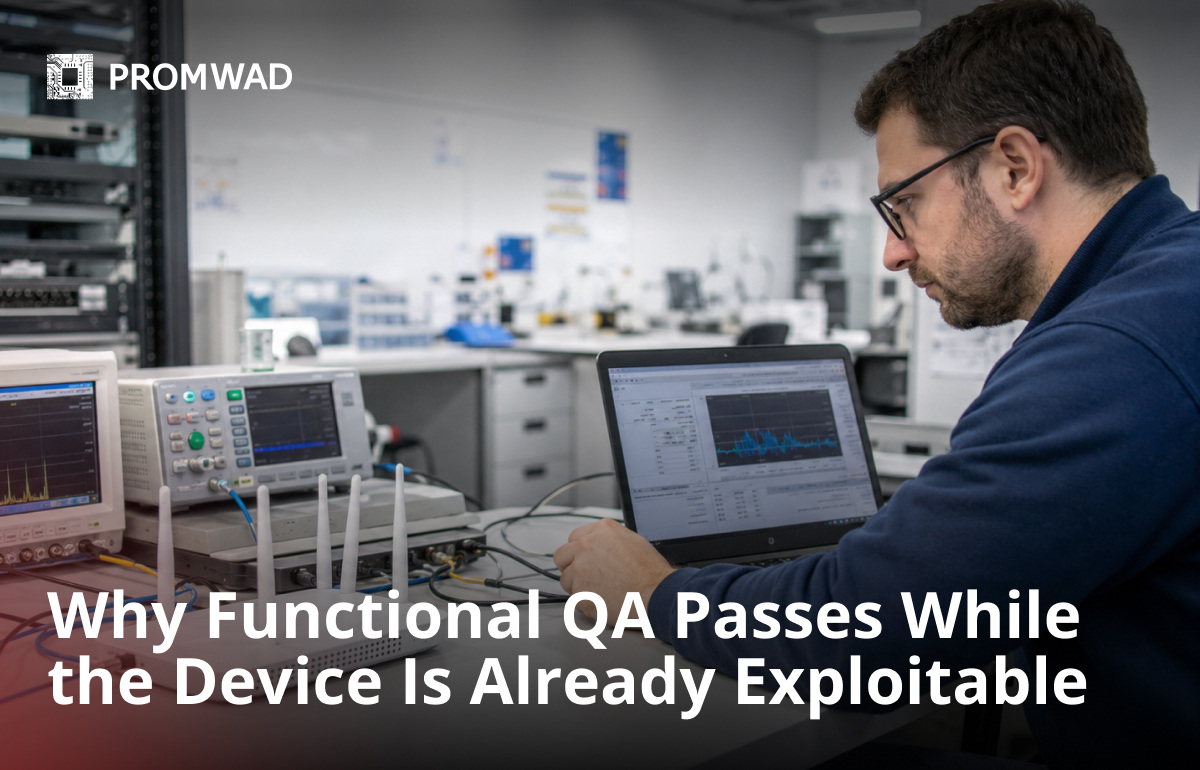
The access point passed internal QA. Provisioning worked, wireless throughput matched the specification, roaming held stable under load, and the management interface responded correctly across all supported browsers.
Then the customer's security team ran a standard wireless audit.
Less than ten minutes later, the WPA2 password was recovered from a captured handshake using a low-power laptop CPU. The device kept functioning normally throughout. Nothing in QA had failed. Every test the release process was designed to run, it ran correctly.
The gap was in what the release process was never designed to check.
Teams typically assume: if a wireless product passes functional QA, interoperability testing, and WPA2 authentication checks, the security posture is acceptable for shipment.
In reality: functional QA validates whether the system works under expected conditions. Attackers test how it behaves under hostile ones. Those are different test domains, and a device can pass one while failing the other in under ten minutes.
Quick Overview
Problem:
Common causes:
Where it appears:
Engineering focus:
Why It Fails
The failure starts at the firmware configuration layer. The device ships with a WPA2-PSK credential that satisfies minimum length requirements but contains low entropy and a repeatable structure. QA confirms authentication succeeds. No one measures how fast that credential falls under offline dictionary attack.
The wireless layer opens the next gap when deauthentication behavior and WPA2 handshake exposure are never validated under attack conditions. Once a deauth frame goes out and a client reconnects, the EAPOL exchange can be captured in seconds.
After capture, the cracking process runs entirely offline. It does not touch the access point, so no alerts fire and no traffic anomalies appear. The device keeps functioning while the attack runs undetected.
The process layer closes the chain. Security validation sits outside the embedded QA release checklist, so functional testing closes, firmware ships, and the credential weakness survives untouched into production.
Where the Exposure Actually Sits
The weakness does not originate at a single layer. It travels across them.
Attack path: firmware credential policy → WPA2 configuration → wireless beacon exposure → EAPOL handshake capture → offline cracking → unauthorized network access → management surface exposure
Teams focus on the WPA2 encryption layer because that is where the visible security mechanism lives. The actual constraint sits earlier, at credential generation. WPA2 protects the transport. What collapses is the pre-shared key — converted into the PMK that offline cracking actually targets — because its entropy was never enforced during provisioning.
On current GPU-based cracking hardware, WPA2 PMK throughput reaches the order of millions of attempts per second. Targeted dictionaries built around observed credential patterns turn into sub-second operations. After handshake capture, the access point cannot rate-limit, detect, or interrupt anything, because the attack runs entirely offline.
This is why hiding the SSID or patching the management interface does not close the actual exposure. The weakness lives at the credential-generation layer inside the firmware provisioning logic.
Security Validation for Embedded Wireless Products
Promwad has been engineering embedded systems since 2004, including OpenWrt and prplOS-based wireless platforms (as a prpl Foundation member). Our team performs wireless security assessment, firmware hardening, OpenWrt and prplOS review, penetration testing, and embedded security validation aligned with the EU Cyber Resilience Act, IEC 62443, and ETSI EN 303 645 frameworks for connected telecom and IoT devices.
How to Approach This
Step 1: Test the assumptions, not the features
Start with the shipping firmware build, not a development image with debug credentials. Capture WPA2 handshakes under realistic deployment conditions and test whether default credentials, provisioning patterns, or reused password structures survive an offline dictionary attack. Measure entropy at build time rather than after the fact.
Step 2: Separate the attack surface into layers
Isolate each layer independently: firmware credential generation, wireless authentication behavior, management interface exposure, provisioning workflow, and firmware hardening policy.
Reproduce the handshake capture under monitoring mode. Run offline cracking with a controlled dictionary and measure time-to-crack rather than a simple pass or fail.
This pattern surfaces consistently in security audits of embedded devices where functional QA and wireless penetration testing run as separate, non-overlapping processes.
Step 3: Validate the fix against the actual attack path
After updating the credential policy, capture a fresh handshake from the new firmware build and rerun the cracking workflow under identical hardware conditions. Confirm the targeted dictionary attack no longer succeeds under the same test conditions and becomes impractical against the corrected credential model.
If your current QA process does not include an active wireless test against the shipping build, that gap is typically where certification findings originate.
An Enterprise Access Point That Passed QA and Fell to Aircrack-ng in Under Nine Minutes
In one of our wireless security engagements, the client was a wireless solutions vendor preparing an OpenWrt-based access point for enterprise deployment.
The device passed every functional check. Provisioning worked. WPA2 authentication held. The management interface behaved correctly.
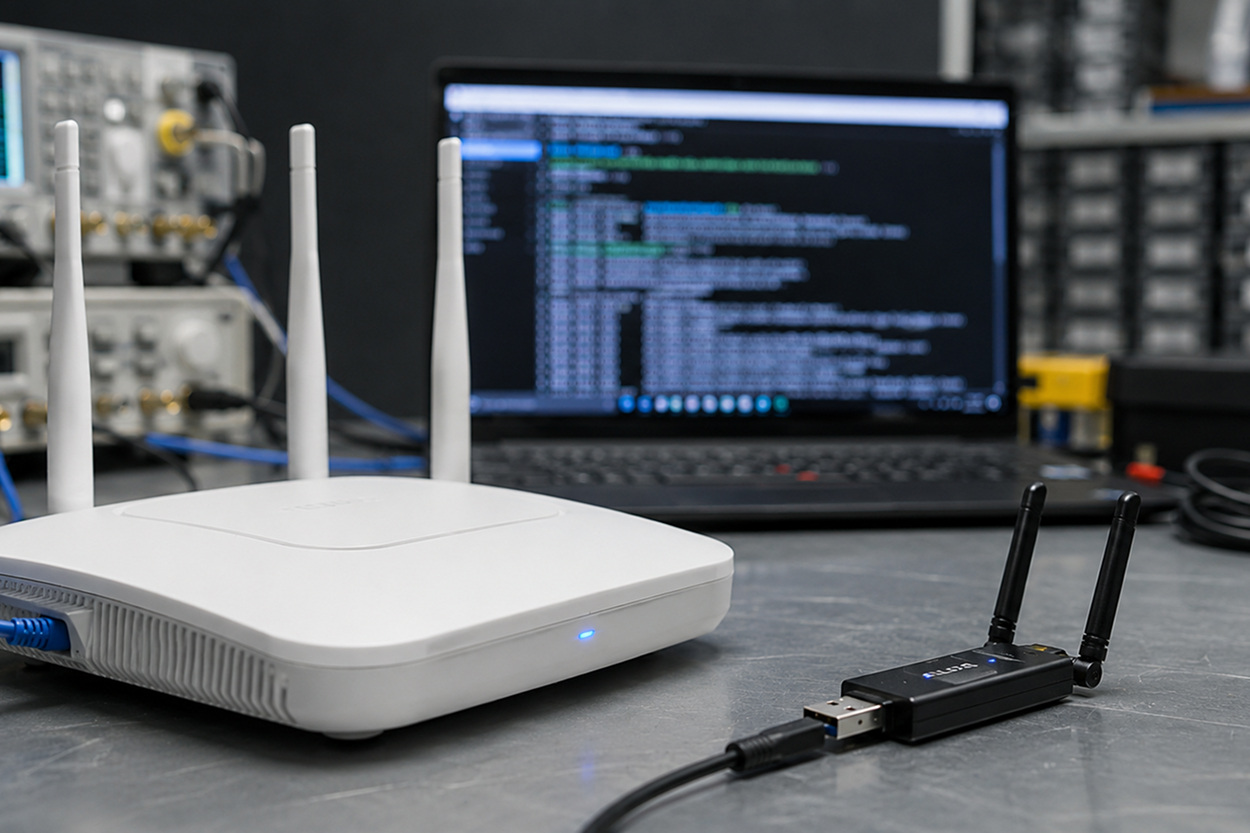
Our wireless audit captured the WPA2 handshake using airodump-ng after a deauthentication frame, then ran Aircrack-ng against a targeted 78,125-entry dictionary built around the observed credential structure.
The password fell at line 59,570 of the wordlist. Time elapsed: 8 minutes 57 seconds on a single-core Celeron-class laptop at 2 GHz. On modern GPU cracking hardware, the same workload completes in fractions of a second.
The fix did not touch the WPA2 implementation. The provisioning process stopped generating predictable credential structures and enforced entropy at build time. Confirmed the targeted dictionary attack no longer succeeded under the same test conditions and became impractical against the corrected credential model.
With the corrected provisioning logic and additional security requirements validated, the client closed an enterprise supply contract that depended on passing the procurement security review.
Full engineering write-up — tools, commands, dump captures, and the exact remediation flow: → Security Scanning with Aircrack-ng
When Functional QA Is Not Enough
Typical Wireless Security Validation Tasks
Credential entropy analysis — Auditing how the firmware generates, stores, and rotates WPA2-PSK credentials across production batches, including entropy enforcement at build time.
Handshake capture testing — Reproducing EAPOL exchange interception under realistic deployment conditions using monitoring-mode adapters and standard wireless toolchains.
Deauthentication simulation — Validating how the device and its clients behave under active deauth conditions, including Protected Management Frames coverage where supported.
Provisioning logic review — Examining factory provisioning workflows, key injection, and default credential policy against the shipping firmware build rather than a development image.
You May Be Facing This If:
- Your access point ships with a management password structure shared across production batches
- Your firmware build does not enforce password entropy requirements during provisioning
- Your QA process validates connectivity and throughput but never attempts handshake capture or offline cracking
- Your production firmware still accepts credentials generated from dictionary-derived naming schemes
- Your wireless validation process excludes monitoring-mode or deauth-based attack simulation
- Your enterprise customer now requires documented evidence of wireless penetration testing before procurement approval
Real Trade-offs
- Enforcing unique high-entropy credentials increases provisioning complexity and manufacturing time, because every unit requires individualized credential generation at build time.
- Removing default credentials entirely creates operational overhead for installers and support teams who depend on predictable access patterns during field deployment.
- Choosing certificate-based authentication (EAP-TLS) over WPA2-PSK removes the PSK-based offline dictionary cracking vector but increases onboarding complexity for enterprise customers without PKI infrastructure.
- Expanding QA coverage to include wireless penetration testing adds validation time and requires monitoring-mode hardware and specialized expertise outside the standard release checklist.
- Stronger password entropy often breaks automated provisioning scripts built around deterministic credential generation. These need redesign, not just parameter updates.
- Enabling and validating Protected Management Frames, where supported, can reduce deauthentication-based capture scenarios, but may create compatibility issues with legacy clients.
Security Validation Becomes Part of the Firmware Process
Catching this category of weakness before shipment requires structured wireless security engineering for embedded products against the shipping firmware build, on top of any compliance checklist.
That process includes WPA2 handshake interception testing, active deauthentication workflows, offline cracking validation under realistic hardware conditions, firmware credential analysis, hardening review, and verification against enterprise procurement requirements.
These findings appear regularly in wireless products that ship with symmetric or predictable credential structures across production units. In embedded networking devices, the gap between functional QA and security QA remains one of the most consistent sources of pre-deployment findings — typically discovered first by an enterprise customer's security team during procurement review, when changing the production firmware has already become expensive.
FAQ
Why can a device pass functional QA but fail a wireless security audit?
Is WPA2 the problem in this case?
Does upgrading to WPA3 fix this?
Why does offline WPA2 cracking bypass device-side protection?
What should be tested before shipment?
Does this matter for enterprise procurement and regulatory compliance?
Related Engineering Cases
- Security Scanning with Aircrack-ng: Wireless penetration testing using Aircrack-ng against shipping access point firmware — full toolchain, dump captures, and remediation flow.
Run Security Validation Before Shipment
If your wireless device has never undergone active handshake interception and offline cracking validation, the production firmware may already be exploitable under standard penetration testing conditions.