Embedded AI Hardware Platforms 2026: Edge SoCs, NPUs, and MCU-Class Accelerators
In 2026, embedded AI hardware is at an inflection point. What began as a handful of experimental platforms a few years ago has grown into a rich ecosystem of silicon designed to deliver real-time intelligence at the edge. In 2025, teams evaluated hardware based on a mix of performance, ecosystem support, and power efficiency, creating a snapshot of the top platforms from high-performance boards to lightweight AI accelerators. In 2026, the conversation has matured. Development teams not only want good AI performance but also predictable power profiles, seamless integration with machine learning workflows, and hardware ecosystems that support ongoing model evolution. Choosing the right platform now means understanding how edge SoCs, dedicated NPUs, and MCU-class accelerators differ and where each excels.
This article surveys the embedded AI hardware landscape as it stands in 2026, explains what real differences matter in practical design work, and provides a structured way to think about platform selection. We synthesize trends in performance, power, deployment scale, and developer experience — all grounded in how actual products are being built today.
Why Embedded AI Hardware Matters in 2026
AI at the edge drives a wide range of products, from industrial inspection cameras and autonomous mobile robots to wearables and sensor networks. By 2026, the number of connected embedded AI endpoints is measured in the tens of billions, and many of them cannot rely on cloud processing because of latency, cost, or connectivity limitations. Instead, developers are asking long-tail questions such as how can I deliver reliable on-device inference for sensor data in a sub-1 W power envelope? and what hardware balance between compute, memory, and power gives me predictable product lifetime and real-time responsiveness? These questions reflect the reality that embedded AI is no longer optional but a prerequisite for intelligent automation and adaptive systems.
Real-world product examples illustrate the stakes. A traffic monitoring sensor must classify objects in frames at 15–30 FPS without burning excessive power on city roadside posts. An industrial predictive maintenance node must detect vibration anomalies continuously while operating on a small battery for months. A consumer wearable must interpret user gestures with sub-second responsiveness while still delivering a week of battery life. These scenarios force teams to think differently about hardware — not just peak TOPS or benchmarks, but inference energy per task, integration overhead, and ecosystem support.
How Embedded AI Hardware Stacks Up in 2026
To make sense of the hardware options in 2026, it helps to group platforms by the role they play in real designs. Each category solves a somewhat different problem set, and the right choice depends on application requirements, power budgets, and production scale.
This clearer separation between edge SoCs, NPUs, and MCU-class accelerators becomes even more apparent when viewed against the embedded AI platforms developers were choosing just a year earlier. In 2025, engineers compared a wide range of hardware — from high-performance platforms like NVIDIA Jetson and Qualcomm edge SoCs to low-power options such as ESP32-class MCUs and smart image sensors — largely through side-by-side rankings of performance, power, and ecosystem support. A practical overview of those choices can be seen in a 2025 ranking of the top embedded AI hardware platforms, which reflects a landscape where diverse silicon options coexisted without yet forming the distinct architectural roles that define embedded AI design in 2026. Seen in retrospect, those platforms now align naturally with today’s more structured categories, illustrating how the ecosystem matured from platform selection to architectural intent.
High-Performance Edge SoCs
Edge system-on-chips (SoCs) remain the dominant choice for products that demand a blend of general computing and AI inference. These chips integrate CPU cores, GPU or DSP units, and significant neural processing engines on the same silicon. They are capable of running full operating systems, managing multimedia pipelines, and processing machine learning tasks concurrently.
Typical use cases include robotics perception stacks, industrial HMIs with vision analytics, and advanced wearable hubs. High-performance SoCs in 2026 commonly deliver AI inference capabilities in the range of 15–30+ TOPS, with power envelopes between 5 and 15 watts.
Platforms in this class are chosen when performance, ecosystem maturity, and peripheral integration outweigh strict power constraints. They offer development flexibility and support for complex ML models that benefit from hardware acceleration.
Mid-Range Edge AI SoCs
Not every embedded AI product needs the top of the performance pyramid. Mid-range edge SoCs provide a balanced mix of AI performance, multimedia features, and cost efficiency. These platforms typically deliver 8–18 TOPS of inference performance within a 4–10 watt operating range. They are well suited to interactive kiosks, smart appliances with vision analytics, and mobile edge applications that require camera pipelines and touch interfaces.
The advantage of mid-range SoCs lies in their ability to handle rich user experiences and localized inference without the bill of materials cost and thermal overhead of flagship silicon. Teams building products where AI is important but not the sole compute driver gravitate toward these platforms.
Dedicated Neural Processing Units (NPUs)
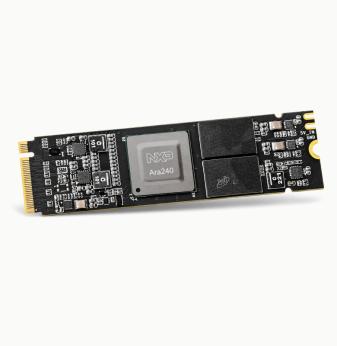
Dedicated neural processing units (NPUs) represent a different design philosophy. Instead of providing a complete compute platform, NPUs focus on efficiently executing neural networks. They are typically paired with a host processor that handles system logic, communications, and control, while the NPU accelerates inference tasks.
In 2026, NPUs for embedded AI often deliver 2–10 TOPS of performance with moderate power requirements (roughly 2–6 watts). They are particularly effective for vision analytics, sensor pattern classification, and use cases where inference is frequent and predictable. NPUs reduce load on the host CPU and deliver consistent performance for repeated model executions.
Teams choosing NPUs balance inference throughput with lower overall system power and reduced complexity compared to edge SoCs. NPUs also benefit from mature compilers and quantization toolchains that convert trained models into efficient run-time code.
MCU-Class Accelerators for TinyML
On the lower end of the performance spectrum are MCU-class AI accelerators. These are not stand-alone processors but AI blocks embedded within microcontroller platforms that run TinyML models at ultra-low power. They do not match the throughput of SoCs or NPUs, but they excel in deeply constrained environments where power is measured in fractions of a watt.
These accelerators enable embedded systems to execute inference for tasks such as voice trigger detection, anomaly signal classification, simple gesture recognition, and predictive triggers without draining coin-cell batteries or large power sources. MCU-class accelerators in 2026 typically offer performance from 0.5 to 2 TOPS while consuming less than 1 watt.
For designers focused on long operational life, small form factors, and minimal maintenance, MCU accelerators bridge the gap between simple control logic and genuine AI inference.
H3 Emerging Energy-Harvesting AI Cores
A new category emerging in 2026 comprises AI cores that can operate from harvested energy sources such as small solar panels, vibration harvesters, or RF energy. These platforms push embedded AI into environments where battery replacement is costly or impossible — remote sensor networks, environmental monitoring systems, or infrastructure health nodes.
Though their inference performance is modest (usually under 1 TOPS), these energy-harvesting AI cores make it feasible to classify events, detect anomalies, and trigger communications only when necessary, all without conventional power sources.
What to Look For When Choosing a Platform
Selecting the right hardware for embedded AI in 2026 is a nuanced process. Teams must balance multiple dimensions:
— Performance vs Power: High TOPS numbers look good on paper, but energy per inference and duty-cycle behavior often matter more in real products.
— Memory and Storage: AI workloads demand RAM and flash to store models and activation buffers; constrained memory may limit usable models.
— Ecosystem Support: Toolchain maturity, model conversion, debugging capabilities, and community resources significantly affect development cost.
— Real-Time Requirements: Applications with strict latency bounds require hardware that can deliver consistent inference times without thermal throttling.
— Form Factor and Cost: Larger SoCs and NPUs add BOM cost and PCB complexity, while MCU accelerators enable highly compact designs.
In practice, design teams ask questions like: what hardware balance gives me seven days of battery life with real-time inference? or can this platform support model updates over the air without degrading performance? These questions highlight the trade-offs inherent in embedded AI.
Selecting the right silicon is only the first step. Many edge AI platforms that look comparable during evaluation behave very differently once deployed inside a real product, where enclosure thermals, sustained workloads, memory pressure, and future model updates become limiting factors. That is why production validation of edge AI hardware has become an essential part of platform selection, confirming that performance, power, and latency targets remain achievable under the conditions the finished product will actually face.
Case Studies from 2026
The value of embedded AI hardware choices becomes clear when looking at actual product deployments. In one industrial automation scenario, a manufacturing plant deployed vision analytics sensors that classify defects in real time. These systems leveraged mid-range edge SoCs with integrated NPUs to process high-resolution camera feeds, achieving classification latency under 30 ms while staying within a 7 W power budget. The result was a significant reduction in network traffic and improved factory throughput.
In another use case, a wearable health monitor incorporated MCU-class accelerators to run TinyML models that detect heart rhythm anomalies. Running inference locally allowed the device to provide immediate user feedback while maintaining a battery life of more than two weeks — a balance that would be difficult without localized AI.
A third example involves distributed environmental sensors powered by energy harvesters. These units used specialized AI cores to classify acoustic events, triggering communications only when predefined thresholds were met. The sensors operated autonomously for months without battery intervention, demonstrating the potential of energy-harvesting AI silicon.
Long-Tail Questions Engineers Are Asking in 2026
Design conversations in 2026 often include questions such as:
• How does inference energy compare across edge SoCs and NPUs at typical workloads?
• What is the cost impact of choosing mid-range SoCs versus dedicated NPUs for a smart camera product?
• How can TinyML workflows be optimized on MCU accelerators to fit within 100 KB of active RAM?
• What are the real-world latency implications of running an object detection model on an energy-harvesting AI core?
These questions shape architectural decisions and influence platform choice more than peak performance numbers alone.
Future Directions Beyond 2026
Looking forward, embedded AI hardware platforms will continue to diversify. We can expect even tighter integration between hardware and machine learning toolchains, hardware that adapts inference behavior based on context to save power, and broader use of heterogeneous processing elements that dynamically allocate workloads across SoCs, NPUs, and accelerators. Standardization of AI benchmarking for embedded platforms may also emerge, helping teams compare performance and energy efficiency more directly.
In summary, 2026 marks a maturation point for embedded AI silicon. Designers now choose from a spectrum of hardware that spans powerful edge SoCs to ultra-efficient MCU accelerators. The right platform depends on use case, power profile, and the nature of the ML workload — and understanding those trade-offs is key to building successful embedded AI products.
AI Overview
In 2026, embedded AI hardware divides into distinct but complementary classes: high-performance edge SoCs for complex workloads, dedicated NPUs for efficient inference, and MCU-class accelerators for TinyML tasks at ultra-low power. Choosing among these platforms requires balancing performance, power consumption, memory resources, and toolchain support. Trends show that embedded intelligence is expanding into every layer of connected systems, enabling products that deliver real-time insights at the edge with predictable energy profiles and scalable development workflows.
Our Case Studies in Edge AI