


NVIDIA Jetson Is Not Enough: Why Industrial Robots Need Real-Time Ethernet Integration
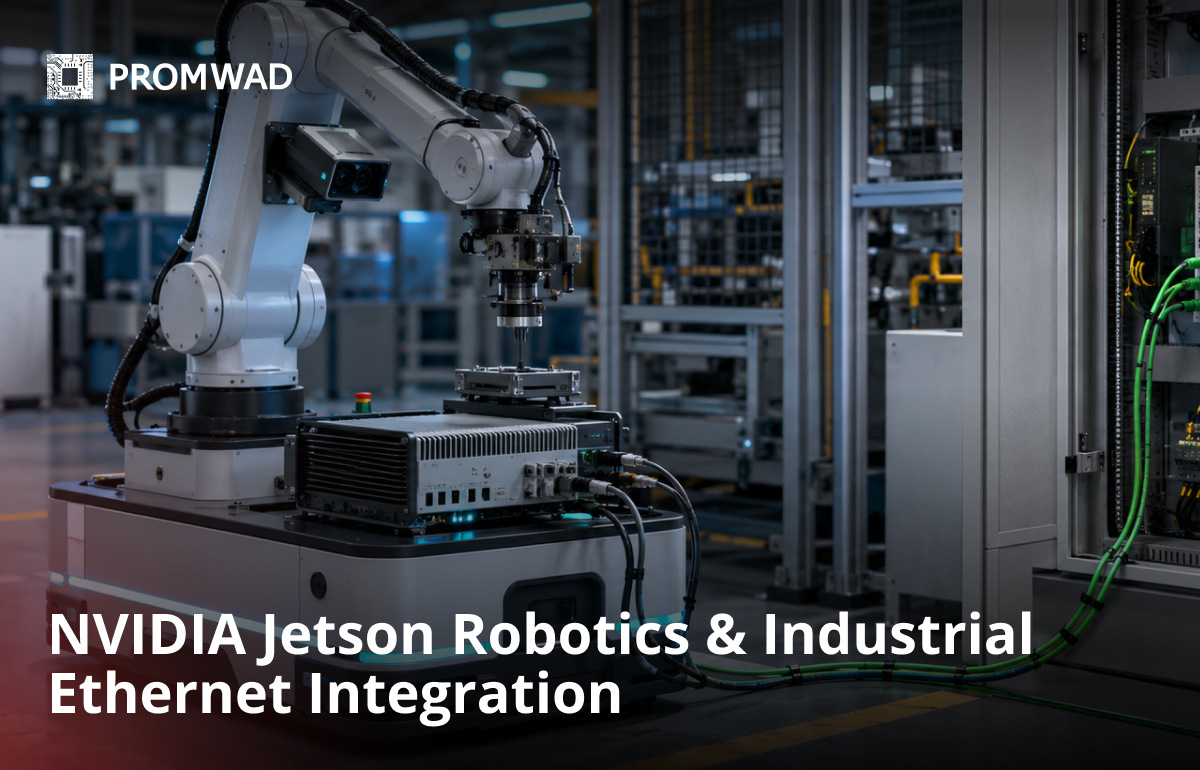
The robot worked in the lab. The perception stack ran on a Jetson Orin, the cameras found parts on the conveyor, Nav2 planned clean paths, and the ROS 2 graph held together through a full demo loop. Inference latency sat well inside budget. The hard part looked done.
Then the platform went to a customer’s line. There the mobile base had to take motion commands through the same network the factory’s PLC already trusted — PROFINET — and coordinate with servo drives that expected cyclic, deterministic updates on a fixed interval. That is where it stopped behaving. The drives faulted on missed cycles. Jitter crept into the path between a vision decision and the actuator that was supposed to act on it. At one point, the PLC or safety function transitioned the cell to a safe state because the process data became stale, invalid, or outside the configured communication watchdog window.
Nothing in the AI stack had failed. The model was fine, the GPU was barely warm, the navigation graph was correct. The robot failed at the layer nobody had treated as the hard part: deterministic communication with the industrial equipment around it.
Teams typically assume: if the AI workloads run cleanly on Jetson or Orin and the ROS 2 stack behaves in the lab, the robot is close to production.
In reality: a production robot is only as deployable as its weakest real-time link to servo drives, PLCs, and safety controllers. AI compute is one layer of the architecture. Deterministic industrial communication is a separate one — and it does not arrive for free with a GPU or a middleware framework.
This is the gap that rarely shows up in a prototype review and always shows up on a factory floor.
Quick Overview
Problem: An NVIDIA-based robot that demos perfectly cannot integrate reliably with the servo drives, PLCs, and industrial Ethernet networks a real factory runs.
Common causes: Fieldbus communication added late in the project, protocol mismatch from one customer site to the next, jitter on the perception → control → actuation path, weak fieldbus diagnostics, and a prototype architecture that will not scale into a product family.
Where it appears: AMRs, robotic arms, delta robots, machine-tending cells, and any NVIDIA-based platform that has to share a network with PLCs and servo drives.
Engineering focus: Deterministic communication, host-to-fieldbus partitioning, drive-profile support (CiA 402, PROFIdrive), and validation under real motion load — not bench inference numbers.
Why AI Compute Does Not Make a Robot Production-Ready
A Jetson or Orin module is very good at the work it is built for: running perception, fusing sensor data, planning, and AI inference at the edge. ROS 2 sits on top of that and gives a clean, modular way to assemble a robotics application out of nodes that publish and subscribe. Isaac ROS adds GPU-accelerated perception and navigation building blocks. For mapping, localization, and "where do I go next," this stack is exactly the right tool.
None of it, on its own, makes a robot deployable in a factory.
A production robot has to do something a demo never forces it to do: it has to deliver decisions to actuators on a schedule the actuators can trust, and it has to do that while sharing a network with equipment it did not design. A servo drive does not care that the path was planned beautifully. It cares whether a fresh position or velocity setpoint arrives in its control window, every cycle, with bounded latency and bounded jitter. A PLC and a safety controller care that the network behaves the way their configuration expects. Miss those constraints and the robot is not slow — it faults, or it drops to a safe state, or it moves in ways nobody intended.
ROS 2 helps you build the software. It does not, by itself, guarantee deterministic delivery to a drive, and a GPU does not make a network real-time. Determinism is a property you have to design into the communication path, not one you inherit from the compute module. That is the distinction most NVIDIA-based robotics projects discover late.
Where NVIDIA-Based Robotics Platforms Usually Break
The failures cluster in a few predictable places. None of them are exotic. All of them are easy to defer until they become expensive.
Servo-drive communication gets added last. Perception and navigation are the interesting problems, so they come first and consume the schedule. The fieldbus link to the drives gets treated as plumbing and bolted on near the end — which is exactly when its timing requirements collide with an architecture that was never shaped around them.
Protocol support differs by site. A Siemens-heavy plant expects PROFINET. A Rockwell / Allen-Bradley plant expects EtherNet/IP. A motion-centric machine builder wants EtherCAT. The same robot, sold to three customers, needs three different network personalities — and a platform built around one of them quietly excludes the other two.
Jitter appears between perception, control, and actuation. If time-critical communication remains too close to a general-purpose Linux path, it can compete with AI and middleware workloads for scheduler and CPU resources. Even when average latency looks acceptable, the worst-case timing can drift under load — and that is the number a servo loop actually lives or dies by. The visible symptom is a faulting drive; the cause is two layers upstream.
Diagnostics are thin. When a drive drops off the bus or a cycle is missed, a production system needs to know which node, which cycle, and why. Prototypes often have almost nothing here, so field failures turn into multi-day debugging sessions instead of a clear diagnostic readout.
The prototype does not become a product family. A one-off that talks to one drive over one protocol is a demo. A platform that a manufacturer can reuse across AMRs, arms, and delta robots — and across customers running different networks — is a product. Those are different architectures, and the second one is hard to retrofit onto the first.
Underneath all of these sits one structural problem: every time a new protocol is required, a platform without a dedicated communication strategy faces redesign pressure — new stack, new drivers, sometimes new hardware. That is the cost that compounds.
The Industrial Ethernet Layer: EtherCAT, PROFINET, and EtherNet/IP
For a robotics manufacturer, supporting industrial Ethernet is not a checkbox feature. It decides which factories the robot can enter and how much integration each deployment costs. Three protocols cover most of the market, and they are not interchangeable.
EtherCAT is built for deterministic motion and distributed I/O. Its processing-on-the-fly approach and distributed-clock synchronization make it strong where many axes have to stay tightly coordinated, which is why it shows up so often in motion-heavy machinery.
PROFINET is the common language of Siemens-centric and PLC-heavy environments. If the cell is built around a Siemens controller, PROFINET is usually the price of admission.
EtherNet/IP dominates Rockwell / Allen-Bradley ecosystems. In plants standardized on that infrastructure, a robot that cannot speak EtherNet/IP is a robot that does not get installed.
These protocols define the industrial communication layer for cyclic process-data exchange and device connectivity. They are distinct from the application profiles that actually command a drive — and conflating the two is a frequent source of confusion. Industrial Ethernet moves the data; a drive profile defines what the data means to a servo. CiA 402 is the drive profile widely used over EtherCAT — carried via CoE (CANopen over EtherCAT), the application layer EtherCAT uses for device communication — defining the modes of operation a drive understands — profile position, cyclic synchronous position, velocity, torque. PROFIdrive is the corresponding drive profile in the PROFINET world. Getting motion right means getting both layers right: the network and the profile riding on it. (Latency budgets in industrial control systems are where these two layers are won or lost.)
Why a Dedicated Communication Layer Changes the Architecture
The cleanest way out of protocol-by-protocol redesign is to stop asking the AI compute module to also be a fieldbus controller. Those are different jobs with different timing models, and forcing them onto the same processor is what produces the jitter described above.
A dedicated industrial communication controller — the Hilscher netX family is built for exactly this — runs the protocol stack independently of the host. The host keeps doing what it is good at: perception, navigation, AI. The communication subsystem owns the deterministic, cyclic conversation with the drives and the PLC. The two exchange data across a defined boundary instead of fighting over one scheduler.
A similar boundary can be created within a single chip, but separate cores do not automatically mean separate timing domains. In an AMP architecture on heterogeneous industrial SoCs, Linux and RTOS workloads may still share the memory controller, interconnect, DMA paths, and IPC resources, so determinism depends on how those shared resources are partitioned and validated under production load.
In a netX-based design that boundary is concrete. The host connects over PCIe — in Promwad's platform, through an AX99100 PCIe bridge on the communication side — and the two sides exchange data through Dual-Port Memory or DMA, so the protocol stack can run to its own timing while the host reads and writes process data without blocking on the wire. Because netX implements its real-time Ethernet support in a way that lets you load different firmware for different protocols on the same hardware, adapting the same platform from EtherCAT to PROFINET to EtherNet/IP becomes a configuration and firmware decision rather than a board respin.
That is the architectural payoff: the platform can support key industrial Ethernet protocols — including EtherCAT, PROFINET, and EtherNet/IP — without redesigning the hardware for each one. The determinism lives where it belongs, and the AI compute is insulated from the fieldbus timing it was never meant to guarantee. In practice, the deterministic communication path is handled by a subsystem designed for industrial protocol execution, while Jetson/Orin remains focused on AI and robotics workloads. The same separation is the core idea behind system partitioning for physical-AI edge robots: keep hard real-time work off the general-purpose path so neither starves the other.
To see where a symptom and its cause separate, walk the real path of a single motion command:
camera / LiDAR → perception (Jetson) → ROS 2 planning → motion setpoint → host ↔ netX (PCIe / Dual-Port Memory / DMA) → fieldbus stack (EtherCAT / PROFINET) → servo drive (CiA 402 / PROFIdrive) → actuator
When a drive faults, the operator sees it at the far right of that chain. The cause usually sits somewhere in the middle — a setpoint that arrived late because the host path was loaded, or a synchronization assumption the network never actually met. A design that separates the compute path from the communication path keeps that middle section deterministic, which is the whole point.
A Reusable NVIDIA + Hilscher Robotics Platform
Promwad built a reusable platform approach around exactly this separation: NVIDIA Jetson / Orin for the AI and robotics workloads (ROS 2, Isaac ROS, Nav2), and a Hilscher netX controller as the dedicated industrial communication layer. The platform supports key industrial Ethernet protocols — EtherCAT, PROFINET, and EtherNet/IP — so robotics manufacturers can connect standard modules and ready-made servo drives without adding a separate integration layer for every protocol.
The protocol stack runs independently on the netX side and exchanges process data with the host over PCIe through Dual-Port Memory or DMA. On a mobile test platform, motor drives were connected over EtherCAT and PROFINET respectively, validating the platform across both protocols, with CiA 402 as the primary drive profile and PROFIdrive under evaluation. The cyclic industrial-communication path is partitioned away from general-purpose Linux, reducing jitter in fieldbus exchange while leaving motion planning and setpoint generation as separate real-time design concerns.
Full engineering write-up — architecture, the netX communication design, and the drive-profile work: → NVIDIA Jetson robotics platform with industrial Ethernet support
What This Architecture Gives Robotics Manufacturers
The business value follows directly from the engineering decision to separate compute from communication.
Adapting to a new factory becomes a smaller job, because switching the network personality does not mean redesigning the platform. Protocol-specific redesign cost drops, because the expensive part — the hardware and the host architecture — stays constant across EtherCAT, PROFINET, and EtherNet/IP. Interoperability with standard drives and PLCs improves, because the platform speaks the profiles those components already expect. One platform can carry a family of products — AMRs, robotic arms, delta robots, and other industrial robotics systems where AI compute has to interface with servo drives and industrial networks — instead of a separate design per robot type. And the integration risk between AI compute, motion control, and the industrial network is bounded by design rather than discovered in the field, which is what shortens the path from prototype to production.
When You Need This Approach
- Your robot runs AI workloads on NVIDIA Jetson or Orin but must connect to EtherCAT, PROFINET, or EtherNet/IP networks.
- Your prototype works, but production integration with servo drives is unstable or faults under load.
- Your customers require different industrial protocols depending on the factory environment.
- Your team wants one reusable platform instead of a protocol-by-protocol redesign for every deployment.
- Your roadmap depends on edge AI, motion control, and industrial-network compatibility holding together at the same time.
How Promwad Helps
This is hardware/software co-design work, and the engagements are concrete rather than generic:
- Architecture review for NVIDIA-based robotics platforms, focused on where the compute and communication paths meet.
- Embedded Linux, BSP, and driver integration for the host side, including the host-to-communication interface.
- Industrial Ethernet integration with Hilscher netX across EtherCAT, PROFINET, and EtherNet/IP.
- Servo-drive communication and drive-profile support (CiA 402, PROFIdrive).
- Edge AI and robotics-software integration on NVIDIA-powered robotics platforms.
- Production-readiness work that turns a working prototype into a platform a manufacturer can ship and reuse.
Need to connect NVIDIA-based robotics with industrial Ethernet? Promwad can review your architecture, identify the integration risks between AI compute and motion control, and define a practical path from prototype to production.
FAQ
Why does my NVIDIA Jetson robot work in the lab but fail when it connects to servo drives?
Is ROS 2 on Jetson enough for real-time motion control?
What is the difference between industrial Ethernet protocols and drive profiles like CiA 402?
Why use a dedicated controller like Hilscher netX instead of running the protocol stack on the Jetson?
Can Promwad help if our prototype is built but the industrial integration is unstable?
Related Engineering Cases
- NVIDIA Jetson Robotics Platform with Industrial Ethernet Support — the full case behind this article: Jetson/Orin + Hilscher netX, EtherCAT/PROFINET/EtherNet/IP, CiA 402.
- Reusable Robotics Software Platform (EtherCAT, 5G, ROS 2) — a reusable robotics software platform built around EtherCAT and ROS 2.
- NVIDIA-Powered Robotics Development — Promwad’s NVIDIA robotics engineering profile.
- Industrial Protocols on a netX Robotics Platform — background article on solving robotics protocol compatibility with Hilscher netX.
- EtherCAT and AI Vision: Deterministic Motion Control with Smarter Perception — how to keep hard real-time work off the general-purpose path.