


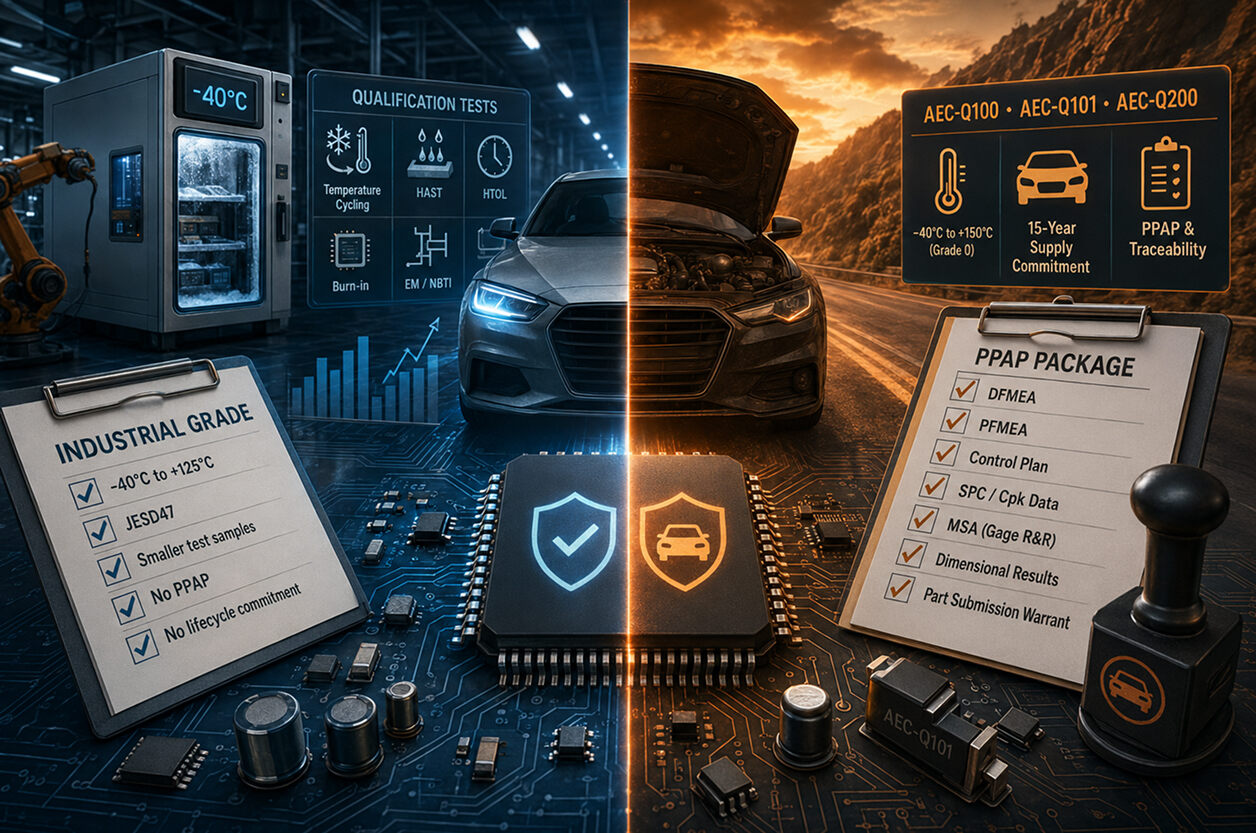
Every industrial-grade MCU datasheet lists −40°C to +85°C or −40°C to +125°C operating range. So does every automotive-grade MCU. The temperature numbers are similar. The price is not — automotive-grade parts typically cost two to four times more for nominally similar silicon. ECU teams running tight budgets look at that price delta and wonder whether they're paying for real engineering or for a certification stamp.
The honest answer: mostly real engineering, but in dimensions that don't show up on the datasheet. The qualification gap between industrial-grade and automotive-grade is real, and understanding exactly where it lives changes how ECU design teams make component decisions.
This article breaks that gap down — not abstractly, but in the specific dimensions that matter when a component goes into a system that will run for 15 years in an engine compartment, or in a battery management system, or behind an instrument cluster on a truck that operates in Alberta in January.
The AEC-Q Standards — What They Actually Test
AEC-Q100 is the qualification standard for integrated circuits used in automotive applications. It was developed by the Automotive Electronics Council — originally Chrysler, Ford, and GM — and has become the universal entry ticket for semiconductors in vehicle supply chains. Passing AEC-Q100 doesn't mean the device is appropriate for every automotive application. It means it passed a specific battery of stress tests. Knowing what those tests are matters more than knowing the certification exists.
The AEC-Q100 test suite runs across seven categories. The complete qualification requires 41 individual tests and takes a minimum of six months to complete. Sample sizes are substantially larger than equivalent industrial qualification: JESD47 (the industrial equivalent) requires 1,500 devices for Early Life Failure Rate testing; AEC-Q100 requires 2,400. For temperature cycling and biased HAST (Highly Accelerated Stress Test), the industrial standard requires 25 units per lot — AEC-Q100 requires 77.
The AEC-Q100 test categories:
- Accelerated environment stress tests: temperature cycling (2,000 cycles for Grade 0), autoclave, biased HAST, unbiased HAST, thermal shock — all verifying that packaging and die-attach survive repeated thermal excursions
- Accelerated lifetime simulations: high-temperature operating life (HTOL, 1,000 hours at elevated temperature for Grade 0), early life failure rate, high-temperature storage life — simulating years of actual field operation
- Package assembly integrity tests: bond wire fatigue, solder ball shear, die shear, electromigration — verifying mechanical attachment integrity under vibration and thermal stress
- Die fabrication integrity tests: electromigration, oxide integrity, hot carrier injection, negative bias temperature instability (NBTI) — verifying that the transistor-level failure mechanisms accelerate acceptably under stress
- Electrical distribution tests: parametric verification that electrical characteristics are within spec not just at room temperature but at the temperature extremes
- Defect screening: wafer-level burn-in, package-level burn-in
- Cavity package integrity tests (where applicable)
The industrial JESD47 qualification is similar in structure but systematically less aggressive: smaller sample sizes, fewer temperature cycles, shorter HTOL duration, and less stringent sample lot diversity requirements. A device can pass JESD47 and fail AEC-Q100 — not because it has a different die, but because the automotive qualification exposes infant mortality and wearout mechanisms at higher sample volume and greater stress severity.
The four AEC-Q100 temperature grades and where each applies:
| Grade | Temperature range | Typical location |
| Grade 0 | −40°C to +150°C | Under-hood, powertrain, engine control |
| Grade 1 | −40°C to +125°C | Body control, ADAS, transmission |
| Grade 2 | −40°C to +105°C | Passenger compartment, infotainment |
| Grade 3 | −40°C to +85°C | Passenger compartment, low-thermal-stress locations |
Most industrial-grade parts are rated to +85°C commercial or +125°C industrial. Grade 1 overlaps the industrial +125°C rating numerically — but the qualification testing behind that rating is not equivalent, and the ambient vs. junction temperature interpretation matters. An automotive Grade 1 device is qualified to operate at 125°C ambient continuously. An industrial part rated to +125°C may be characterized at junction temperature under specific test conditions that don't reflect 15 years of continuous elevated ambient.
The discrete semiconductor equivalent is AEC-Q101 (for MOSFETs, diodes, bipolar transistors). The passive component equivalent is AEC-Q200 (resistors, capacitors, inductors, rated −55°C to +150°C in many cases). The sensor standard is AEC-Q103. The multichip module standard is AEC-Q104. A complete ECU BOM running a power management subsystem needs AEC-Q100 for the MCU, AEC-Q101 for the gate driver FETs and protection diodes, and AEC-Q200 for the bulk capacitors on the supply rails. Missing any one of these in a safety-relevant system is an audit gap, not just a datasheet concern.
What AEC-Q Qualification Doesn't Cover — and Why PPAP Exists
Passing AEC-Q100 qualifies the component. It says nothing about whether the manufacturer can consistently produce it at automotive quality levels. That gap is closed by the Production Part Approval Process (PPAP) and the broader APQP (Advanced Product Quality Planning) framework.
PPAP is the formalized evidence package that a component supplier presents to an automotive customer before production parts are approved for use in a vehicle program. It contains up to 18 elements including design records, engineering change documentation, the DFMEA (Design Failure Mode and Effects Analysis) covering the component's potential failure modes and their effects, a Process FMEA covering the manufacturing process, control plans, measurement system analysis (Gage R&R studies), dimensional results from initial production samples, and statistical process capability data (Cpk values) demonstrating that the manufacturing process is stable and capable.
The key PPAP elements that distinguish automotive supply chain participation from industrial supply chain:
- DFMEA: the component supplier documents every predicted failure mode, the effect of each failure, its detectability, and the design controls that prevent it. For a microcontroller, this covers not just die-level failure mechanisms but supply voltage exceedance, reverse battery protection, ESD events, and electromagnetic interference responses.
- SPC/Cpk data: the supplier must demonstrate that critical parameters (threshold voltages, leakage currents, timing parameters) are produced with statistical capability index Cpk ≥ 1.33, meaning the process is centered and the spread is well within specification limits. This is ongoing, not a one-time sample qualification.
- Lot traceability: every component in an automotive PPAP package has complete traceability from wafer fab through assembly and test to shipment — date code, lot ID, wafer lot, assembly site. This is why automotive components come with documentation that industrial-grade parts do not.
An industrial-grade MCU from a reputable supplier is manufactured carefully and characterized thoroughly. It does not have PPAP documentation. When an ECU program encounters a field failure cluster and the OEM asks the Tier 1 to provide lot traceability data and compare failed units against production Cpk records for the suspect parameter, the answer to that question determines whether the root cause is found in weeks or in months. Automotive grade answers it. Industrial grade does not.
Lifecycle Commitment — The Gap That Hurts Most at 7 Years
Electronics change fast. Automotive programs do not. The typical automotive component lifespan requirement is 15 years in production plus 10–15 years of service life after end of vehicle production. A vehicle program launched in 2025 may still need identical spare parts in 2050. An MCU selected for an infotainment domain controller in 2023 needs to be available — identical, same die revision, same package, same silicon process — for spare parts for decades after the car goes out of production.
Industrial-grade components offer no such commitment. A supplier can obsolete an industrial-grade part, change the die revision without notification, or migrate to a newer process node at any time. A 12-month end-of-life notice is typical. That might be acceptable for an industrial automation controller with a 5-year product life and a user base that expects to upgrade. It is not acceptable for a Body Control Module that will be in production for 7 years and in service for another 15.
Automotive-grade component suppliers commit to:
- 15-year production lifetime supply commitments (with some variation by supplier and product family)
- Change notification requirements: any die revision, package change, process migration, or manufacturing site change that could affect electrical or mechanical performance requires advance notification and qualification data — typically 12 months minimum, often 24 months
- Last-time buy provisions: when a device is eventually obsoleted, automotive customers receive formal notification and sufficient lead time to execute a last-time buy covering their remaining production and service life requirements
Silicon Labs' application note on automotive qualification versus AEC-Q100 compliance makes this distinction clearly: a device can be AEC-Q100 qualified without being automotive-grade in the full supplier sense. AEC-Q100 certifies the component passed qualification tests. Automotive grade (designated with -A in Silicon Labs' part numbering) additionally includes PPAP documentation, DFMEA, expedited failure analysis response times, and the lifecycle management commitments above. Not all AEC-Q100 parts carry all these attributes.
For ECU teams, this distinction matters at the BOM review stage. An industrial MCU with AEC-Q100 qualification data may pass a component review and fail a supply chain audit six months later when the program management team asks for the PPAP package.

Where Industrial-Grade Parts Are Actually Acceptable
The case for automotive-grade everything is clear in principle. In practice, ECU teams routinely use industrial-grade components in specific contexts — and get away with it, or even get it validated, when the context is right.
Non-safety-relevant, low-thermal-stress, infotainment-adjacent functions are the primary candidates. An infotainment head unit's audio DSP, handling music decoding in a climate-controlled passenger cabin, operating at ambient temperatures that rarely exceed 60°C, connected to no safety-relevant vehicle function, with a product life of five to seven years — this is an application where industrial-grade parts are regularly used, and OEMs will accept them with appropriate justification documentation.
The justification documentation matters. Using industrial-grade parts in an ECU without OEM approval is a supply chain violation. Using them with a documented design rationale — temperature analysis showing the component junction temperature stays within industrial grade limits under worst-case ambient, a lifetime analysis confirming the part's MTBF under those conditions meets the program requirement, and an agreed derogation from the relevant OEM purchasing standard — is a defensible design decision.
Contexts where industrial grade is typically acceptable in automotive ECUs:
- Infotainment and human-machine interface subsystems with no safety coupling and passenger compartment placement
- Body control modules handling non-safety comfort functions (seat heating, mirror adjustment) where OEM standards permit
- Telematics units where ambient temperature is controlled and the device is treated as a replaceable module
- ADAS sensor processing where the sensor interface IC is classified at ASIL QM (no safety integrity requirement) in the system's ISO 26262 analysis
Contexts where automotive grade is non-negotiable:
- Any device in a safety function classified ASIL A through ASIL D
- Engine and transmission control units, where under-hood temperatures exceed industrial-grade limits
- Power electronics control (inverter gate drivers, OBC control) with high ambient and thermal cycling
- Powertrain safety monitors and watchdog circuits, regardless of ambient temperature
- Any BOM item that a Tier 1's PPAP package must cover for OEM submission
The Practical Design Process — How ECU Teams Navigate the Gap
The gap between industrial and automotive grade is not just a procurement question. It shapes circuit architecture decisions from the first schematic review.
Temperature budgeting starts at the system level. A Grade 0 MCU rated to 150°C ambient must have its junction temperature (Tj) stay below that limit under all operating conditions. Junction temperature equals ambient plus the thermal resistance from junction to board (θja) multiplied by power dissipation. If ambient is 140°C (realistic in an engine compartment) and the MCU dissipates 500 mW with θja of 40°C/W, junction temperature reaches 160°C — above Grade 0. The design choices that follow are either a more powerful thermal management path (heatsink, copper pours, thermal vias), a lower-power MCU variant, or a board placement that reduces the ambient exposure.
Industrial-grade teams doing ECU work for the first time often underestimate how constrained the thermal budget becomes when ambient is 120–140°C rather than 40–60°C. Adding 80°C to the ambient subtracts 80°C from the thermal headroom between junction limit and operating temperature.
BOM classification framework that works in practice:
- Classify every component by its position in the system's safety analysis (ASIL level) and its thermal environment
- Components in ASIL A–D functions: automotive grade (AEC-Q100/Q101/Q200), PPAP required
- Components in ASIL QM functions, Tambient > 105°C: automotive grade required for temperature, PPAP negotiable by OEM program
- Components in ASIL QM functions, Tambient < 85°C, non-powertrain: industrial grade acceptable with documented temperature analysis and OEM derogation
- All passive components in power supply paths (bulk capacitors, filter inductors) on safety-relevant rails: AEC-Q200 regardless of ASIL level
The supply chain process for each category is different too. Automotive-grade components are sourced exclusively through authorized distribution channels — counterfeiting is an active problem, and automotive OEM supply chain audits will check purchase order and traceability documentation. Industrial-grade components sourced through open-market brokers are never acceptable in an automotive ECU regardless of grade, because lot traceability is lost at that point.
Quick Overview
Automotive-grade components differ from industrial-grade primarily in qualification rigor, supply chain documentation, and lifecycle commitment — not necessarily in fundamental silicon design. AEC-Q100 qualification requires larger test sample sizes, more aggressive stress conditions, and die-level testing at temperature extremes compared to the industrial JESD47 equivalent. Full automotive-grade status adds PPAP documentation (DFMEA, SPC Cpk data, lot traceability), 15-year supply commitments, and mandatory process change notification. Grade 0 covers −40°C to +150°C for under-hood applications; Grade 1 covers −40°C to +125°C for body control and ADAS. Industrial-grade parts are acceptable in automotive ECUs only for ASIL QM functions operating below the industrial temperature limit, with documented OEM derogation. Any safety function (ASIL A through D) requires full automotive-grade components with complete PPAP package.
Key decision framework for ECU component classification:
- ASIL A–D function, any temperature: AEC-Q100/Q101/Q200 + full PPAP mandatory
- ASIL QM function, Tambient > 105°C: AEC-Q100 minimum for temperature compliance
- ASIL QM function, Tambient ≤ 85°C, non-powertrain: industrial-grade acceptable with thermal analysis and OEM derogation
- Power supply path passives on safety-relevant rails: AEC-Q200 regardless of ASIL
- Any component sourced through open-market brokers: not acceptable regardless of grade
Challenges
The qualification gap shows up as a time and budget problem for design teams coming from industrial embedded backgrounds into automotive ECU programs. AEC-Q100 qualification takes a minimum of six months — which means silicon that doesn't yet exist as an automotive-grade variant can delay a program if the team discovers the gap late. PPAP preparation by the component supplier takes additional time. Industrial-to-automotive migration of an existing design requires a complete BOM re-evaluation against both temperature grade and documentation requirements, which often surfaces several components without automotive-grade equivalents, triggering either alternative component selection or OEM derogation requests.
Outlook
The automotive IC market is projected to reach $116.6 billion in 2025 and grow to $189.8 billion by 2030 at 10.24% CAGR, driven by increasing electronic content per vehicle in ADAS, electrification, and software-defined vehicle architectures. The component selection pressure is moving in the direction of higher ASIL ratings across more of the vehicle — a domain controller that previously handled infotainment is now also processing sensor fusion for ADAS, pushing more of its BOM from ASIL QM into ASIL B or C. That migration makes the qualification gap relevant for components that industrial-background ECU teams previously treated as non-critical.
Related Terms
AEC-Q100, AEC-Q101, AEC-Q200, AEC-Q103, AEC-Q104, AEC-Q006, Automotive Electronics Council, JESD47, temperature grade, Grade 0 Grade 1 Grade 2 Grade 3, HTOL, high-temperature operating life, HAST, temperature cycling, ELFR, early life failure rate, FIT rate, PPAP, production part approval process, APQP, advanced product quality planning, DFMEA, PFMEA, control plan, SPC, Cpk, Gage R&R, MSA, Part Submission Warrant, PSW, IATF 16949, ISO 26262, ASIL A B C D, ASIL QM, functional safety, ISO 16750, ECU, engine control unit, body control module, domain controller, Tier 1, OEM, PCN, product change notification, last-time buy, lifecycle management, counterfeiting, authorized distribution, traceability, lot traceability, junction temperature, thermal resistance, θja, thermal budget, AEC-Q100 derogation, industrial grade, commercial grade
Our Case Studies




FAQ
What is the difference between AEC-Q100 qualification and being "automotive grade"?
AEC-Q100 qualification means the component has passed the Automotive Electronics Council's defined stress test suite for integrated circuits, demonstrating its reliability under the specified temperature grade and failure mechanism tests. Being "automotive grade" in the full supplier sense includes AEC-Q100 but adds the complete PPAP documentation package (DFMEA, process capability Cpk data, dimensional results, measurement system analysis), a lifecycle management commitment typically covering 15 years of production supply, mandatory change notification for die or process revisions, and expedited failure analysis response times for field returns. A device can be AEC-Q100 compliant without meeting all these additional requirements. ECU teams sourcing components for OEM programs need the full automotive-grade package, not just the qualification data.
Why does automotive-grade component cost more than an industrial part with identical electrical specifications?
Multiple real cost drivers underlie the price premium: larger qualification sample sizes (AEC-Q100 requires 77 units per lot versus 25 for JESD47 equivalents, with corresponding material and test time cost), longer HTOL test duration (1,000 hours minimum), additional die-level characterization at temperature extremes rather than room temperature only, production with Statistical Process Control documentation and ongoing Cpk monitoring, PPAP package preparation and maintenance, 15-year supply commitment that forces the supplier to manage process continuity over a much longer horizon than industrial products, and change notification requirements that constrain the supplier's ability to cost-reduce the process freely. The premium reflects those real engineering and process costs. It doesn't reflect gold-plated silicon — the die may be identical to an industrial variant. It reflects the documentation, testing, and supply commitment wrapped around that die.
At what ASIL level does an ECU function require automotive-grade components?
ISO 26262 does not specify component grade directly — it specifies the safety requirements for the system, and the hardware development process must demonstrate that the components used meet those requirements. In practice: any function classified ASIL A, B, C, or D requires components that can be supported by a hardware safety case, which industrial-grade parts generally cannot provide due to the absence of PPAP documentation, DFMEA, and the statistical production data needed to support FIT (Failure-in-Time) rate claims. ASIL QM (Quality Managed, no specific safety integrity requirement) permits industrial-grade components subject to temperature analysis and OEM program agreement. The specific rules vary by OEM — some require AEC-Q100 for all components in a safety-relevant ECU regardless of individual function ASIL, which is a stricter position than ISO 26262 mandates.
How do ECU teams handle obsolescence risk when an automotive-grade component goes end-of-life?
Automotive-grade suppliers are contractually required to provide advance end-of-life notification, typically 12–24 months, allowing ECU teams to plan a last-time buy covering the remaining production program and service life requirements. The practical process: monitor the component supplier's product change notification (PCN) system actively, maintain a lifecycle risk register for every critical component in the BOM reviewed at least annually, size the last-time buy based on remaining vehicle production volume plus estimated warranty and service demand at the OEM-required service life (typically 15 years after end of vehicle production), and qualify an alternative part in parallel during the notification period if the last-time buy quantity is insufficient. Designing multiple footprint compatibility into the PCB for likely alternative packages during initial hardware design reduces the respin cost of a future alternative part qualification.