


Engineering Observability for Live Media Pipelines: Why Healthy Systems Still Produce Broken Streams
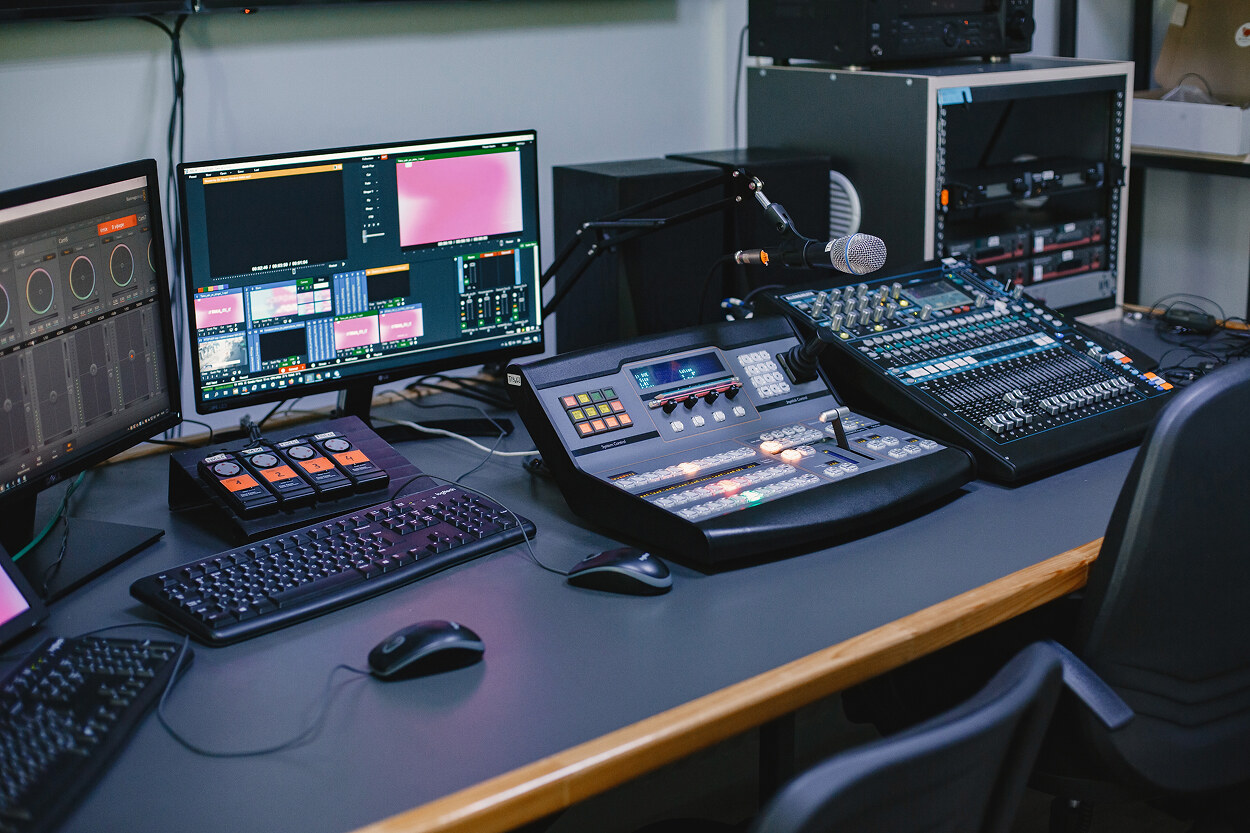
A live media pipeline can be fully “green” on every dashboard and still deliver a broken stream to the viewer. CPU usage is stable, services respond within SLA, network throughput looks normal, and no component reports an error. At the same time, the user sees buffering, delayed playback, audio drifting out of sync, or intermittent visual artifacts. This is not an anomaly or an edge condition. It is a structural mismatch between how live media systems behave and how observability is typically implemented.
Traditional monitoring assumes that system health can be inferred from the status of individual components. If each service operates within its thresholds, the system is considered healthy. This assumption holds in request-response architectures where transactions are short-lived and failures are discrete. Live media pipelines do not behave this way. They are continuous, time-sensitive systems where small deviations accumulate across stages and only become visible at the output. Observability that does not account for this accumulation will systematically miss the real failure modes.
The central idea is simple but often ignored: in live video, correctness is not defined by whether components are running, but by whether the stream maintains its temporal and structural integrity from ingest to playback. Everything else is secondary.
Failure chain #1: latency drift across a “healthy” pipeline
Consider a pipeline running a low-latency live stream. The ingest receives a stable input feed. The encoder processes frames with an average delay of 40 milliseconds. The packager produces segments on schedule. The CDN distributes content without errors. The player maintains a buffer that prevents rebuffering events.
Now introduce small variability at the encoder. Instead of a stable 40 ms delay, frame processing fluctuates between 40 and 70 ms depending on scene complexity or CPU contention. This is still within acceptable limits for the encoder itself, so no alert is triggered. At the same time, the network introduces jitter, causing slight delays in segment delivery. The CDN compensates by smoothing delivery, and the player increases its buffer to maintain playback stability.
Individually, each component is behaving correctly. No thresholds are violated. However, the cumulative effect is an increase in end-to-end latency. The stream that was originally near real-time now lags by several seconds. For interactive use cases such as sports betting, live auctions, or remote production, this is a functional failure.
This is the core observability problem. No single metric indicates failure. Only the aggregated behavior across the pipeline reveals the issue. Without correlating latency across stages and aligning it in time, the system appears healthy while violating its primary requirement.
Failure chain #2: buffer oscillation and QoE collapse
A second class of failure appears at the player level and is often invisible to backend monitoring. Consider an adaptive bitrate streaming scenario where the network bandwidth fluctuates around a threshold. The player responds by switching between bitrate profiles. Each switch introduces a small disruption as new segments are requested and buffered.
If the network variability is high enough, the player enters a state of buffer oscillation. It repeatedly fills and drains its buffer, switching bitrates frequently. From a QoS perspective, the system remains within acceptable limits. Bitrate adapts as expected, packet loss is minimal, and throughput is sufficient. From a QoE perspective, the viewer experiences unstable playback, visible quality shifts, and occasional micro-stalls.
Backend observability does not capture this because it does not see the player state. The CDN delivers segments correctly. The encoder produces valid streams. The network metrics look acceptable. The failure exists entirely at the interaction between network variability and player logic.
This illustrates why QoS metrics alone are insufficient. Observability must include player-side telemetry and correlate it with backend conditions. Without this, teams cannot diagnose or even detect this class of failure.
Failure chain #3: ST 2110 timing misalignment without packet loss
In professional broadcast pipelines using ST 2110, failure manifests differently. Instead of buffering or latency drift, the system relies on precise timing across devices. Video, audio, and ancillary data are transmitted as separate streams and must be synchronized at the receiver.
Assume a scenario where all network links report zero packet loss and stable throughput. However, there is slight clock drift between devices due to imperfect Precision Time Protocol synchronization. Packet inter-arrival times vary beyond acceptable limits, causing misalignment between streams. The result is audio drifting relative to video or subtle frame inconsistencies.
Traditional monitoring does not detect this because it focuses on packet loss and bandwidth. The network is “healthy” by those metrics. The failure lies in timing precision, which requires measuring packet spacing, sequence alignment, and clock synchronization.
This type of failure is particularly difficult to diagnose because it does not produce explicit errors. It manifests as quality degradation that requires domain-specific observability at the packet and timing level.
Latency as a cumulative system constraint
Across all these scenarios, latency behaves as a cumulative property. It is not sufficient to measure delay at individual stages. The system must track how latency evolves as media moves through the pipeline.
This requires aligning timestamps across components. In practice, each stage operates in its own time domain, using local clocks or loosely synchronized systems. Without normalization, latency measurements cannot be correlated. Observability systems must establish a unified timeline, often based on synchronized clocks or embedded timestamps in the media stream.
Once aligned, latency can be decomposed into its components. This allows teams to identify where delays originate and how they interact. More importantly, it enables detection of drift, where small increases at multiple stages combine into a significant deviation.
This is fundamentally different from traditional monitoring, which treats latency as a local metric rather than a global constraint.
QoS vs QoE: mapping system metrics to user experience
The gap between QoS and QoE is one of the main reasons observability fails in live media systems. QoS metrics describe system behavior in terms of network and processing performance. QoE metrics describe the outcome from the user’s perspective.
Bridging this gap requires explicit mapping. For example, increased jitter at the network layer may translate into buffer instability at the player. Packet loss may result in visible artifacts depending on codec resilience and error concealment strategies. Bitrate adaptation may hide network issues while introducing quality fluctuations.
Observability systems must model these relationships. This involves correlating metrics across layers and identifying patterns that lead to QoE degradation. Without this mapping, teams operate on incomplete information, optimizing metrics that do not directly reflect user experience.
Instrumentation strategy: building observability into the pipeline
Effective observability starts with correct instrumentation. Metrics must be collected at points that reflect how media flows through the system.
At ingest, signals should capture input jitter, timestamp accuracy, and initial buffering behavior. At encoding, metrics must include processing delay distribution, frame drops, and bitrate stability. Packaging layers should track segment creation time relative to input timestamps, not just absolute timing. Transport layers must measure jitter, retransmissions, and path variability across networks. At the player, metrics must include startup time, buffer levels, bitrate switches, and playback interruptions.
The critical requirement is correlation. Each stage must produce data that can be aligned with upstream and downstream metrics. This often requires embedding identifiers and timestamps within the media stream itself, enabling reconstruction of its path through the pipeline.
Why logs and tracing are insufficient on their own
Logs provide localized information about events within a component. They are useful for debugging specific issues but do not capture system-wide behavior. In live media pipelines, failures emerge from interactions over time, not isolated events.
Tracing systems attempt to connect events across services, but they are typically designed for discrete transactions. Media pipelines do not have clear request boundaries. Attempting to apply traditional tracing leads to either excessive data or loss of critical timing information.
Flow-based observability is required instead. This approach treats the media stream as the primary entity and tracks its progression through the system. It requires persistent identifiers, synchronized timestamps, and the ability to reconstruct sequences of events across components.
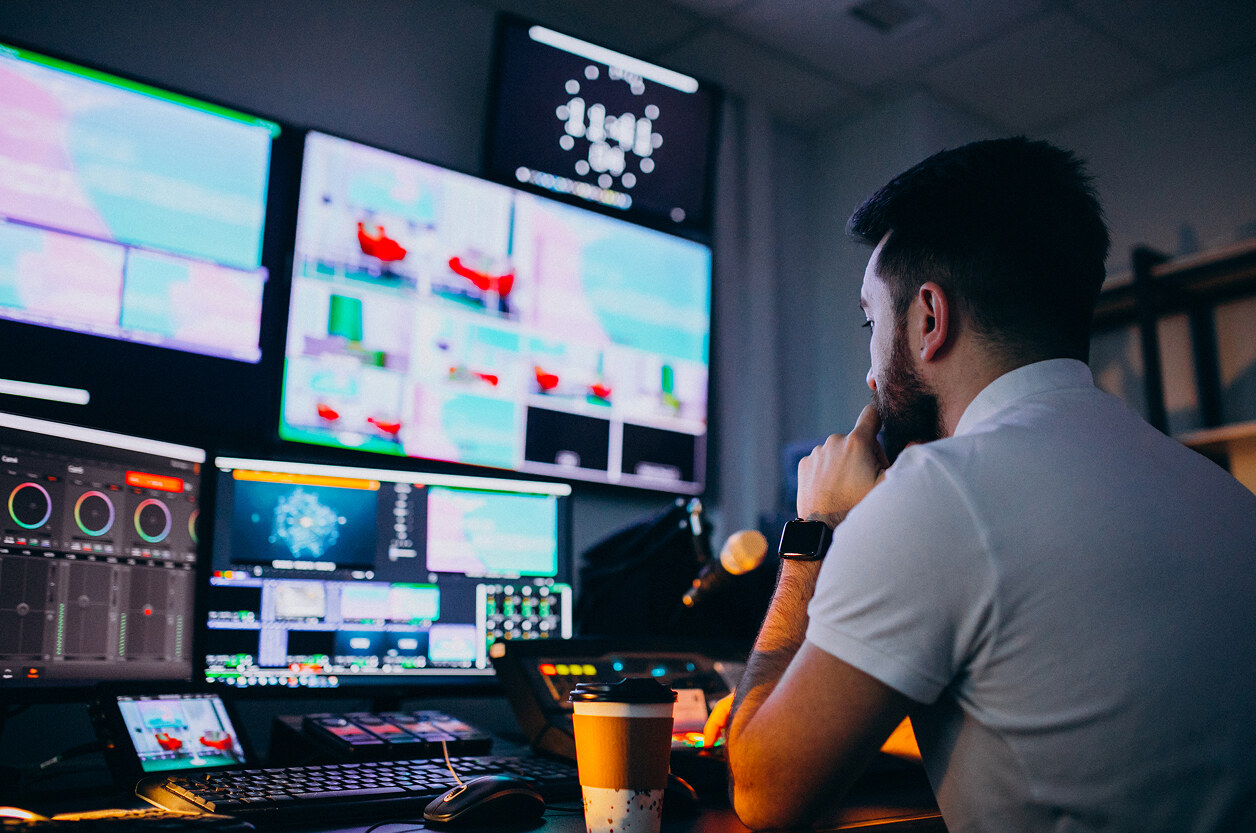
Edge telemetry: observing the system where it matters
The final state of the pipeline is determined at the player. Network conditions, device performance, and buffering strategies all influence the outcome. Backend observability alone cannot capture this.
Edge telemetry provides direct visibility into playback conditions. It captures rebuffering events, latency at the device, bitrate adaptation behavior, and rendering performance. Integrating this data with backend metrics allows teams to close the loop between system behavior and user experience.
This integration is essential for diagnosing issues that only appear under real-world conditions, such as last-mile network variability or device-specific limitations.
Designing observability around real failure modes
The key shift in engineering observability for live media is moving from infrastructure metrics to failure-oriented models. Instead of monitoring whether services are healthy, systems must detect whether the stream meets its requirements.
This involves defining metrics and alerts around latency drift, synchronization errors, buffering instability, and quality degradation. Observability must focus on detecting these patterns early, before they become visible to users.
It also requires accepting that failures are often emergent. They arise from interactions between components rather than isolated faults. Observability systems must therefore be capable of correlating signals across the entire pipeline.
Final assessment
Live media pipelines expose the limitations of traditional monitoring because they operate as continuous, time-sensitive systems. Component-level metrics are necessary but not sufficient. They must be complemented by flow-based observability that tracks media as it moves through the pipeline.
The primary challenge is not collecting more data, but structuring it in a way that reflects system behavior. This includes aligning timestamps, correlating metrics across stages, and integrating edge telemetry.
For engineering teams, observability must be designed as part of the system architecture. It is not an add-on. Without it, pipelines will continue to appear healthy while delivering degraded streams.
Quick Overview
Live media observability requires tracking continuous media flow, latency accumulation, and user experience instead of isolated service metrics.
Key Applications
Broadcast pipelines, OTT streaming, low-latency delivery, real-time media systems.
Benefits
Improved detection of latency drift, better debugging of complex failures, alignment with user experience.
Challenges
Complex metric correlation, strict timing requirements, need for edge telemetry integration.
Outlook
Observability will evolve toward flow-based architectures with integrated QoE analysis and real-time correlation across distributed pipelines.
Related Terms
QoS, QoE, ST 2110, latency budget, jitter, packet timing, CDN, telemetry, real-time streaming
Our Case Studies


FAQ
Why do live media pipelines fail even when all services are healthy?
What is the most critical metric in live video observability?
Why is QoE different from QoS in streaming systems?
What makes ST 2110 observability complex?
Why is player telemetry important in observability?
What should I store as evidence from automated runs?