NDI Protocol Implementation for Professional Live Broadcasting
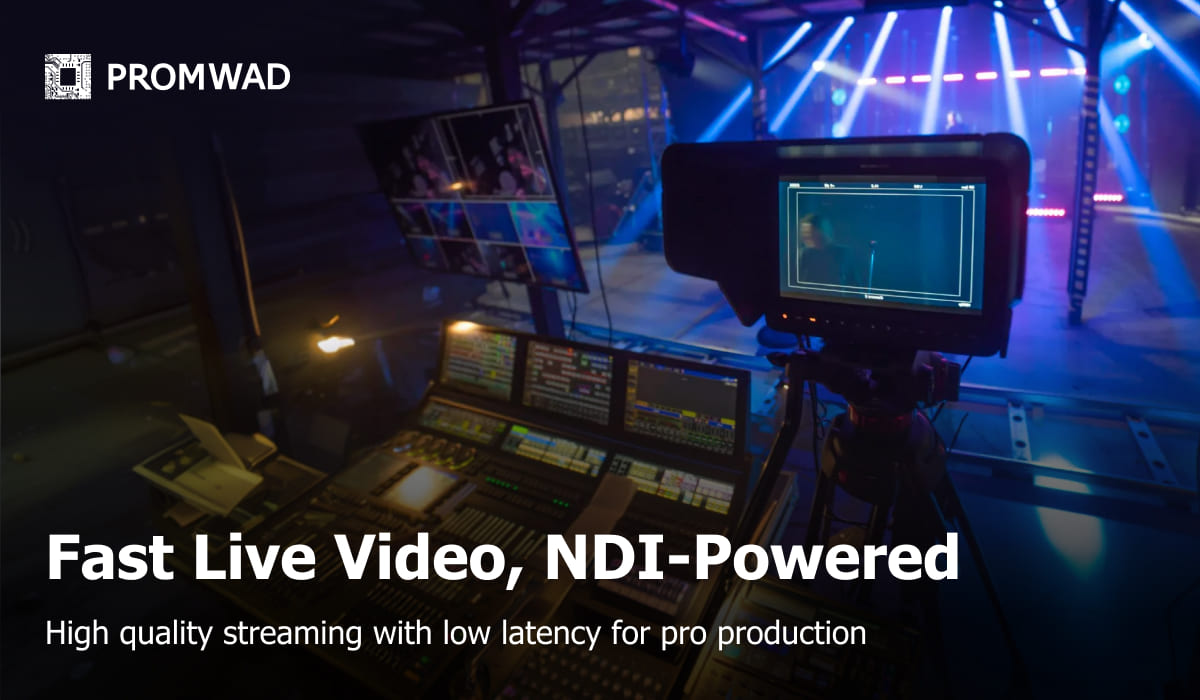
Project in a Nutshell: Promwad built an NDI-based software solution for a European manufacturer of professional broadcast equipment to stream and record high-resolution camera video with minimal delay. We integrated cameras from multiple vendors and made the system easy to scale from one camera to multi-camera setups. The platform provides a transparent control layer for operators and a separate module for reliable camera management. It delivers consistent video quality suitable for live production workflows. The client received a solid foundation they can reuse and extend for new camera models and production scenarios.
Client & Challenge
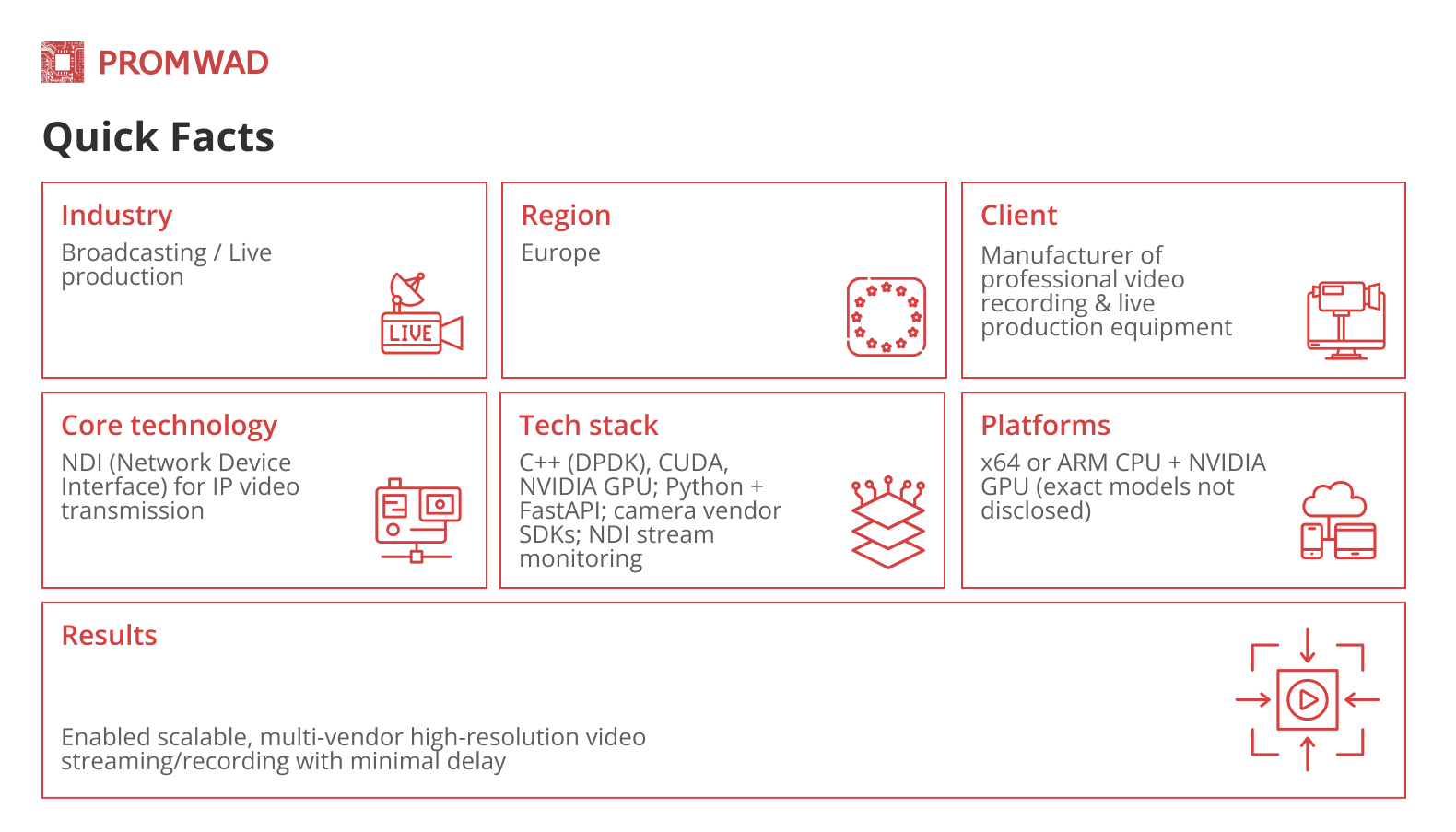
A European manufacturer of professional video recording and live production equipment needed a reliable way to move large volumes of high-resolution camera video over the network without visible quality loss and with minimal end-to-end delay. They required seamless integration with cameras from multiple vendors and a foundation that could scale from single-camera setups to multi-camera systems.
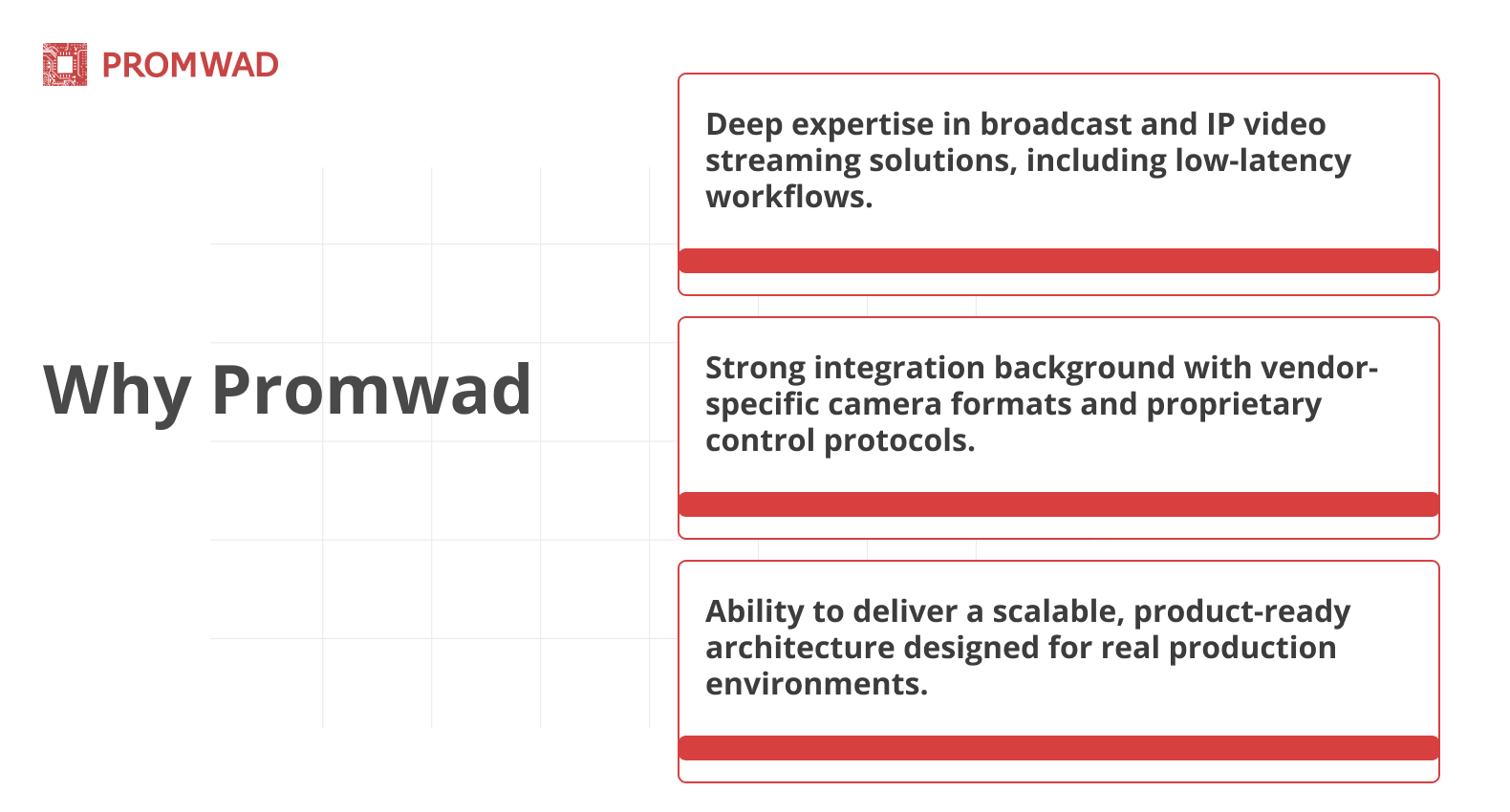
They selected Promwad for our proven expertise in broadcast and low-latency video streaming solutions.
Solution
To solve this problem, the Promwad engineering team designed and developed a solution powered by the NDI (Network Device Interface) technology. NDI is a standard for multimedia data transmission over IP networks that allows devices to automatically find each other, synchronise frames and transmit video in high quality with minimal latency (up to 50 ms).
Solution Architecture
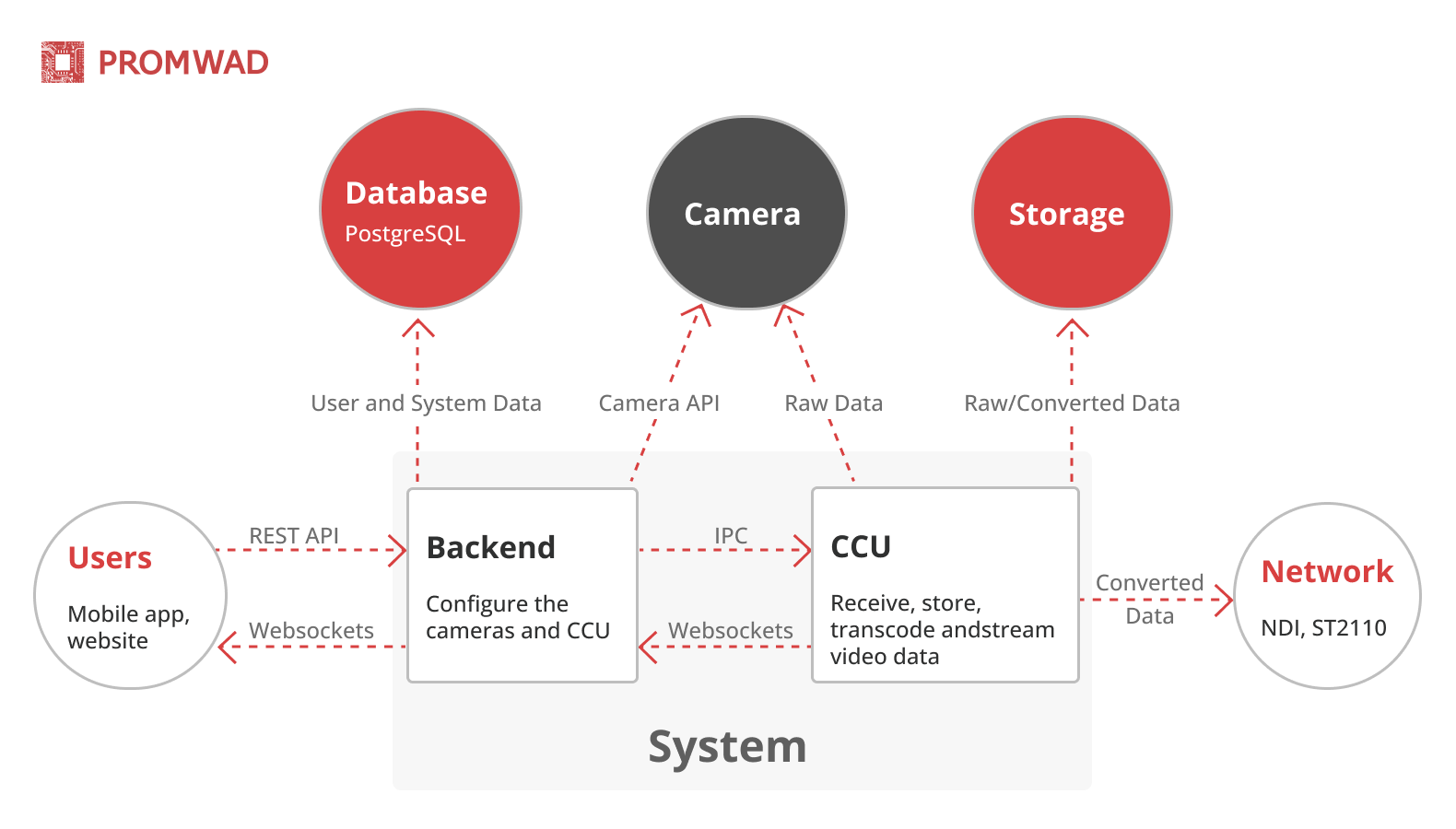
The solution includes three core components:
- A web server that accepts REST commands from users for seamless interaction with the system.
- A camera computational unit: a high-performance C++-based application responsible for receiving, storing, processing, and streaming multimedia data from cameras. It uses DPDK to maximise network throughput and CUDA to decode proprietary camera vendor-encoded data to RAW.
- A remote control unit for cameras that supports their proprietary protocols. This abstraction level provides control of each camera individually, thus making the whole system flexible and scalable. It was implemented with Python and FastAPI.
To validate stream integrity and latency during integration, the team used a monitoring application compatible with NDI streams (e.g., NDI Simple Monitor) to observe real-time transmission and confirm stable quality.
Video Streaming with NDI Protocol
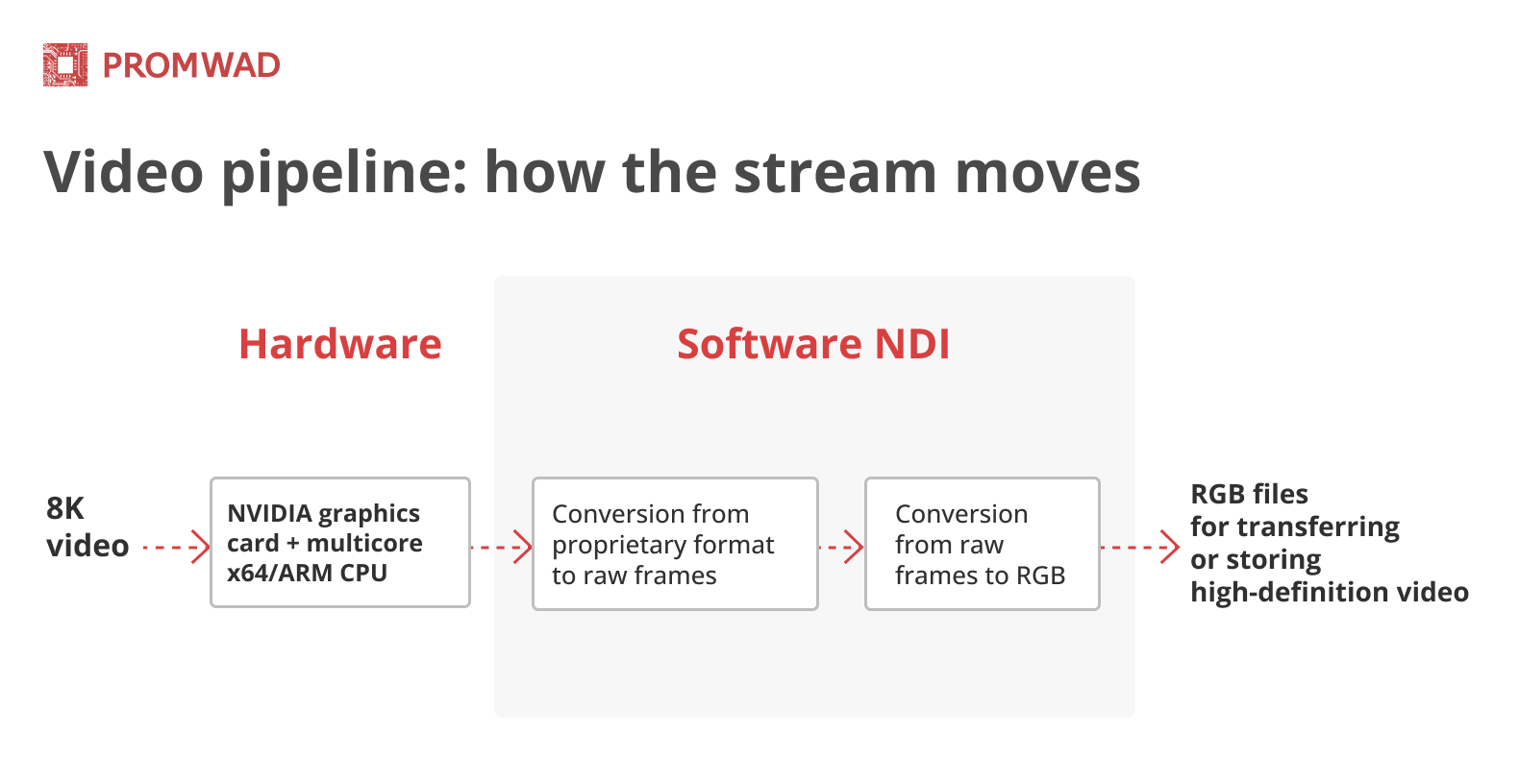
Video stream broadcasting from high-resolution cameras using the NDI protocol consists of the following steps:
- Input: a proprietary 8K camera stream is ingested by the system.
- Decode to RAW: GPU-accelerated decoding on an NVIDIA graphics card with a multicore x64 or ARM processor.
- Convert to RGB: with special software developed by Promwad, it converts RAW frames to RGB using camera vendor SDKs.
- Transmit via NDI: RGB frames are compressed using NDI’s internal codec and delivered over the network for live production workflows or recording.
Outcomes
The new NDI-powered software solution allowed Promwad's client to provide seamless integration with professional cameras to transmit or store high-definition video with low latency.
This new product meets the requirements of streaming and professional recording and ensures a competitive advantage in the video production market.
More of What We Do for NDI Support
- NDI Integration: explore our expertise in developing NDI solutions for our clients.
- Enterprise Data Storage System Development: Check out our project to develop a corporate NAS system with NDI streaming support for multi-camera environments.
- ST 2110 vs IPMX vs NDI: Learn more about our research into standards for professional audiovisual equipment.
FAQ
What do you actually deliver in an NDI integration project?
We integrate NDI into your product or system (software, hardware, embedded) and make it production-ready with discovery, routing, control hooks, telemetry, diagnostics, and serviceability for long-running, real-world operation.
NDI vs NDI|HX: How do you choose the right option?
We match the option to your constraints: choose NDI for minimum latency and maximum responsiveness; choose NDI|HX when bandwidth is constrained, or endpoints are distributed, then tune profiles to your latency, quality, and network realities.
How do you ensure reliability under real network load?
We design for field conditions using QoS/DSCP and VLAN guidance, traffic shaping, unicast/multicast decisions based on topology, and buffering and recovery logic to handle packet loss and jitter.
Can you integrate NDI into embedded devices with tight CPU/GPU/FPGA and thermal limits?
Yes — we integrate with awareness of CPU/GPU/FPGA budgets, NIC limitations, memory bandwidth, and thermal envelopes, optimising the pipeline for your target specs and platform constraints.
How do you migrate from SDI/HDMI to AV-over-IP with NDI without stopping production?
We run a step-by-step transformation: start with a pilot zone, build a rational hybrid architecture (NDI edges with an SDI core, or the reverse), and expand based on measured network and operational KPIs.