Promwad at NXP Tech Days Stuttgart 2026: Prompt-Driven Edge AI for Automotive Multi-Camera Systems
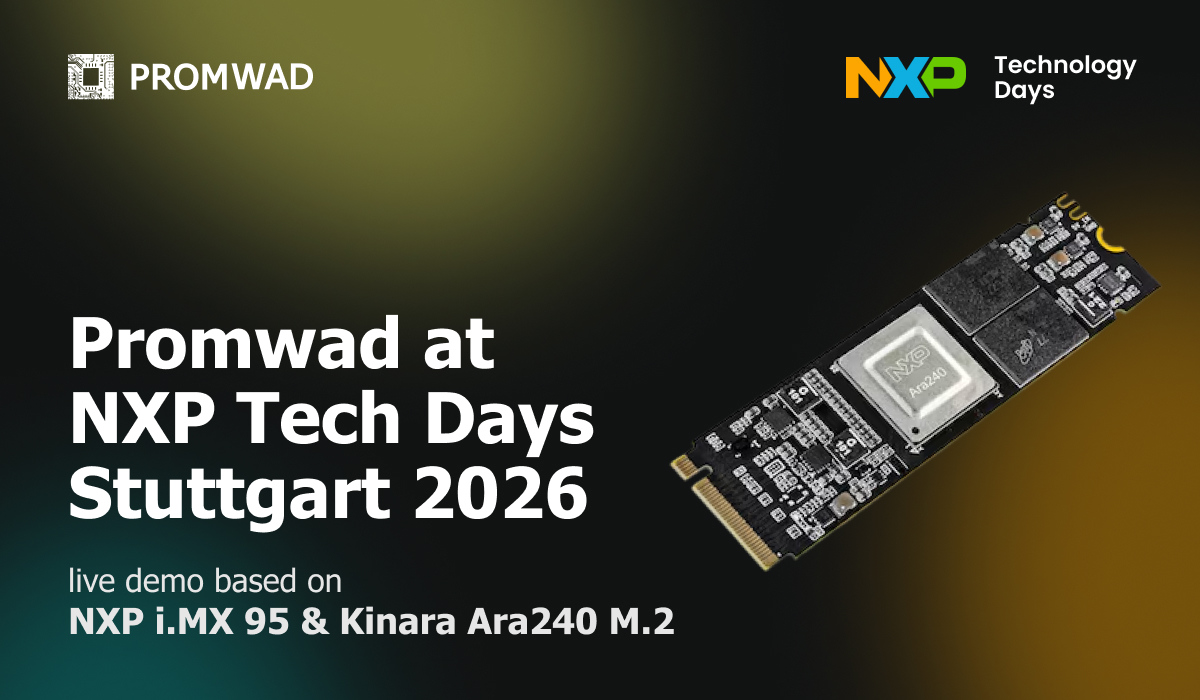
A live demo combining the NXP i.MX 95 applications processor with a Kinara Ara240 M.2 AI accelerator — for fully local, conversation-driven video analytics on an embedded platform.


On May 21, 2026, Promwad will join NXP Tech Days Stuttgart at Forum am Schlosspark in Ludwigsburg, Germany. Our engineers are bringing a new live demo built around two NXP development platforms — the i.MX 95 EVK and FRDM i.MX 8M Plus — interconnected over Ethernet and extended with a Kinara Ara240 M.2 AI accelerator. The setup shows how a discrete NPU can complement an on-chip NPU to enable prompt-driven, fully local video analytics for next-generation automotive and industrial systems.
NXP Tech Days is NXP Semiconductors' global training program for engineers, embedded developers, and technical leaders. Each one-day edition combines expert-led technical sessions, hands-on workshops, and interactive live demos covering automotive electrification, edge AI, secure connectivity, and industrial control.
The Stuttgart edition is one of the program's most engineering-dense stops in Europe, drawing OEM design teams, Tier-1 engineers, and NXP design partners from the DACH region and beyond. For Promwad, the event is an opportunity to engage directly with NXP technical specialists, the wider partner ecosystem, and product teams working on real-world edge AI deployments.
The Demo: Multi-Camera Vision Meets Conversational Edge AI
The starting point is our existing i.MX 95 multi-camera reference setup, previously shown at NXP Technology Days Istanbul. It runs four parallel video streams on a single split-screen display, with two of those streams handling on-device intelligence:
- Object detection on one camera, executed locally on the i.MX 95's built-in eIQ Neutron NPU.
- Gesture recognition on a second camera, mapped to system control actions — for example, toggling all live streams on or off with a predefined gesture.
- CAN-bus indication: recognized gestures are signaled in real time on an external LED panel, mirroring how an automotive ECU would consume and react to AI events.
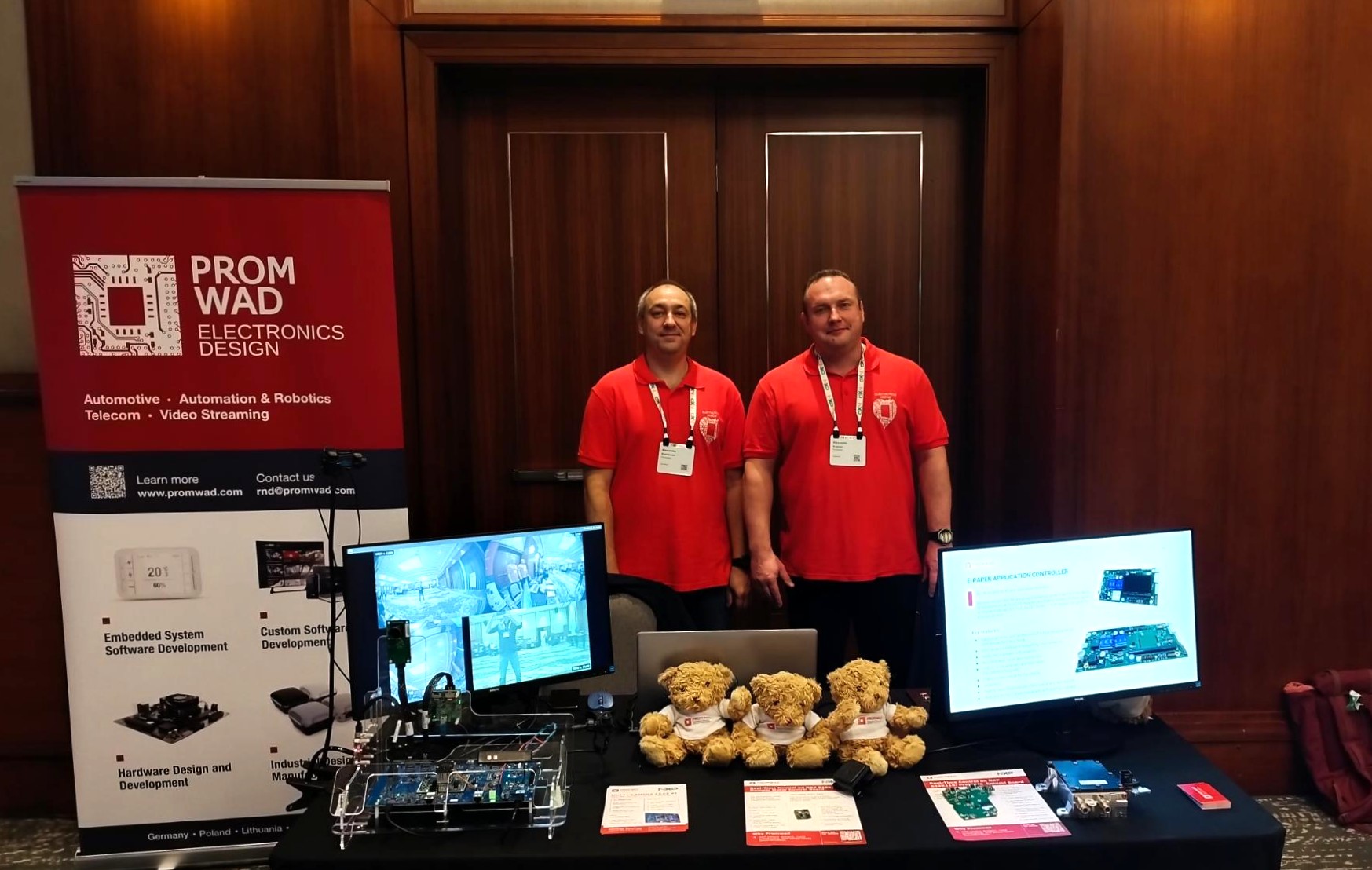
The Promwad team is showcasing multi-camera Edge AI on i.MX 95 in Istanbul. Oct 2025
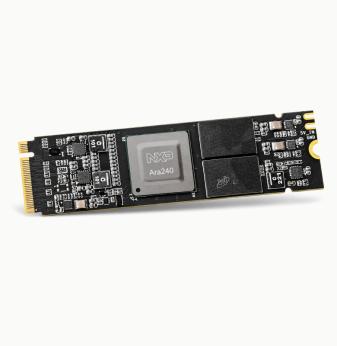
For Stuttgart, our team is extending this architecture with a second platform: an FRDM i.MX 8M Plus development board equipped with a Kinara Ara240 M.2 module. The two boards are connected over Ethernet. On the Ara-2 module, we run Qwen2.5-7B-Instruct-Ara240 to handle LLM tool calling: visitor requests are received in natural language, and the model routes them to the agent’s tools running on the i.MX 95.
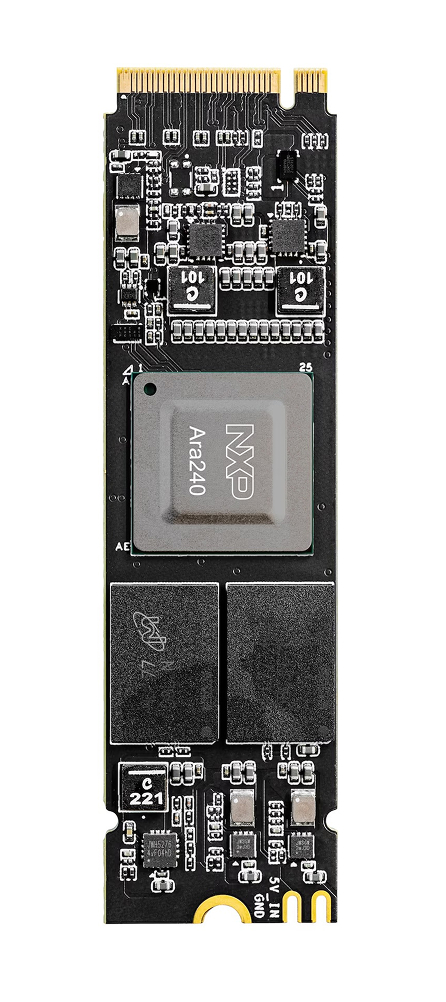
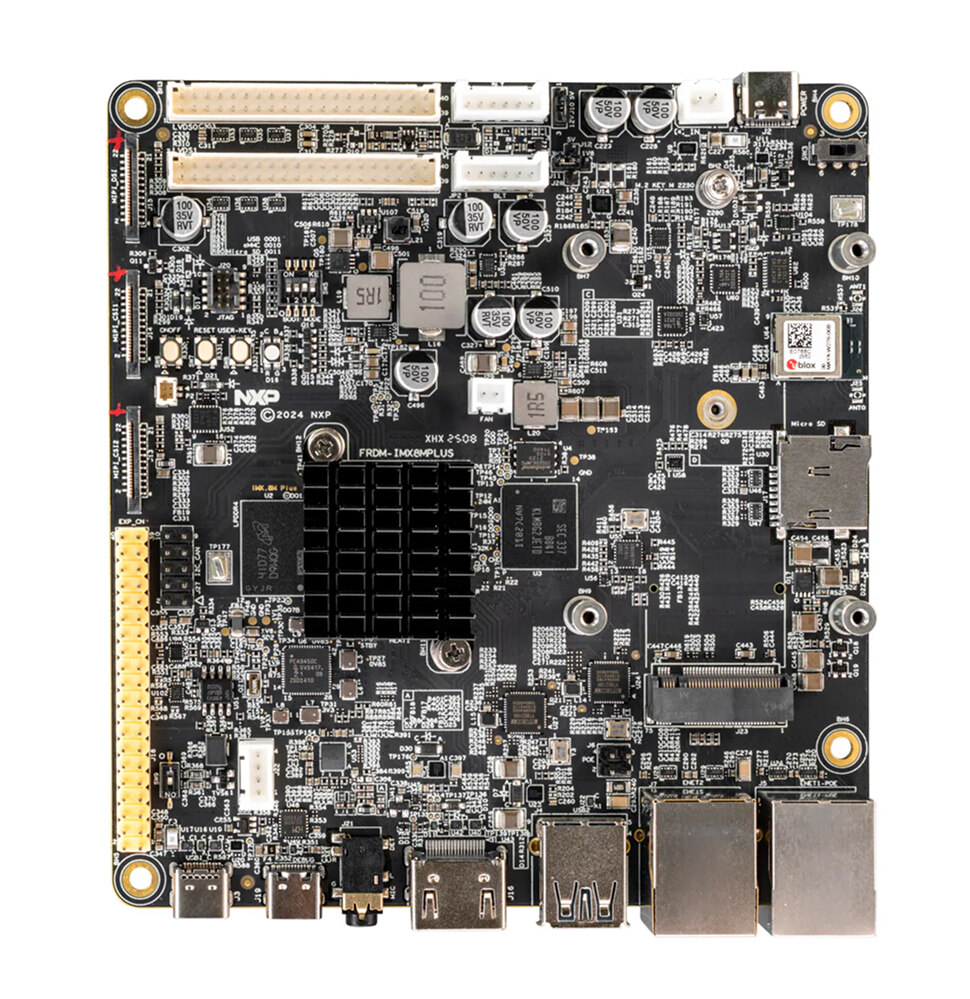
FRDM i.MX 8M Plus Development Board & Ara240 16GB M.2 Module. Source: nxp.com
On top of this hardware, our engineers are running a neural network on the Ara240 that interacts with the user through text prompts. The system understands natural-language commands such as:
- "Show only camera 2" — and the display reconfigures from a four-stream view to a single-stream view.
- "Find every person who walked past camera 4 in the last 30 minutes" — and the system returns the relevant frames from a local recording buffer.
- "Switch camera 3 to pose view" — and the agent flips the live overlay from a face bounding box to a 17‑point MoveNet pose, all running on the Neutron NPU.
- "When I show a palm, switch camera 3 to face view" — and the agent binds the gesture; the next time the visitor raises an open palm in front of camera 4, the system reconfigures itself automatically.
- "Zoom into camera 4 by 2× and light up the palm LED" — and the agent executes both actions in a single response: the wide‑angle gesture cam crops to a close‑up of the hand, and the CAN‑attached LED panel echoes the action.
Crucially, all inference runs locally on the device. There is no cloud component, no client-server roundtrip, and no external dependency. The system illustrates what a self-contained, edge-resident conversational layer for embedded products can actually look like in 2026.
The Ara240 M.2 Module: A Discrete NPU for Embedded Platforms
The Ara240 16GB M.2 module is an AI accelerator built around Kinara's Ara240 discrete NPU. Key specifications:
- Up to 40 eTOPS of AI performance with flexible precision.
- M.2 M-Key form factor (NGFF 2280), with support for up to four PCIe 4.0 lanes in x4 configuration.
- Designed for use as a companion processing unit alongside development boards with M.2 M-Key PCIe capability — including NXP's FRDM i.MX 95 and FRDM i.MX 8M Plus.
For embedded teams, the architectural advantage is straightforward: the host SoC keeps responsibility for real-time control, deterministic I/O, and safety domains, while the Ara240 takes on heavy ML inference — vision-language models, video analytics, large multimodal networks.
Engineers can scale AI workloads inside an existing product family without changing the base SoC, and they can pair the same accelerator with different NXP platforms depending on the target use case.
This modularity is exactly the kind of property that matters in real product programs, where AI requirements typically grow faster than hardware refresh cycles.
Edge AI as a Differentiation Layer in Automotive
The reason multi-camera, prompt-driven edge AI matters right now is that the automotive industry is already moving in this direction — and Tier-1s and OEMs are looking for embedded architectures that can support it.
European premium brands such as BMW, Volkswagen, and Jaguar have been experimenting with gesture control for years, mostly as a complement to infotainment systems, trunk opening, and a handful of in-cabin convenience functions.
Chinese electric-vehicle manufacturers — often described as "smartphones on wheels" — have taken the concept significantly further. Flagship Chinese EV crossovers combine LiDAR, cameras, and neural networks to support a much broader gesture set: remote parking maneuvers, in-cabin window and sunroof control, and rich multimedia interaction.
The strategic lesson for OEMs is not that gesture and prompt-based interfaces are about to replace physical buttons, touch screens, or voice assistants — they aren't. The point is that edge AI is becoming a differentiation layer: a new UX surface on top of the central display and the voice assistant, used to signal product sophistication and attract buyers in a crowded market.
What changes with the i.MX 95 + Ara240 combination is the engineering economics of building such a layer. The whole pipeline — multi-camera streaming, object detection, gesture recognition, prompt-driven video analytics, CAN-side integration — fits on two NXP development platforms with a single M.2 accelerator, runs entirely on-device, and stays within the latency and privacy envelope that automotive customers actually require.
Meet Promwad in Stuttgart
Promwad is a European R&D partner for product companies and OEMs, with 21+ years of engineering experience and a team of 100+ in-house engineers. We've delivered electronics design services and embedded systems development projects for automotive, industrial, broadcasting, and telecom customers, and we work as an NXP design partner.
You'll find our demo on the Avnet booth at NXP Tech Days Stuttgart on May 21, 2026. From Promwad's side, two team members will be on-site:
- Alex Worobjow, Commercial Director at Promwad GmbH.
- A lead software engineer from our embedded AI team, available for deep technical discussions on the demo architecture, the Ara240 integration, and how a similar setup could be adapted to your product roadmap.
Can't make it to Stuttgart? Book a call to explore how multi-SoC edge AI architectures — combining NXP application processors with discrete NPUs such as Kinara Ara240 — can fit into your next product release.
Our Case Studies