How Predictive Maintenance Reshapes Dispatch Economics for Service Providers

Service providers in HVAC, industrial maintenance, utilities, and technical facility management are under growing pressure to deliver uptime, not just service visits. For many customers, the buying logic has changed. They no longer want a provider that arrives quickly after a failure. They want a provider that prevents failures from happening in the first place.
That shift changes the economics of field service. A traditional service model built on calendar-based maintenance and reactive dispatching becomes much harder to sustain when contracts are tied to uptime, penalties, and measurable operational performance. What used to be accepted inefficiency now directly erodes margin.
This is especially visible in dispatch operations. Many service organizations still send technicians based on schedules, threshold alarms, and customer complaints rather than verified equipment condition. The result is that 25-33% of dispatches are unnecessary, while each truck roll may cost €450-1,200 depending on distance, labor, and logistics. In large service fleets, this becomes a structural financial problem rather than a minor operational inefficiency.
At the same time, service providers rarely operate homogeneous fleets. They maintain equipment from multiple manufacturers across different sites, protocols, and asset generations. One OEM may expose telemetry through OPC UA, another through its own cloud, another through Modbus, and older equipment may provide almost no usable diagnostic data. Without a unified data layer, predictive maintenance does not scale.
This is why predictive maintenance matters for service providers. It is not simply an AI add-on. It is a way to change dispatch logic, improve first-time fix rates, reduce unnecessary truck rolls, and protect uptime contracts using a single health view across mixed-OEM fleets. The core question is no longer whether analytics can be applied to service data. The real question is whether service operations have the telemetry architecture and decision model required to intervene before failures, not after them.
Cut Unnecessary Truck Rolls
Before They Cut Your Margins
25-33% of dispatches are unnecessary, and each truck roll costs around €1,200. UnifAI by Promwad connects mixed-OEM equipment, detects failures early, and helps service providers reduce wasted dispatches, protect SLA performance, and build a measurable business case in as little as 90 days.
Built for service providers and O&M teams.
Why truck rolls have become too expensive for the old field service model
In the traditional service model, scheduled maintenance and reactive callouts were the default operating logic. Equipment was inspected according to maintenance calendars, and technicians were dispatched when a failure had already become visible. This model assumed that the cost of sending a technician was manageable and that some inefficiency was simply part of the business.
That assumption is much weaker today. Truck rolls are more expensive because labor costs have increased, technician capacity is tighter, territories are broader, and many service organizations must support more complex installed bases than before. A single dispatch is no longer just a line item for travel and labor. It also consumes scheduling capacity, spare parts planning, and opportunity cost across the wider service organization.
The true problem is that dispatch decisions are still often made with incomplete information. A system may generate an alarm, but the maintenance organization may not know whether the asset is genuinely degrading, whether the issue is intermittent, whether a remote reset would solve it, or whether a site visit is actually required. In many cases, the technician is sent simply because the organization lacks enough condition data to decide otherwise.
This is why truck roll waste has become such an important metric. If one in three dispatches is unnecessary, then dispatch cost is no longer a secondary efficiency issue. It becomes a major drag on operating margin. In a large fleet, this can easily amount to millions in avoidable annual cost. A service operation may look busy and responsive on paper while still losing money through blind dispatching.
Where service providers actually lose money in reactive service operations
The financial losses in field service are not limited to the visible cost of technician travel. They come from a chain of inefficiencies created by reactive decision-making.
Unnecessary dispatches
An unnecessary dispatch happens when a technician is sent to site without a fault that truly requires on-site intervention. This may happen because a threshold alarm was triggered without broader context, because maintenance schedules force preventive visits regardless of actual condition, or because the service team has no reliable view of the asset’s health.
In practice, these visits are common. A technician may drive to a site only to confirm that the equipment is still functioning, that the issue was temporary, or that the problem could have been handled remotely. When this happens repeatedly across a fleet, the cost becomes structural.
First-time fix failures
Even when a dispatch is justified, the visit may still fail economically if the technician cannot resolve the problem on the first attempt. This usually happens when the technician arrives without enough diagnostic information, the correct spare part, or the right skill profile for the specific failure mode.
A first visit that only identifies the issue creates a second truck roll, more travel, more time, and more disruption for the customer. This drives service cost upward and weakens customer confidence in the provider’s ability to manage uptime.
SLA penalties
Reactive service also becomes dangerous when contracts are tied to outcomes. Under uptime-based agreements, a provider may commit to availability levels such as 99% uptime. If the provider only reacts after a failure is visible, the risk of breaching contract thresholds increases sharply.
Penalty structures can be severe. Even a few breaches can eliminate the premium margin won in the tender. In some cases, repeated failures can cause a provider to lose the contract entirely. What matters here is not just technical response time. It is the ability to identify degradation early enough to act before downtime turns into a financial event.
Why outcome contracts make reactive maintenance a dangerous model
The shift from service hours to uptime commitments is one of the biggest changes in field service economics. Under a labor-based model, inefficiency is damaging but often survivable. Under an outcome-based model, inefficiency is directly exposed.
If a service provider sells uptime, then each undetected failure mechanism becomes a contract risk. A chiller, pump, compressor, or industrial subsystem may begin degrading weeks before failure. If the provider has no condition view and learns about the failure only from an alarm or customer complaint, then the contract is already under pressure.
This is why reactive service is increasingly incompatible with high-value uptime contracts. The provider is always one failure away from penalties, escalation, or churn. The commercial promise is proactive, but the operating model remains reactive. That mismatch is hard to sustain.
Predictive maintenance changes this by moving the provider from post-failure response to pre-failure intervention. If a service organization can detect early abnormal behavior and estimate breach risk before a service level incident occurs, it can intervene when the economics are still favorable. This is what turns predictive maintenance into a contract protection mechanism, not only a maintenance optimization tool.
Why fragmented OEM ecosystems block predictive maintenance
Many service providers understand the value of predictive maintenance in principle but struggle to implement it in practice because their installed base is fragmented. This is usually the hardest structural barrier.
A typical service fleet may include 150–300 data sources across sites, manufacturers, and legacy systems. One manufacturer may expose telemetry through OPC UA, another through MQTT, another through BACnet or Modbus, while some OEMs lock useful data inside proprietary cloud APIs. Older controllers may not integrate cleanly with anything.
This fragmentation creates separate silos of operational data. Each silo may be useful on its own, but predictive maintenance does not work well in isolated islands. To build reliable anomaly detection, health scoring, remaining useful life estimation, or fleet prioritization, the provider needs comparable asset data across the whole installed base.
Without a unified OEM data layer, predictive maintenance becomes manual and fragmented. Engineers must interpret different vendor dashboards, reconcile inconsistent naming, map different operating states, and retain much of the diagnostic logic in human memory rather than in the system. That is not scalable. It is also risky, especially when critical integration knowledge depends on a few experienced employees.
What changes when there is one health view across sites, manufacturers, and protocols
Predictive maintenance becomes operationally meaningful when heterogeneous equipment data is normalized into a single asset view. That is the role of a unified OEM data fabric.
In practical terms, this means collecting telemetry from mixed sources and mapping it into a common canonical asset model. Protocols such as OPC UA, MQTT, Modbus, BACnet, Profibus, OEM cloud APIs, and CMMS/EAM APIs can be normalized so that assets from Siemens, ABB, Schneider, Grundfos, Daikin, Bosch, and legacy controllers are represented in one health framework rather than separate vendor silos.
A common model such as ISO 13374 matters here because predictive maintenance depends on more than raw data collection. The system needs semantic consistency: timestamps aligned, measurement types normalized, context retained, and asset states interpreted in a comparable way. Once this exists, service operations can move from fragmented machine data to a single health picture across every site and manufacturer.
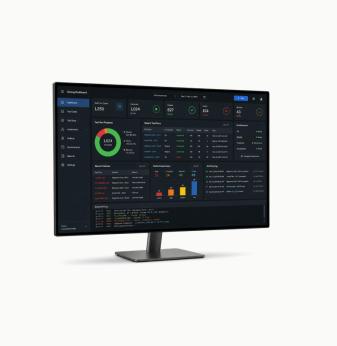
That single health view changes decision-making. Dispatchers no longer have to guess based on disconnected alarms. Service managers can compare asset condition across customers and locations. Leadership can see which parts of the fleet are creating the most dispatch waste and which contracts carry the highest breach risk. The platform stops being a set of dashboards and becomes an intelligence layer over the installed base.
How predictive dispatching reduces wasted truck rolls and improves first-time fix rates
Blind dispatching happens when service teams know that something might be wrong but do not know enough to decide whether a visit is necessary or what that visit should involve. Predictive dispatching replaces that logic with ranked, condition-based prioritization.
In a predictive dispatch model, telemetry is continuously analyzed for anomalies, degradation patterns, and probable failure modes. Instead of producing only generic alarms, the system generates a prioritized work queue. This queue reflects which assets actually need intervention, how urgent the problem is, and what type of service response is most likely required.
That change has direct operational effects. The organization dispatches only when equipment actually needs it. The technician can arrive already knowing the probable diagnosis, the likely spare parts required, and the skill profile needed for the task. This is what makes predictive maintenance relevant to dispatch economics rather than only to engineering analytics.
On the UnifAI page, this logic is reflected in DispatchIQ, which is positioned as a predictive dispatch optimizer. The operational outcomes attached to this model are concrete: 20–35% reduction in truck rolls, 85%+ first-time fix rate, and €1.2–4M annual savings with a 6–12 month payback period. These figures matter because they connect telemetry intelligence directly to field service economics.

How predictive compliance helps sell and protect uptime contracts
The second operational shift happens at the contract level. If predictive dispatch improves service efficiency, predictive compliance improves service confidence.
When all uptime-governed assets are continuously monitored, the provider can estimate breach risk in real time rather than discovering problems only after a service level failure occurs. That means intervention can happen 2–4 weeks before penalties materialize, which is a fundamentally different service posture from reactive alarm response.
This is the logic behind SLA Shield on the UnifAI page. Instead of passively absorbing penalties, the service organization gains a predictive view of contract risk. The commercial implications are significant. A provider that can monitor breach probability across its contract portfolio can bid more confidently on outcome-based work, protect margins, and defend renewals with evidence rather than promises.
The metrics attached to this model are also important: 97%+ SLA compliance, 50–80% penalty reduction, and a possible 15–30% contract premium. Whether actual results vary by fleet and contract type, the core point remains the same: predictive maintenance is not only about reducing failures. It is about making uptime contracts commercially safer to sell and operationally safer to deliver.
Why a 90-day proof of value matters more than an AI transformation roadmap
Many industrial organizations have become skeptical of broad digital transformation language. For a CFO or service director, the issue is not whether predictive maintenance sounds strategic. The issue is whether it produces measurable operational improvement within a reasonable time frame.
That is why a 90-day proof of value is such an important entry strategy, especially in mixed-OEM service environments. It avoids a large, abstract transformation project and instead focuses on a small but measurable business case.
On the UnifAI page, the pilot model is explicit. It starts with a 30-minute scoping call, followed by an asset readiness audit across the top 20 critical assets at 2–3 sites, then a 90-day proof of value with edge gateways and sensors deployed on 50–100 assets. During that period, predictive dispatch logic runs for 8–10 weeks and produces a documented outcome: predicted failures, truck rolls avoided, and measured improvement in first-time fix rate.
This matters because it frames predictive maintenance as an operational test, not a conceptual program. A provider does not need to commit to fleet-wide transformation before seeing evidence. The pilot shows whether the data quality is sufficient, whether the fleet has meaningful anomaly patterns, and whether dispatch economics improve in measurable ways. That is a much stronger decision basis than a multi-year roadmap with no near-term proof.
Where this model connects to Promwad engineering expertise
Promwad’s engineering capabilities are relevant here because predictive maintenance platforms depend on more than analytics. They require an embedded and industrial systems foundation.
The technical building blocks include industrial edge gateways, wireless sensing, protocol integration, telemetry normalization, on-device processing, secure OTA, and connection into enterprise maintenance systems such as CMMS or EAM platforms. Predictive maintenance in the field only works when these layers operate coherently across diverse industrial environments.
The UnifAI material describes a six-layer structure covering edge, ingest, normalize, analyze, visualize, and notify. This maps closely to the real architecture required for service providers: gateways at the edge, adapters for multi-protocol ingest, canonical asset modeling, anomaly detection and RUL logic, white-label dashboards, and automated work-order generation into the service workflow.
That engineering perspective is important because field service organizations do not need another analytics concept in isolation. They need an operational intelligence layer that fits mixed-OEM fleets, works with existing systems, and supports dispatch and contract decisions in day-to-day service operations.
Why predictive maintenance changes the economics of field service
The core problem in field service is not that technicians are underperforming. It is that the operating model often decides too late and with too little information. Calendar-based maintenance and reactive dispatching create unnecessary visits, reduce first-time fix rates, and expose providers to SLA penalties.
These problems become more severe as installed bases grow more heterogeneous and contracts become more outcome-driven. Without a unified data layer across manufacturers, protocols, and sites, predictive maintenance remains fragmented. Without predictive dispatch logic, service teams continue sending technicians into uncertainty. Without predictive compliance, uptime contracts remain commercially risky.
This is why predictive maintenance changes the economics of field service. It replaces blind dispatching with condition-based prioritization. It turns mixed-OEM telemetry into one health view across the installed base. It helps providers intervene before failures create penalties or churn. And it gives decision-makers a measurable path to proof through a 90-day pilot rather than a vague transformation narrative.
For service providers, the question is no longer whether predictive maintenance is interesting. The question is whether they can continue protecting margin, technician capacity, and uptime contracts without it.
AI Overview
Predictive maintenance for service providers is an operating model that uses unified mixed-OEM telemetry, anomaly detection, and condition-based prioritization to reduce wasted truck rolls and protect uptime contracts. Key Applications: predictive dispatch optimization, mixed-OEM fleet monitoring, SLA risk monitoring, CMMS-integrated service prioritization. Benefits: fewer unnecessary dispatches, higher first-time fix rates, stronger SLA compliance, clearer business cases for rollout. Challenges: fragmented OEM data, protocol diversity, telemetry normalization, proving measurable value before scale. Outlook: as service providers shift from labor-based maintenance to uptime-based contracts, predictive maintenance will increasingly become a commercial and operational requirement rather than an optional innovation layer. Related Terms: field service predictive maintenance, condition-based dispatching, unified OEM data layer, industrial asset health monitoring, uptime contract analytics.
Our Case Studies