
Eight Charger Configurations Built on One Architecture
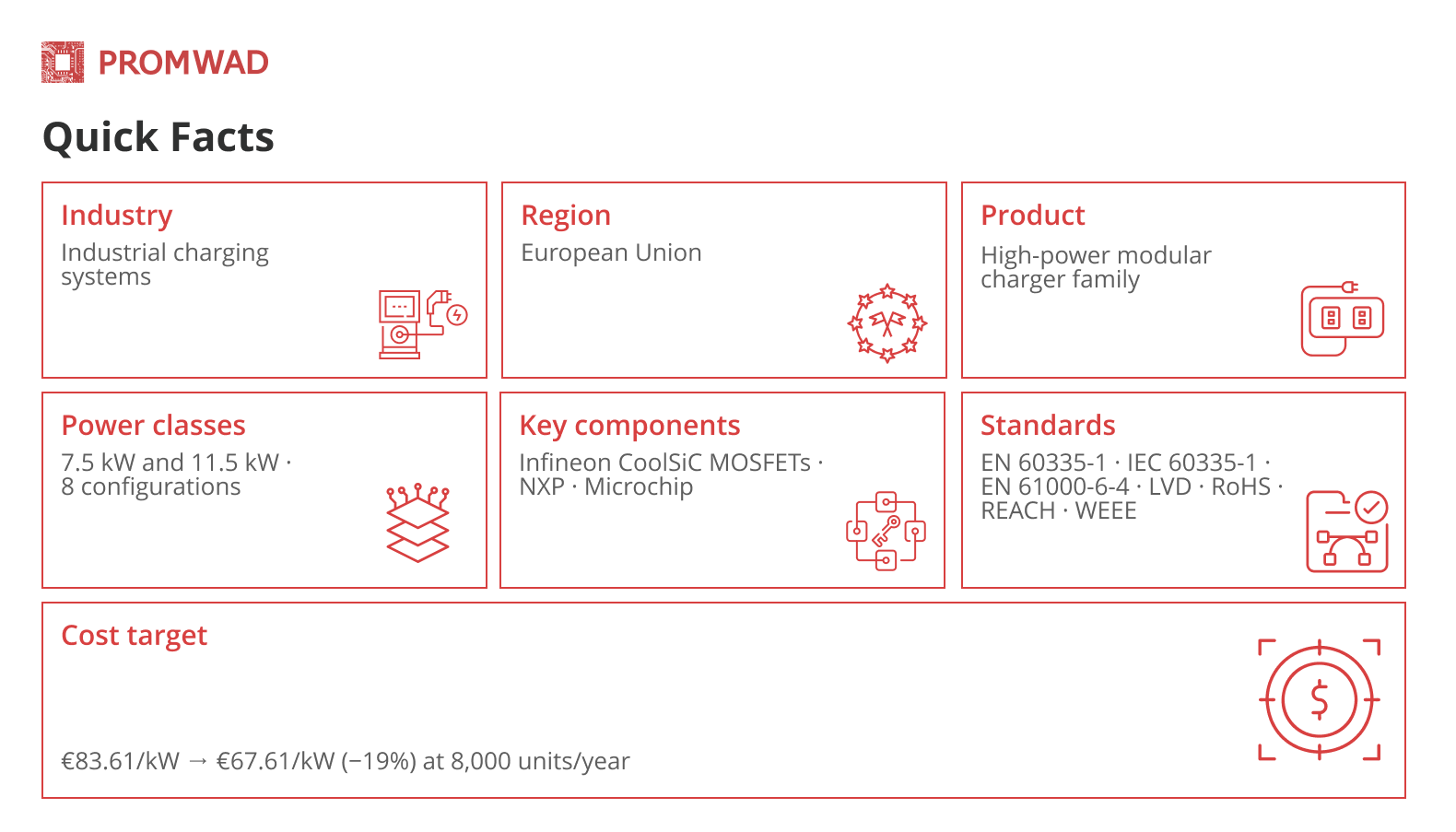
Project in a Nutshell: A European manufacturer of industrial charging systems needed a new generation of high-power charger modules in two power classes: 7.5 kW and 11.5 kW. Each covers its own range of regulated output voltages and currents (24–80 V / 80–150 A and 72–96 V / 80–120 A respectively), with eight configurations across the family. Both classes share one standardized enclosure and one EU certification path for the entire lineup.
Promwad took on hardware architecture, firmware, mechanical design, and pre-compliance validation. The platform targets a cost reduction from €83.61 to €67.61 per kW at a production volume of 8,000 units per year.
Client & Challenge
Our client is a European OEM supplying industrial charging cubicles to logistics, manufacturing, and critical infrastructure operators. As their customers moved into higher-power applications, the existing charger modules fell short, and the product lineup needed a major update to stay in contention.
The engineering scope was demanding. Eight hardware configurations had to share a standardized module form factor (87.55 × 396 × 419.6 mm with quick-access inspection hatches), communicate over CAN with an existing control board, and go through one EU certification process covering every variant in the family. The unified form factor was a hard constraint: all modules had to be interchangeable within the client's existing charging cubicles.
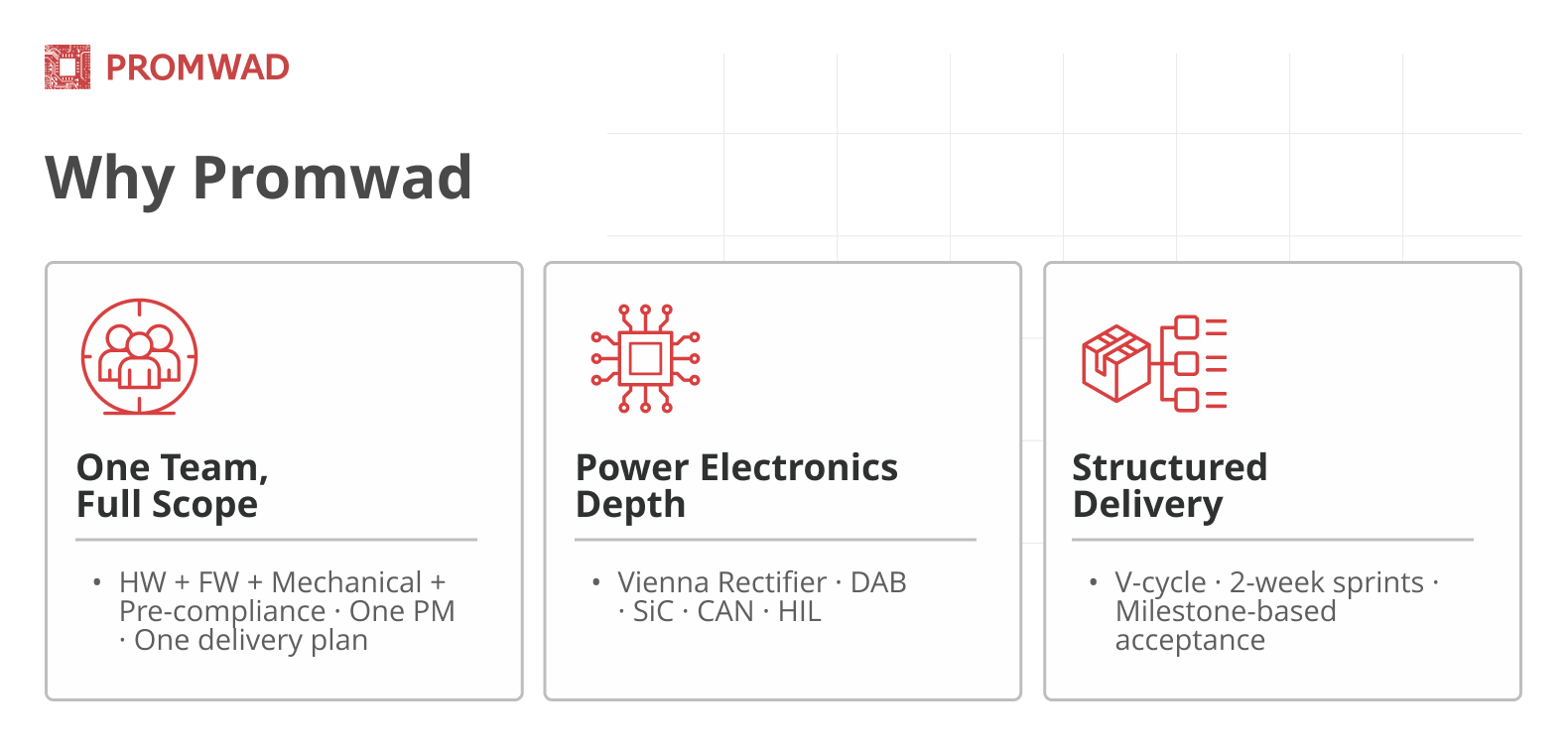
In power electronics, splitting a program across multiple vendors risks catching critical issues only when it's expensive to fix them. The client needed one team that owned the full scope.
Solution
Rather than developing each variant as a separate product, Promwad designed one platform architecture that all eight configurations are built on. The same enclosure, the same documentation, and the same certification path serve the entire family.
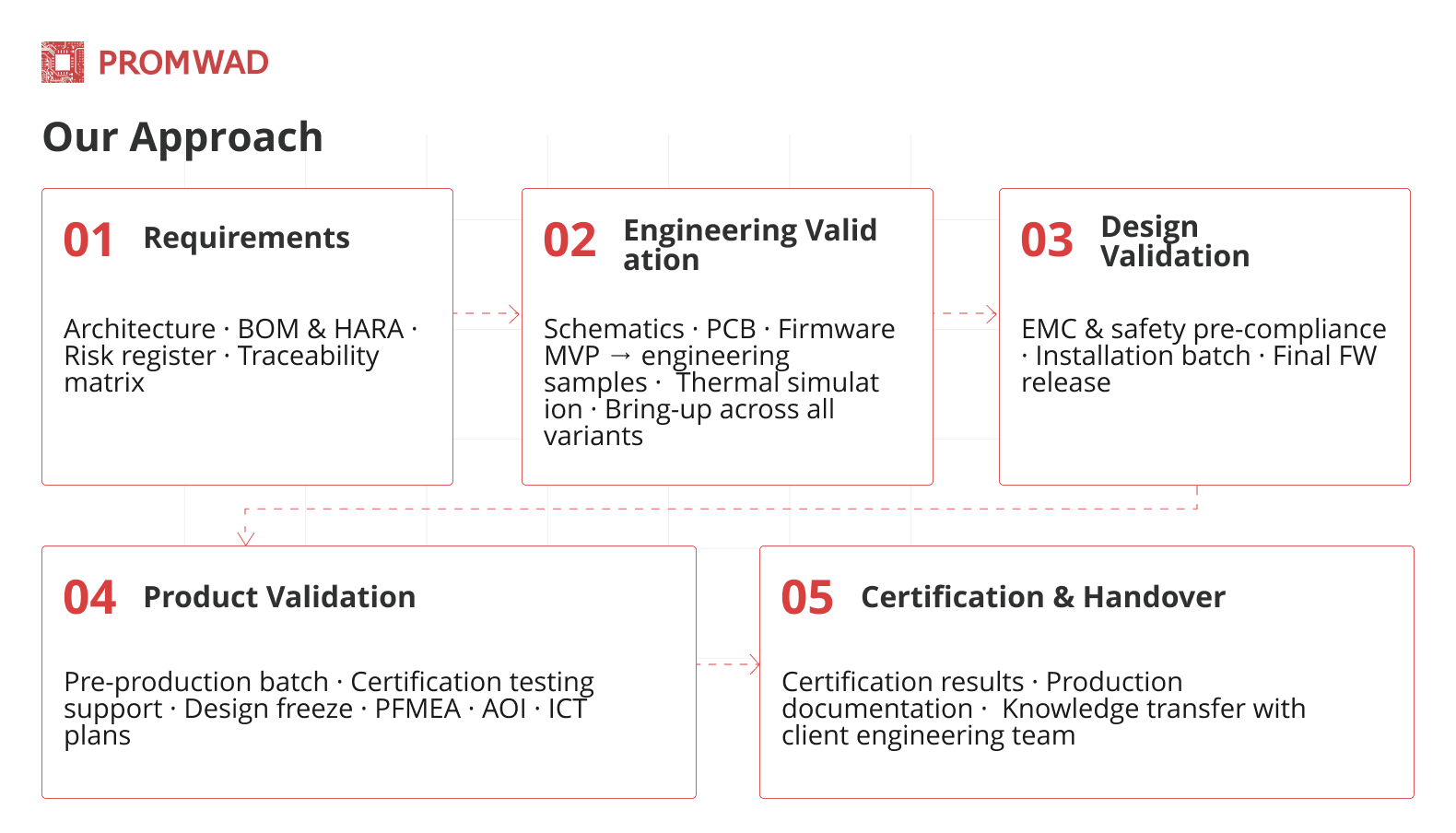
The power chain uses a Diode Rectifier on the AC-DC stage paired with a Phase-Shifted Full Bridge (PSFB) converter for isolated DC-DC conversion, implemented with SiC MOSFETs. Among the topologies evaluated, including Vienna PFC + PSFB and Vienna PFC + DAB, the Diode Rectifier + PSFB combination offered the most practical balance for series production: Vienna PFC would have improved power factor and reduced grid harmonics, but added control complexity and 60–100 € per unit in component cost at the target volume of 8,000 units per year. Each module delivers regulated DC output with under 5% voltage variation; protection against overcurrent, overvoltage, and electromagnetic interference.
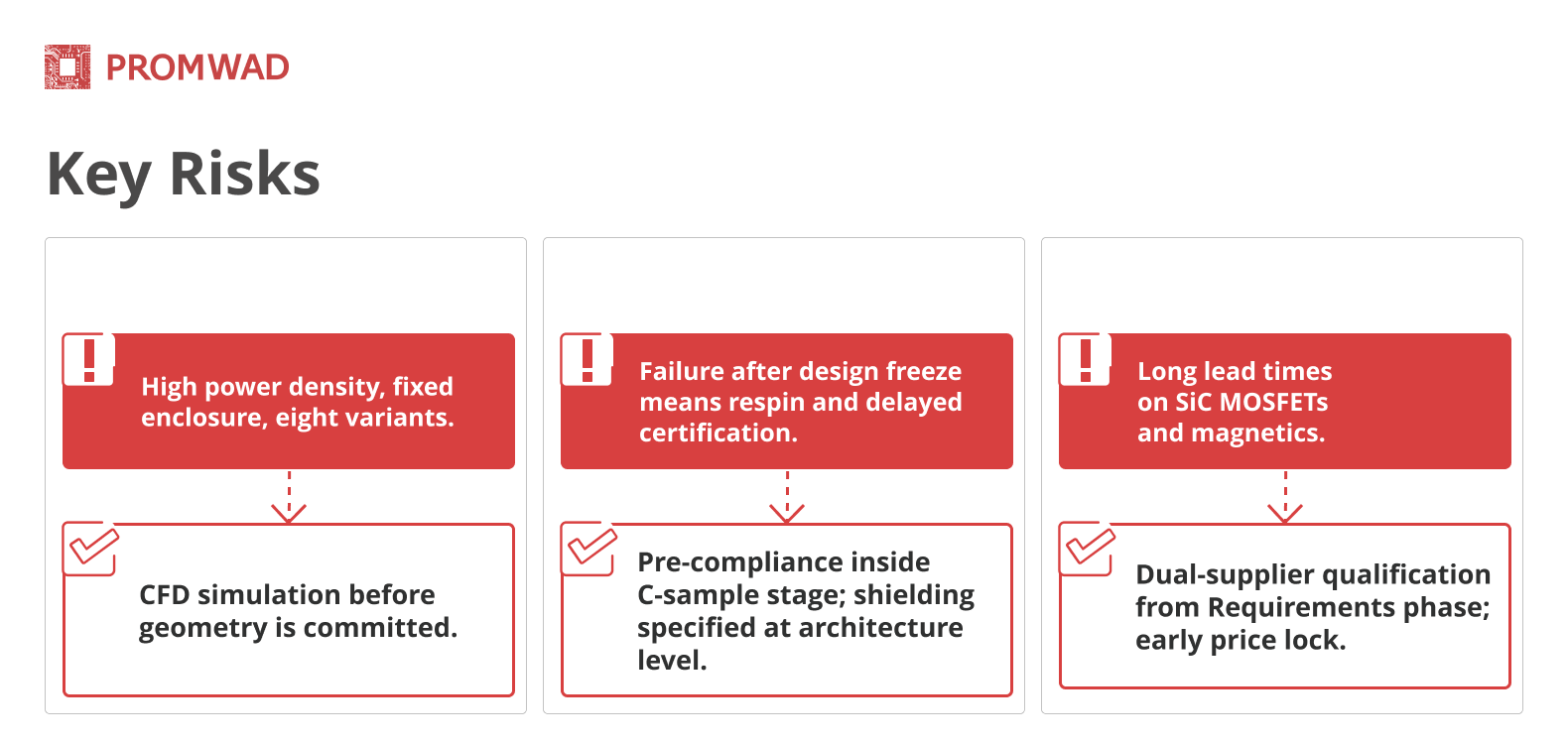
For sites without a neutral conductor, remote locations running on generators, for example, a TNPC topology is available as an alternative path, so those installations can be accommodated without re-architecting the platform. All modules communicate with the existing control board over CAN, and a secure bootloader handles firmware updates at the unit level.
Business Value
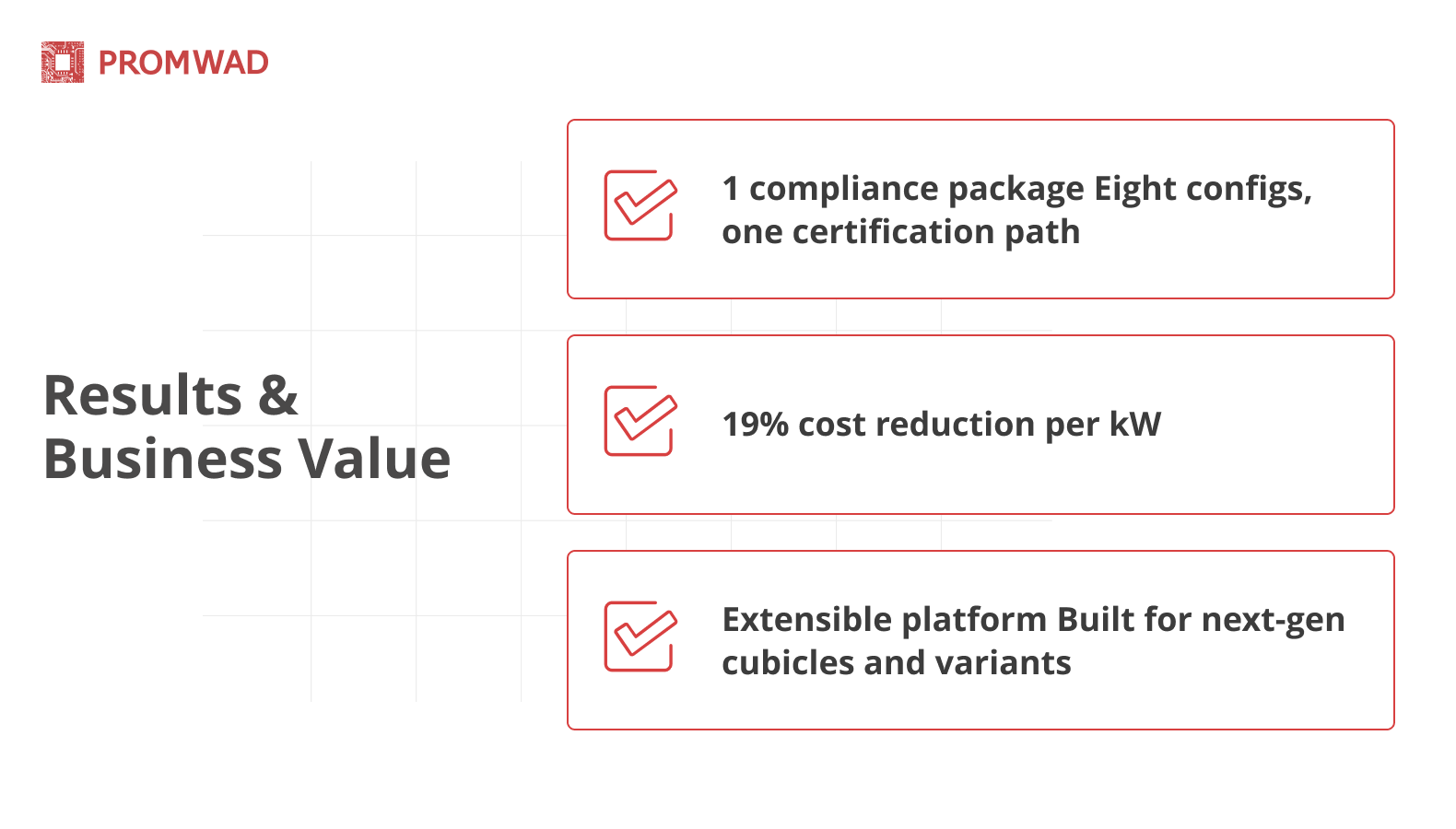
One certification, eight configurations. A shared architecture and shared documentation mean the client manages one compliance package covering EN 60335-1, IEC 60335-1, EN 61000-6-4, LVD, RoHS, REACH, and WEEE across all variants. Adding a new configuration to the family doesn't restart that work.
Cost target embedded in design decisions. The platform is built to reach €67.61/kW at 8,000 units/year, which is 19% below the current €83.61/kW baseline. That number drove topology selection, component sourcing strategy, and every thermal trade-off in the programme.
A foundation, not a one-off. The architecture is sized for next-generation cubicles and product extensions. Knowledge transfer sessions with the client's engineering team are included in the handover package.
More of What We Do for Power Electronics
- Power Electronics Design: our full range of design services for low-, medium-, and high-voltage applications.
- Isolated HV Power for AMB Control: check out this case study of a development High-voltage isolated DC/DC converter.
- Power Electronics for Fuel Cell Systems: how power electronics keeps fuel cell systems stable and ready for real-world deployment.
FAQ
What types of power electronics solutions does Promwad develop?
Promwad develops a wide range of power electronics solutions for low-, medium-, and high-voltage applications. This includes motor controls, DC/DC, AC/DC, AC/AC, and DC/AC converters, charging units, power supply units, power factor correction systems, ESS, UPS, BMS, HVDC-related solutions, traction inverter modules, and power distribution systems.
Can Promwad support a project from concept to production?
Yes. Promwad positions its power electronics services as end-to-end engineering support, helping clients at every stage of development — from initial concept and architecture to design, validation, testing, and production preparation.
Do you develop firmware and control algorithms for power converters?
Yes. Promwad’s engineers develop custom DSP-based firmware for power electronics converters and optimise control parameters such as dead time and PWM to achieve accurate regulation and stable performance.
Can you use FPGA in power electronics projects?
Yes. Promwad designs FPGA-based control and signal-processing solutions for power electronics, including PWM algorithms, feedback control loops, precise regulation, and hardware-level fault detection for real-time protection and response.
Can Promwad support EMC and reliability testing?
Yes. Promwad performs thermal, mechanical, and EMC testing, including thermal cycling, vibration testing, and EMC validation. The company also states compliance-oriented testing against standards such as IEC 61800-3 and the EN 61000 series to improve reliability in demanding environments.