What Changes When Perception, Routing, and Fleet Management Move to the Edge in Warehouse AMRs
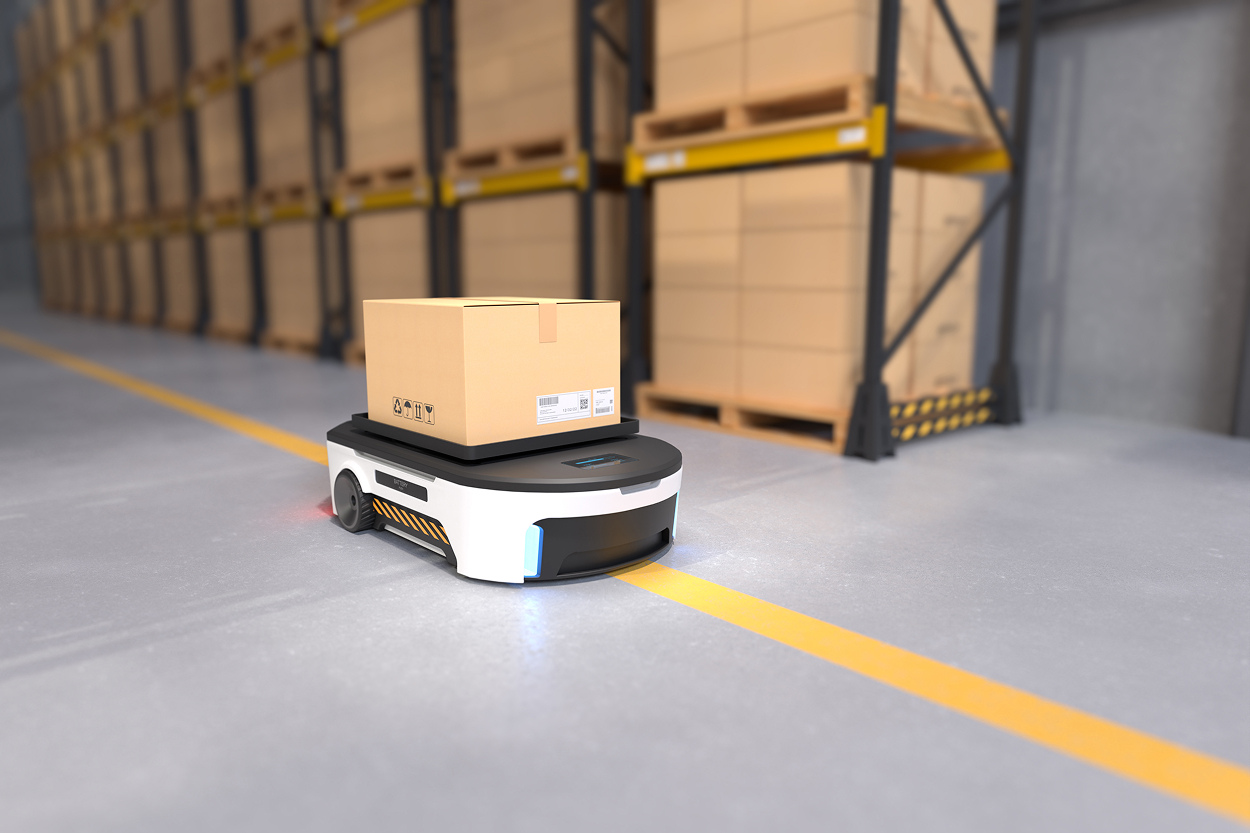
Warehouse AMRs are entering a different phase in 2026. A few years ago, most conversations around autonomous mobile robots in warehouses focused on deployment basics: mapping, obstacle avoidance, simple task assignment, and pilot-friendly ROI. Today the discussion is more demanding. The question is no longer whether AMRs can move goods from point A to point B. The question is what happens when robot perception, routing decisions, and part of fleet intelligence shift from a mostly centralized software model to edge-heavy execution on the robots and local infrastructure.
That shift matters because warehouse automation is no longer defined by isolated robot success. It is defined by whether dozens or hundreds of robots can operate in a mixed, changing, commercially messy environment without turning every edge case into human intervention. Market data reflects that maturity. One 2026 estimate places the warehouse robotics market at about USD 10.96 billion in 2026, with a forecast to reach USD 24.55 billion by 2031. That growth is not being driven by basic movement alone. It is being driven by a broader expectation that robots will handle more variability, adapt faster, and integrate more deeply with warehouse execution systems, inventory logic, and operational priorities.
This is where the edge changes the architecture. Perception at the edge means robots interpret their environment locally and in real time rather than depending too heavily on distant compute or delayed coordination. Routing at the edge means robots can make more context-sensitive navigation decisions based on local traffic, aisle blockage, and mission state. Fleet management at the edge means orchestration is no longer one central brain telling passive robots what to do every second. Instead, the warehouse begins to behave more like a distributed robotic system with shared policy, local autonomy, and layered control.
That is a major engineering shift. It changes latency, reliability, failure modes, software architecture, validation strategy, and even the business case for deployment. It also changes what warehouse operators should expect from AMRs. In 2026, the strongest AMR programs are not simply buying robots. They are building edge-aware logistics systems.
Why warehouse AMRs are changing now
The first reason is operational complexity. Warehouses are dealing with SKU proliferation, tighter delivery expectations, labor constraints, and greater throughput variability. Yaskawa’s warehouse automation positioning reflects exactly this pressure: more mixed inventory, less tolerance for delays, tighter space usage, and higher demand for flexible sorting, picking, packing, and palletizing. In that environment, centralized logic alone starts to struggle because local conditions change faster than a remote scheduler can always manage efficiently.
The second reason is perception workload. A warehouse robot today is often expected to handle not just navigation but also human coexistence, pallet detection, obstacle classification, dynamic zoning, and more variable floor conditions. NVIDIA’s robotics stack positioning makes the same point from the technology side: robots increasingly need edge AI so they can see, perceive, and make decisions in real time. Once that happens, perception cannot remain a lightweight add-on. It becomes one of the core reasons the compute stack moves closer to the robot.
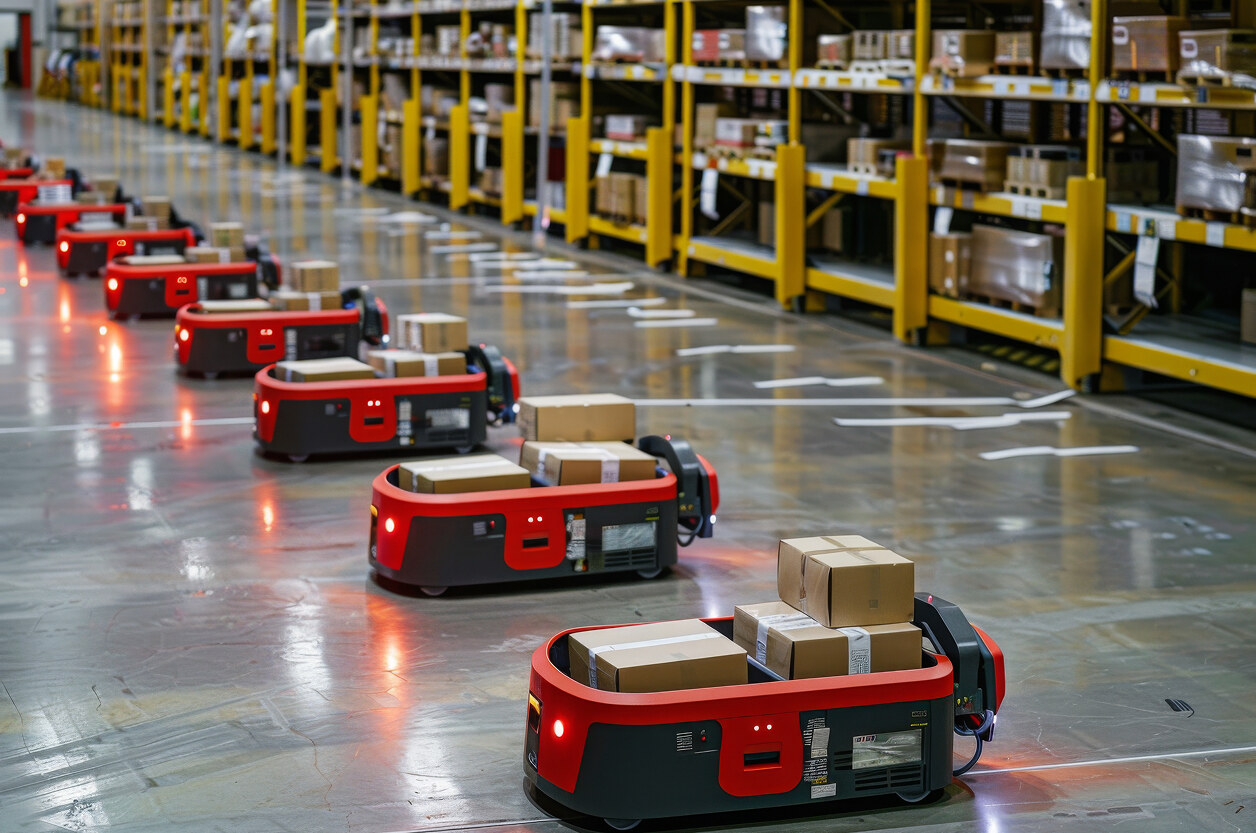
The third reason is scaling. Small AMR fleets can be coordinated with relatively simple central traffic logic. Large fleets cannot. MiR’s fleet-management software materials make this clear by focusing on centralized monitoring, traffic flow, mission scheduling, and ERP, WMS, and MES integration. As fleets grow, the real problem is not just assigning missions. It is preventing congestion, preserving throughput, and balancing robot decisions against warehouse priorities in real time. That becomes much easier when some logic is distributed.
The fourth reason is system integration. Daifuku’s 2026 intralogistics view is especially relevant here because it frames the year not as an era of blind automation acceleration, but as an era of balanced automation, modular growth, and coexistence between mobile robots and fixed automation such as AS/RS. That means the warehouse is no longer one robot type solving one transport task. It is a mixed environment with competing priorities, multiple systems, and more software coordination pressure. Edge-heavy AMRs fit that world better than robots that depend on a rigid central logic model.
Edge perception changes what the robot can do in the aisle
The most immediate effect of moving perception to the edge is lower decision latency. That sounds technical, but operationally it means the robot can react faster to pallet jacks, forklifts, workers, temporary obstacles, and unexpected traffic patterns. In warehouse environments, that matters a lot because the floor is only partially structured. It may be repetitive, but it is not static.
Edge perception also changes robustness. A robot that depends too heavily on cloud inference or remote perception services becomes more vulnerable to network interruption, congestion, and software bottlenecks. A robot that can process camera, LiDAR, depth, or stereo data locally is better positioned to keep operating safely under imperfect connectivity. This is one reason Jetson-class platforms have become so important in robotics. They make it practical to deploy richer perception models directly on the robot or on local edge hardware.
There is another consequence too: perception becomes more context-specific. A robot operating on a warehouse floor does not only need to recognize generic obstacles. It needs to recognize warehouse obstacles. Pallets, pallet jacks, wrapping film, protruding loads, dock traffic, blind intersections, rack shadows, and moving people in safety vests all behave differently. NVIDIA’s developer content around training robots to detect warehouse pallet jacks with synthetic data shows how specific the perception problem has become. The implication is clear: warehouse AMRs are no longer running only generic navigation stacks. They are increasingly running warehouse-aware perception pipelines.
That changes product expectations. Operators begin to expect AMRs to behave more intelligently around local realities, not just around clean map geometry. If perception stays weak, scaling stays limited.
Routing stops being shortest-path logic
The second big change is routing. In older AMR deployments, routing often meant a relatively straightforward path-planning problem: compute the safe path, avoid obstacles, complete the mission. That still matters, but once warehouses become denser and fleets become larger, routing starts to look more like continuous traffic management than pathfinding.
MiR’s public fleet materials emphasize task prioritization, traffic control, queue handling, and centralized management for exactly this reason. A warehouse with many robots cannot rely only on each robot trying to get to its destination efficiently. It needs flow logic. It needs to decide who yields, who gets priority, how congestion is prevented, how battery and charging status affect mission logic, and how robot behavior aligns with warehouse priorities rather than just robot convenience.
When routing moves closer to the edge, two things happen. First, the robot can make more immediate decisions based on local conditions: blocked aisles, temporary obstacles, slowed human zones, or local traffic clustering. Second, the central fleet layer can stop micromanaging every movement and instead focus more on constraints, priorities, and system-wide policy.
That is a healthier architecture for scale. Central software is still needed, but it starts acting more like a traffic governor and mission coordinator than a low-level navigation engine. The robots become more self-sufficient, while the fleet layer keeps the warehouse from drifting into chaos.
This is especially important in mixed-traffic environments. In real warehouses, robots do not operate in empty grids. They share space with people, forklifts, wrapping stations, dock operations, and fixed automation. Routing at the edge allows robots to respond to these micro-conditions faster. Routing at the fleet level ensures that local optimization does not create global inefficiency.
Fleet management becomes layered, not fully centralized
The third shift is the hardest one to describe, but probably the most important: fleet management becomes layered.
In a simple AMR deployment, one central fleet management system may handle most scheduling, dispatching, and traffic logic. That works when tasks are limited and the number of robots is small. But in 2026, warehouse programs are increasingly moving toward larger fleets, mixed robot brands, and more varied workflows. That is why interoperability and multi-fleet orchestration are becoming more visible. Meili FMS and VDA 5050-related discussions point in the same direction: the warehouse is no longer assumed to be a one-vendor robot island.
As soon as that happens, the fleet management cannot remain purely centralized in one monolithic control layer. It has to become layered. The top layer may still handle enterprise integration, KPI logic, mission priorities, and alignment with WMS or WES. A middle layer may coordinate traffic, charging strategy, and fleet balancing. The robot itself may handle local navigation, obstacle interpretation, and immediate tactical adjustments.
This layered model has several advantages. It reduces latency for local decisions. It makes the system more resilient to partial network disruptions. It allows central software to focus on business logic instead of fighting every navigation detail. And it makes mixed fleets more realistic because the central layer can coordinate intent while each robot stack handles local execution.
But it also creates a new challenge: consistency. Once fleet management is distributed, operators need much better observability. It becomes harder to explain why a robot rerouted, why traffic slowed in one zone, or why throughput dropped even though no single subsystem failed outright. Distributed intelligence makes the system stronger, but also more complex to debug.
The edge changes safety, not just performance
A common mistake is to describe edge AI in warehouse robots as a performance upgrade. It is also a safety architecture change.
NVIDIA’s industrial robot safety materials describe dynamic zones, virtual tripwires, shared-space monitoring, and occlusion handling in exactly this way. When robots and humans share aisles and intersections, especially around blind corners or high-rack areas, waiting for central software to interpret every event is not ideal. The closer safety-relevant perception and response are to the robot and the local edge, the better the chance of timely action.
This matters because safety in a warehouse is increasingly dynamic. Static safety rules still exist, but modern AMR environments need adaptive behavior. A zone may need to slow robots only when traffic density rises. A blind intersection may need temporary priority rules. A robot may need to detect not just an obstacle, but an obscured person or another robot emerging into view.
That is exactly where edge perception and edge logic become valuable. They allow safety behavior to become more situational without waiting for a full round trip through centralized software. In practice, that usually means safer interactions and less blunt operational throttling.
Edge-first AMRs change the role of connectivity
As more perception and decision-making moves to the edge, warehouse connectivity does not become less important. It becomes differently important.
In older thinking, strong connectivity was needed partly because the robot depended more heavily on centralized intelligence. In edge-heavy architectures, the robot can keep functioning more gracefully through local decisions. But the network is still critical for fleet visibility, telemetry, software updates, mission synchronization, and integration with warehouse systems. The difference is that connectivity becomes more about coordination and lifecycle management than about making every immediate decision.
This is a healthier model for real operations. Warehouses are never perfectly networked in practice. There are dead zones, interference, traffic peaks, and infrastructure limits. Edge-heavy AMRs tolerate those realities better. But the tradeoff is that operators now need stronger telemetry pipelines to understand what the distributed system is doing.
That is one reason observability, logging, and digital-twin thinking are becoming more important in robotics. Promwad’s public digital-twins-for-robotics article reflects exactly this broader trend: simulation and digital twins are moving beyond design into ongoing performance optimization. For AMR fleets, that matters because distributed behavior is harder to reason about after the fact unless the system captures useful state and decision history.
Warehouse operators get flexibility, but also new complexity
From a business perspective, moving perception, routing, and fleet management to the edge usually creates four visible benefits.
The first is lower operational latency. Robots react faster and more smoothly to local conditions.
The second is better resilience. The warehouse becomes less brittle when connectivity degrades or central software is busy.
The third is better scalability. Local intelligence reduces the burden on a single orchestration layer as fleets grow.
The fourth is better fit for mixed and evolving operations. Edge-aware AMRs are more comfortable in warehouses that are not perfectly static, perfectly mapped, or perfectly standardized.
But none of those benefits come for free. The complexity shifts into software architecture, validation, and lifecycle management. The robots need more onboard or local-edge compute. The system needs better model deployment practices. Fleet management needs more careful partitioning between what is local and what is global. Safety validation becomes harder because behavior is more dynamic. And debugging becomes more difficult because failures are less likely to be simple single-point failures.
That is why 2026 feels different from the earlier AMR wave. The market is maturing from “Can robots do useful work here?” to “Can a distributed robotic system run this warehouse reliably at scale?”
What changes for engineering teams
For engineering teams, the move to the edge changes the design problem in several specific ways.
Perception stacks need to be optimized not only for accuracy, but for deployable edge performance. That means model compression, sensor fusion tradeoffs, and hardware-aware design become more important.
Routing software needs to support both local autonomy and fleet policy. A robot that acts intelligently alone can still create congestion if it ignores warehouse-level flow rules.
Fleet management software needs to expose more than mission lists. It needs to reveal traffic state, decision reasons, bottlenecks, charging behavior, and integration health.
Validation has to cover dynamic conditions, not just static maps. Simulation becomes more important because edge-heavy behavior is hard to test exhaustively on the floor.
Interoperability matters more too. Mixed fleets are becoming more common, which is why standards and adapters like VDA 5050 keep gaining attention.
This is where Promwad fits factually. The company’s public site does not present a named public case study that says it delivered a large production warehouse AMR fleet with edge-based perception, routing, and fleet management exactly as described in this article. It would be wrong to claim that. What the public site does show is adjacent and relevant expertise: robotics engineering services, NVIDIA Jetson-based robotics development, industrial machine vision, smart logistics and autonomous navigation support, predictive maintenance with edge AI, robotics digital twins, and a public Jetson robotics platform case with industrial protocol integration. That is enough to make this topic legitimate for Promwad’s blog without overstating the public evidence.
The safe conclusion is therefore not that Promwad has publicly documented this exact warehouse architecture. The stronger factual position is that Promwad works in the engineering domains that determine whether such architectures succeed: edge AI, robotics software, computer vision, Jetson-based hardware platforms, industrial networking, and lifecycle-oriented robotics engineering.
Conclusion
Warehouse AMRs in 2026 are changing because the warehouse itself is changing. More variability, more mixed traffic, larger fleets, and stronger integration requirements are pushing robotics away from rigid centralized control and toward edge-heavy distributed intelligence. When perception moves to the edge, robots understand the aisle better. When routing moves to the edge, they respond faster to local conditions. When part of fleet management moves to the edge, the warehouse becomes more scalable and more resilient.
But the real story is not that robots get smarter. It is that warehouse automation becomes more system-like. The intelligence is no longer sitting in one place. It is distributed across robots, local infrastructure, and fleet software. That makes operations more capable, but it also makes architecture, observability, and validation much more important.
The strongest warehouse AMR programs in 2026 will not be the ones with the most robots on the floor. They will be the ones that know exactly which decisions belong on the robot, which belong in the fleet layer, and which belong in the warehouse software stack above them.
AI Overview
Warehouse AMRs are shifting from pilot-friendly automation tools to distributed robotic systems. As perception, routing, and part of fleet management move to the edge, robots become more responsive and scalable, but the warehouse also becomes more software-defined and harder to validate.
Key Applications: warehouse transport AMRs, mixed-fleet orchestration, edge perception for mobile robots, dock and aisle traffic control, smart logistics navigation, and warehouse execution integration.
Benefits: lower decision latency, better resilience under network variability, smoother traffic flow, improved human-robot coexistence, and better scaling of larger AMR fleets.
Challenges: distributed-system complexity, harder debugging, heavier edge compute requirements, more difficult validation, interoperability across fleet types, and the need for stronger telemetry and observability.
Outlook: the direction is clear. Warehouse robotics is moving toward layered intelligence, where robots handle more local decisions and fleet software handles more policy and orchestration. The winners will be the teams that design those layers deliberately instead of treating edge AI as an add-on.
Our Case Studies