Africa Is Rewiring Its Broadcast Industry and Promwad Is Building for It
As the continent moves from analogue switch-off to mobile-first streaming in a single leap, Promwad brings 22 years of hardware-software engineering to the operators modernizing Africa's screens. Meet us at IBC 2026 in Amsterdam.

Head of Broadcasting and Telecom at Promwad
Africa's media industry is not catching up. It is leapfrogging.
Across the continent, broadcasters, pay-TV operators, and telcos are compressing two decades of Western media evolution into a few years, skipping the cable era entirely and moving straight from terrestrial and satellite to mobile OTT.
Analyst firm 3Vision now ranks Sub-Saharan Africa as the fastest-growing streaming region in the world by revenue, with regional streaming revenue rising 72% — from $1.8 billion in 2026 to $3.1 billion by 2031. If we zoom out, we see that last year Omdia projected global television and online-video revenue climbing from $775 billion to over $1 trillion by 2030 — and Africa is one of its fastest-moving frontiers.
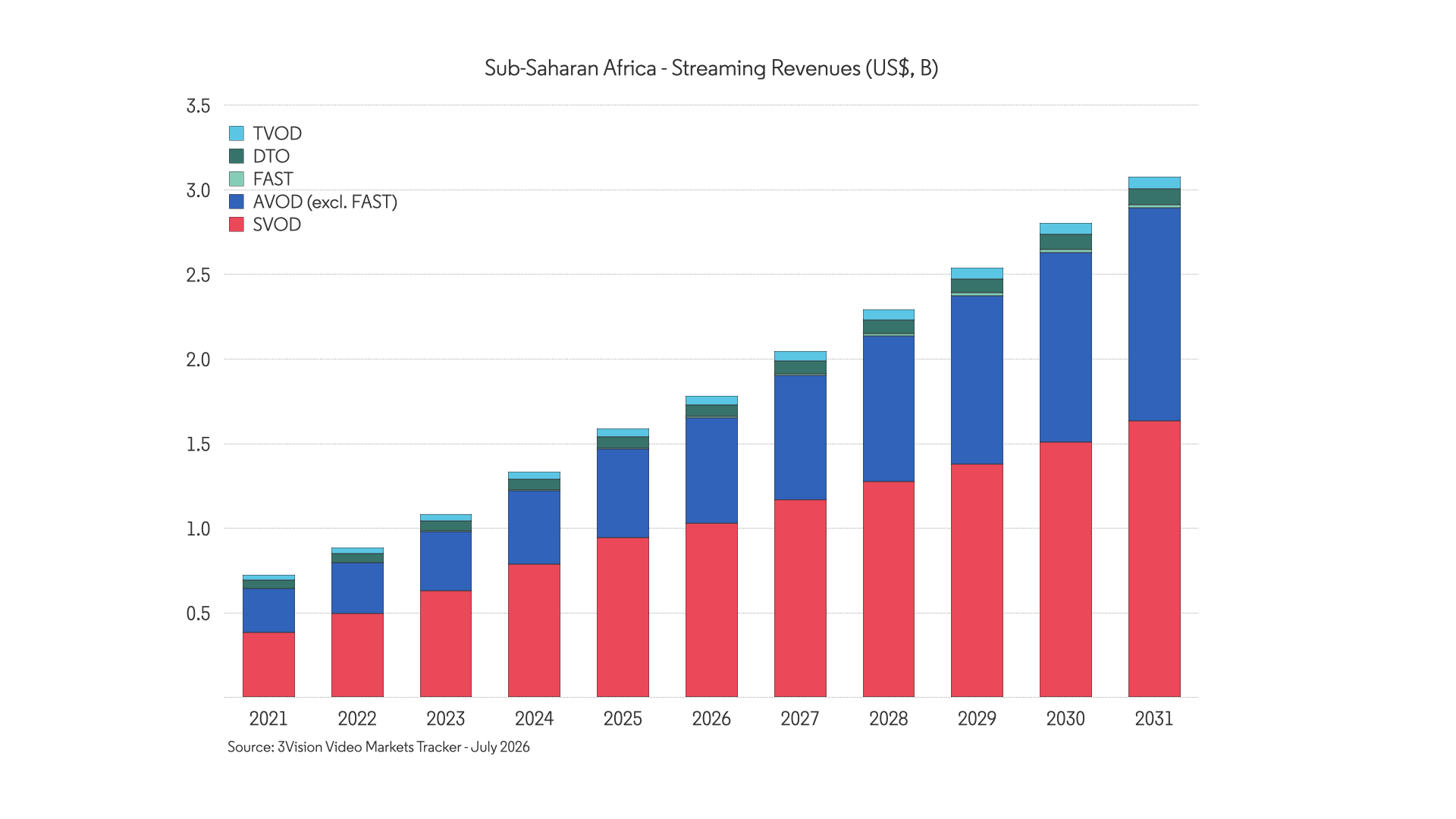
Chart: Streaming revenues in Sub-Saharan Africa (US$, B). Source: 3Vision, July 2026.
For product companies and OEMs building the technology behind these screens, the message is simple: the window is open now. At Promwad, we have spent the last year reading this market closely and we are already engineering for operators inside it.
The streaming surge has outgrown its infrastructure
The launch phase is over. The scaling phase is where the money (and the engineering) now lives.
Broadcast Media Africa's 2026 African OTT Content Streaming Survey captures the tension precisely: 61% of operators are already live, yet only 35% rate their streaming infrastructure as reliably stable — meaning roughly two-thirds cannot guarantee a dependable stream when audiences tune in. Two structural gaps stand between them and profitability:
- The monetization gap. 68% of Africans use mobile money as their primary payment method, but only 32% of OTT platforms support it — and operators that close that gap report conversion uplifts of up to 40%. Add ad-insertion and personalization, and the ARPU math changes entirely.
- The distribution gap. 78% of operators rate partnerships as "very important" or "critical," yet only 16% have telco deals that actually generate revenue. As BMA notes, a single telco partnership can double an operator's reachable audience overnight.
This is a systems-integration problem that calls for resilient, low-latency streaming pipelines, mobile-money and ad-monetization integration, AI/ML recommendation engines, and content-delivery architectures engineered for constrained, high-variance networks — exactly the OTT platform development and real-time streaming work Promwad delivers.

What's fuelling Africa's streaming surge
Behind the growth numbers from Statista, four demand-side forces are converging:
- Localized content wins. African audiences reward stories in their own cultures and languages. In BMA's 2026 survey, local drama, series and film made up 55% of content performance, while international licensed titles trailed below 10% — a global back-catalogue is not the winning play here.
- Mobile-first by default. For most viewers a smartphone is the primary — often the only — screen. That reshapes product design toward lightweight apps, data-efficient bitrates, and low-cost tiers built for constrained networks.
- A young, growing audience. Youthful, expanding middle-class populations in markets like Nigeria and Egypt are pulling demand upward.
- Multilingual by necessity. From South Africa's many official languages to Nigeria's Yoruba, Hausa and Igbo output, scaling means engineering for localization — subtitles, audio tracks, and UX.
As a result, the platforms that localize deepest and deliver reliably on mobile capture the audience; that is a hardware-software integration challenge as much as a content one.
The digital-switchover wave is reshaping the airwaves in parallel
While streaming scales, the terrestrial layer is being rebuilt under it.
In April 2026, South Africa's regulator ICASA published new Digital Terrestrial Television Broadcasting Regulations that codify the country's shift to digital — mandating the DVB-T2 standard and restructuring how multiplex spectrum is licensed — in preparation for an analogue switch-off whose date remains unannounced after more than a decade of delays.
Nigeria's NBC is driving a hybrid satellite-plus-terrestrial switchover under its "Big Picture" strategy, with incentives such as 18 months of zero carriage fees for broadcasters that maintain 60% local content, ahead of a national launch on 17 June 2026.
Established transmission vendors — including Thomson Broadcast, backed by the Madagascar-based Sipromad industrial group and running a dedicated Africa practice — are signing nationwide digital-migration agreements across multiple African regions.
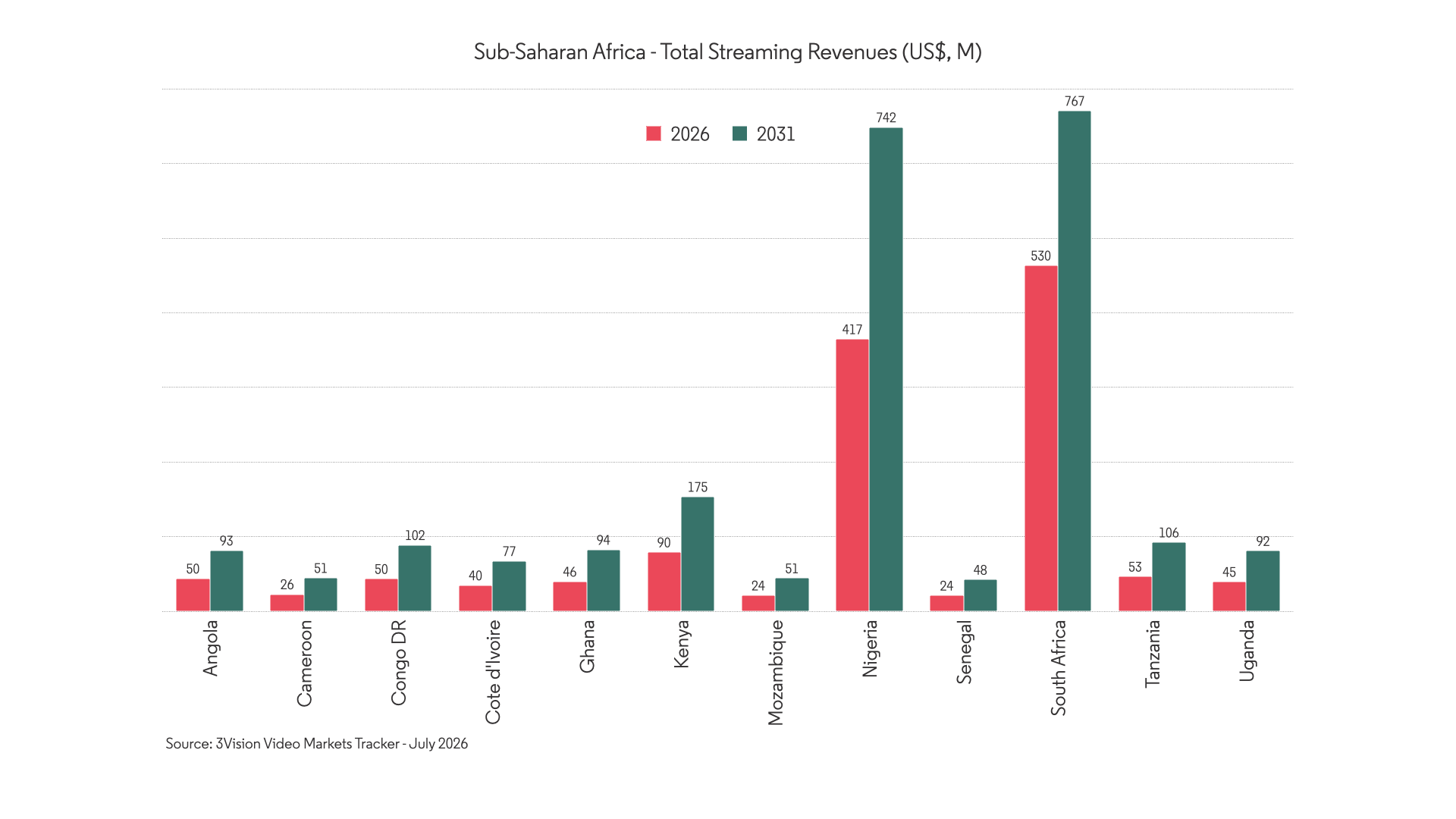
Chart: Streaming revenues in Africa 2026 vs 2031 (US$, B). Source: 3Vision, July 2026.
Modernizing this layer demands deep broadcast equipment development: FPGA-based video and audio processing, ST 2110 / NMOS IP-media integration, hybrid SDI/IP workflows, OpenGear hardware and firmware, and rigorous broadcast and ProAV equipment testing. This is embedded systems development at broadcast reliability — the discipline Promwad was built on.

Photo: a sound designer working with editing software to produce tracks
One modernization moment, two converging fronts
Streaming growth and digital switchover are not separate stories. They meet at the device and at the network edge, where a price-sensitive, mobile-first audience actually watches.
That convergence is where Promwad connects the two fronts: Android TV / AOSP and set-top-box middleware, DRM content protection, and smart-TV and STB applications that carry modernized broadcast and OTT services to affordable hardware at scale. From silicon to streaming app, it is one continuous hardware-software integration problem — and integrating those layers cleanly is precisely what a mature electronics design services partner exists to do.
Why Promwad
Promwad is a European R&D partner for product companies and OEMs, with 22+ years of experience and 100+ engineers specializing in complex hardware-software integration. As a broadcasting-focused hardware design company, we cover the full stack that African modernization now requires — broadcast equipment, OTT platforms, ProAV systems, set-top boxes, and the embedded firmware that ties them together.
We are already engaged with broadcasters and operators in African markets, helping them scale streaming infrastructure, integrate monetization, and modernize transmission for the DVB-T2 era. We are not offering to help the continent catch up. We are engineering the systems that let ambitious African operators move faster, monetize smarter, and deliver at world-class quality.

Let's discuss your plans it at IBC 2026
IBC 2026 runs 11–14 September at RAI Amsterdam, bringing together the media and technology industry from more than 170 countries. If you are an African broadcaster, operator, or OEM planning your next modernization step — OTT scale-up, monetization, or digital switchover — this is where we should talk.
Book a meeting with the Promwad team at IBC 2026:




Our booth at the Made in Germany hall: 8 – 8.C32c
Level up your broadcast business with engineering you can rely on.
Our Case Studies