CFexpress Storage Board for Broadcast FPGA Systems
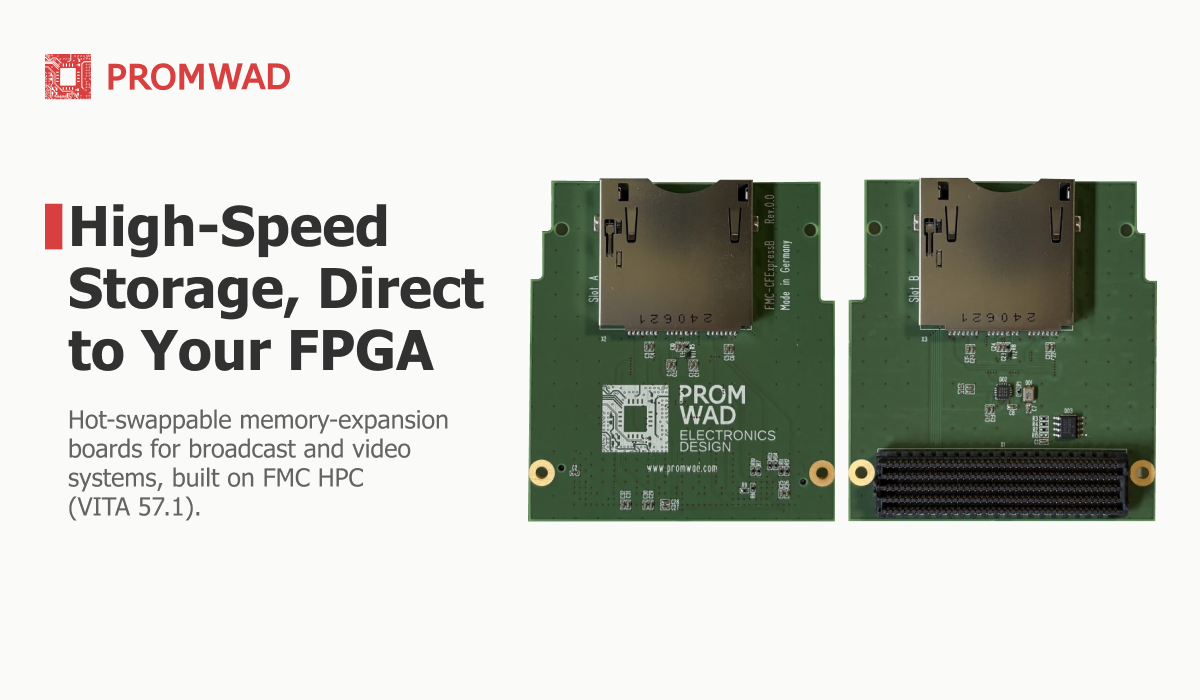
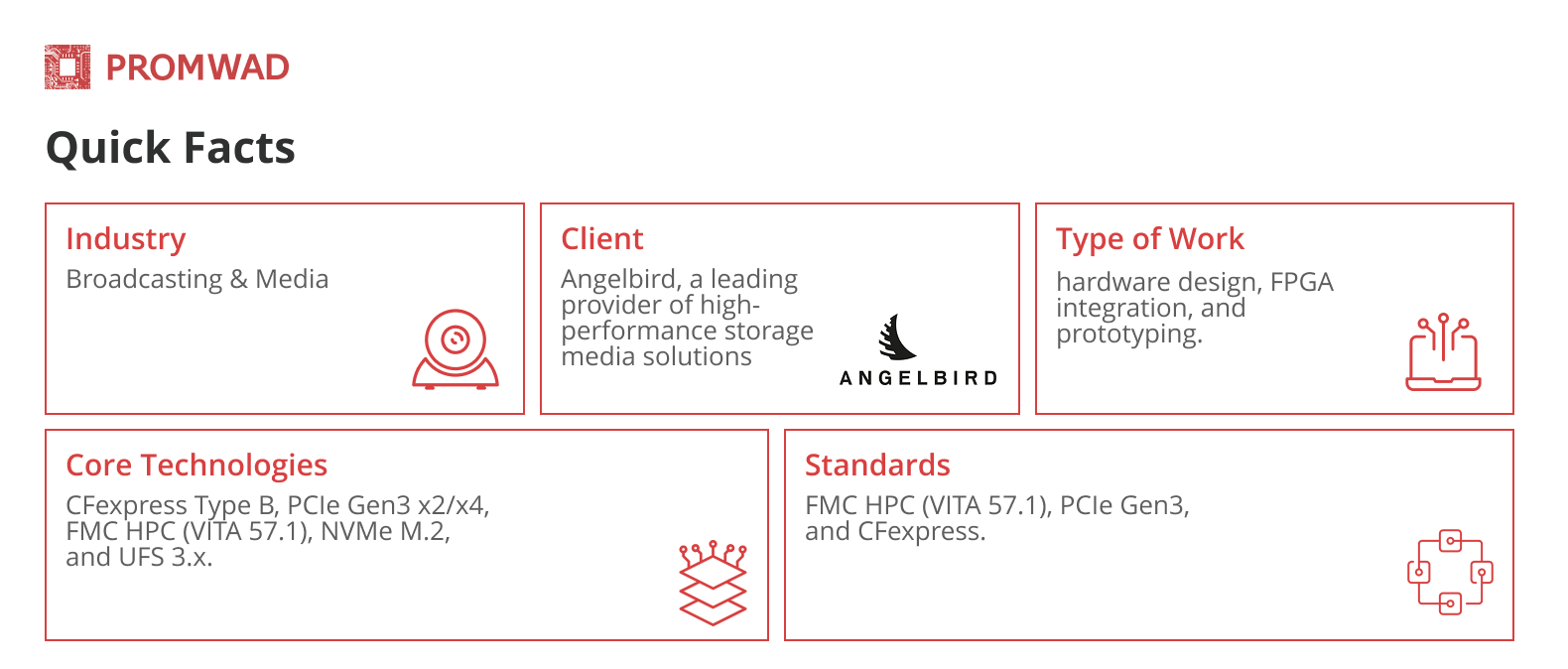
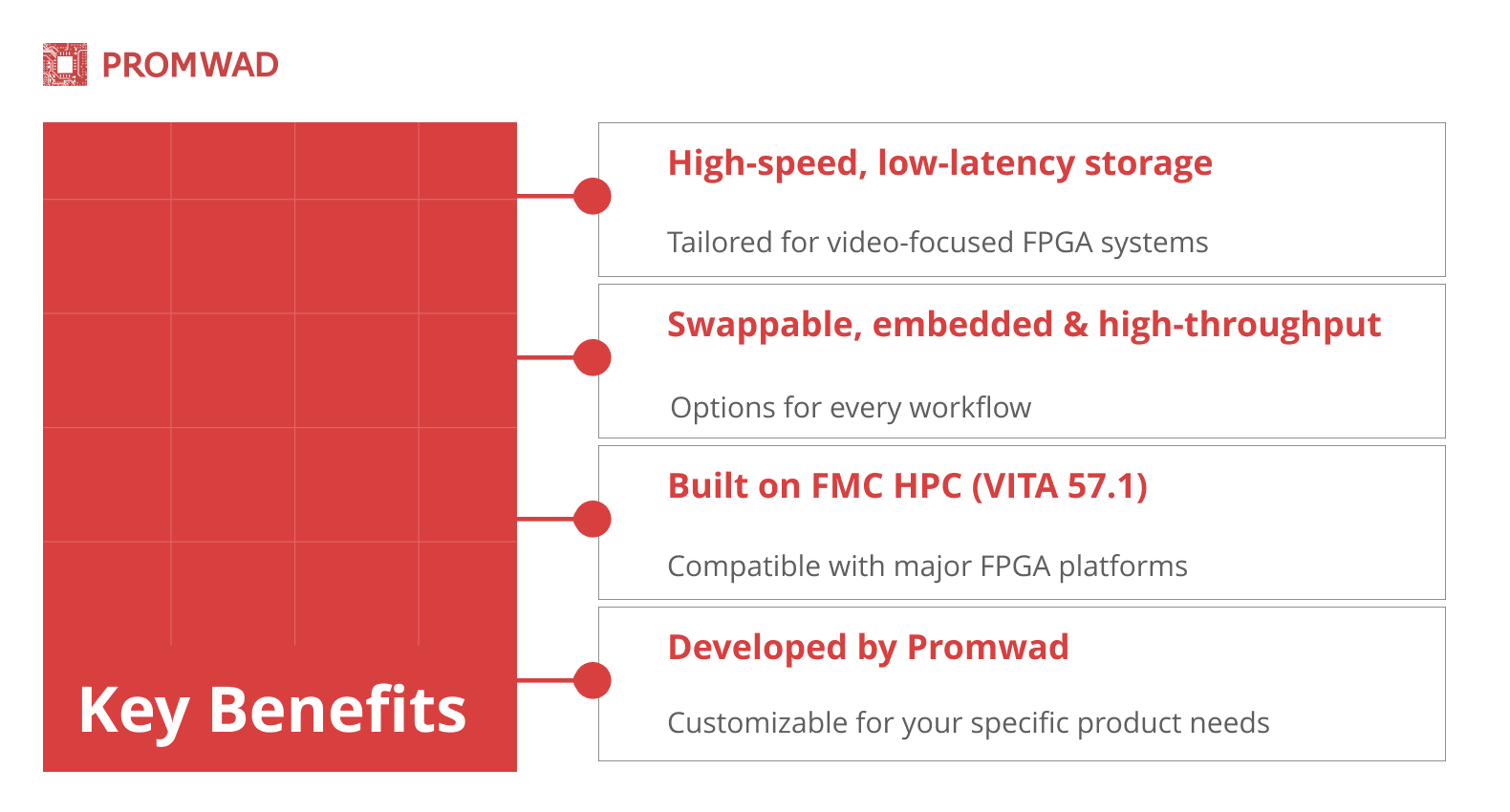
Project in a Nutshell: Angelbird, a leading provider of high-performance storage media, asked Promwad to build a CFexpress storage solution. Promwad developed a line of compact, high-speed memory-expansion boards for FPGA-based broadcasting and video systems. They give video workflows the high-throughput, low-latency local storage needed for stable video processing, real-time reception, and reliable playback. The CFexpress board takes removable media and is already in commercial use. It meets the FMC HPC (VITA 57.1) standard, so it connects directly to leading FPGA platforms. Beyond broadcast, it also fits industrial storage and rugged data logging.
We're demonstrating this application at IBC 2026.
Amsterdam, September 11-14, Hall 8, Stand C32c, German Pavilion.
Client & Challenge
FPGA-based broadcasting and video systems need fast local storage. It has to be high-throughput and low-latency for video processing, real-time reception, and reliable playback, and it has to take removable media so footage can be offloaded instantly.
Angelbird came to Promwad for a CFexpress board that does this and connects directly to leading FPGA platforms.
Solution
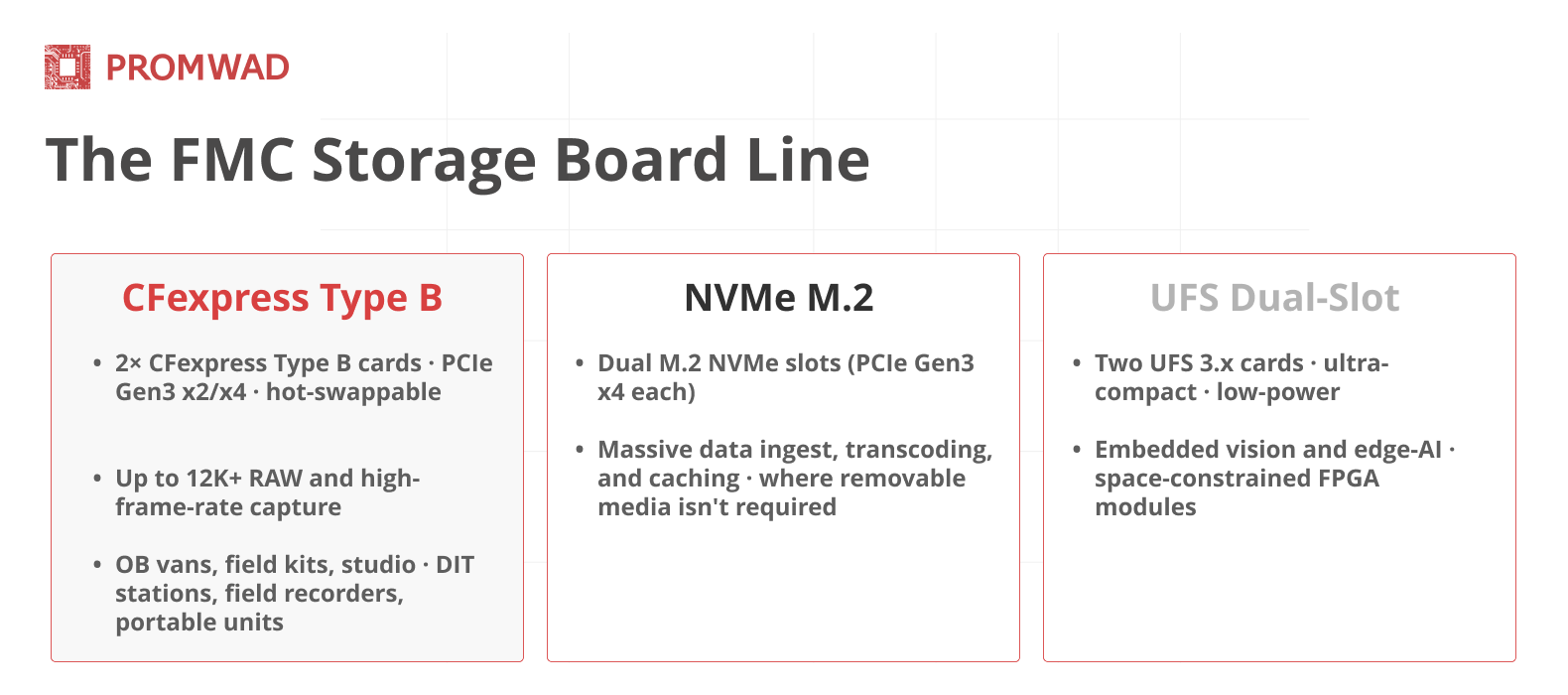
Promwad developed a CFexpress Type B storage board. It runs two CFexpress Type B cards (PCIe Gen3 x2/x4) for hot-swappable, high-speed recording in OB vans, field kits, and studio setups. The board meets the FMC HPC (VITA 57.1) standard and connects directly to leading FPGA platforms. It is commercially proven and widely used for reliable, low-latency edge storage.
Compatibility note: hot-swappable CFexpress Type B cards (PCIe Gen3 x2/x4 interface; compatible with CFexpress 4.0 cards operating at Gen3 speeds).
The board is also used outside broadcast, in industrial storage and rugged data logging.
The Storage Board Line
In addition to the core CFexpress solution, Promwad developed two additional boards to address specific workflows and future storage formats.
Develop Your FPGA Storage with Us
- Custom FPGA Storage Solutions: swappable media, embedded memory, and ultra-fast pipelines for any video workflow.
- End-to-End Development: from architecture and hardware design to FPGA integration and prototyping.
- Standards-Compliant FPGA Boards: supporting FMC HPC and PCIe Gen3, ready to plug into leading FPGA ecosystems.
- Accelerated Time-to-Market: with full support for branding, demo preparation, and real-world field testing.
Results
- A commercially proven CFexpress Type B storage board, already in commercial use across OB vans, field kits, and studio setups.
- Direct connection to leading FPGA platforms via the FMC HPC (VITA 57.1) standard.
- Robust performance up to 12K+ RAW and high-frame-rate capture, with hot-swappable media for instant offload.
- Two more boards developed for other workflows and future storage formats: an NVMe M.2 board and a UFS dual-slot board.
More of What We Do for Broadcasting & Media
- Broadcast Technology Solutions: explore our broadcast engineering services, from FPGA-based hardware and broadcast software to low-latency ST 2110, NDI, and SDI-to-IP pipelines.
- Enterprise Data Storage System Development: check out our project on an enterprise NAS with NVMe and CFexpress storage for low-latency ingest and 8K NDI video workflows.
- FPGA Design-Win for Pro A/V and Broadcast: learn how we design vendor-agnostic FPGA solutions for professional A/V and broadcast equipment.
FAQ
Why use an FPGA-based board for live video and audio instead of a CPU or GPU pipeline?
In live systems the real problem is usually not high latency but latency that changes unpredictably. CPU, GPU, and software pipelines can behave differently under load, updates, or parallel tasks, which causes sync issues and unstable timing. FPGA-based processing uses fixed buffering and deterministic pipeline stages, so timing stays repeatable under load across Full HD, UHD, HDR, and up to 8K workflows.
How do you move large video buffers between the FPGA board and servers or GPUs?
For systems where FPGA processing connects to servers, GPUs, or distributed compute nodes, we design high-bandwidth data paths using RDMA and RoCEv2. On AMD FPGA and Adaptive SoC platforms, we can integrate ERNIC (Embedded RDMA Enabled NIC) for hardware-offloaded transfer with less CPU involvement, so large video buffers move with low, predictable overhead.
Which broadcast IP standards do you support around these pipelines?
We work with SMPTE ST 2110 and NMOS for studio interoperability and PTP sync, AES67 for audio over IP, NDI for cost-efficient AV-over-IP, IPMX for ProAV designs, and SRT or RIST for contribution over public networks. Many projects combine several standards in one device or pipeline.
Can you help migrate an existing SDI setup to IP?
Yes. We guide SDI-to-IP migration with ST 2110 and NMOS, covering PTP synchronization and jitter buffers, NMOS registry integration and flow control, QoS policies, multicast and IGMP, and legacy SDI compatibility with test matrices for lip-sync, packet loss, and failover.
How do you validate low latency and quality before production?
We design and verify a latency budget for each workflow, then validate under real-world load with jitter, lip-sync, and packet-loss simulations, plus failover testing. We also run cross-device validation across cameras, mixers, encoders, playout, and panels, with secure CI/CD delivery and traceability.