Mobile Live Streaming Reference Platform with On-Device AI
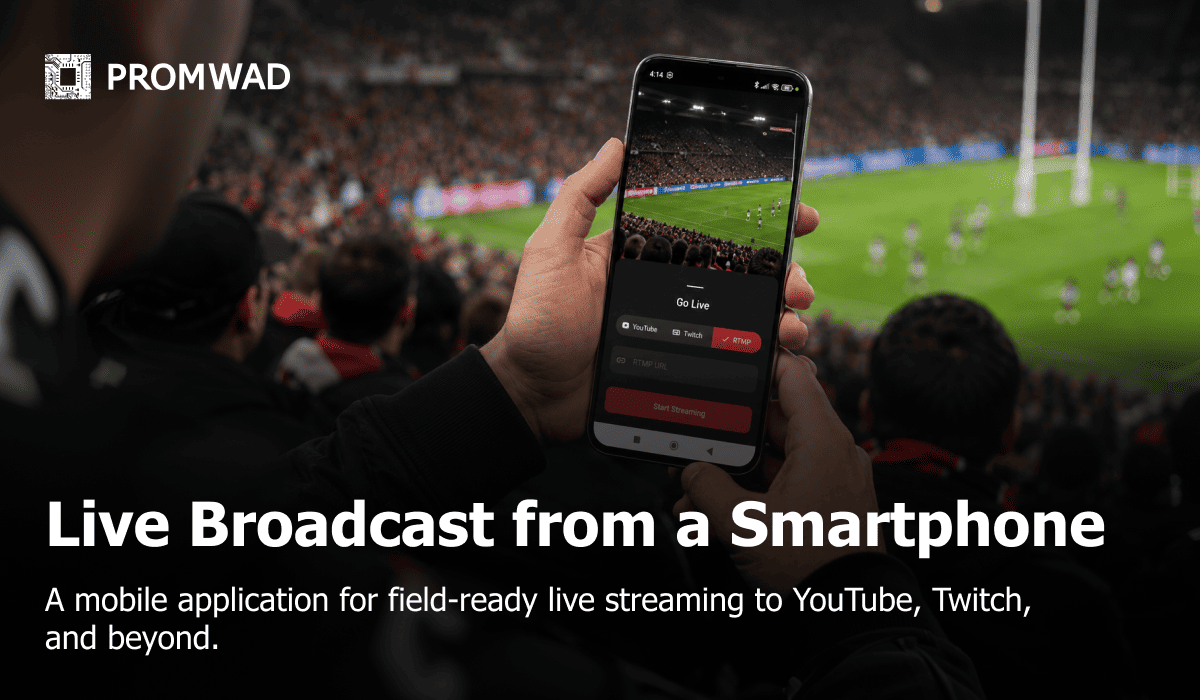
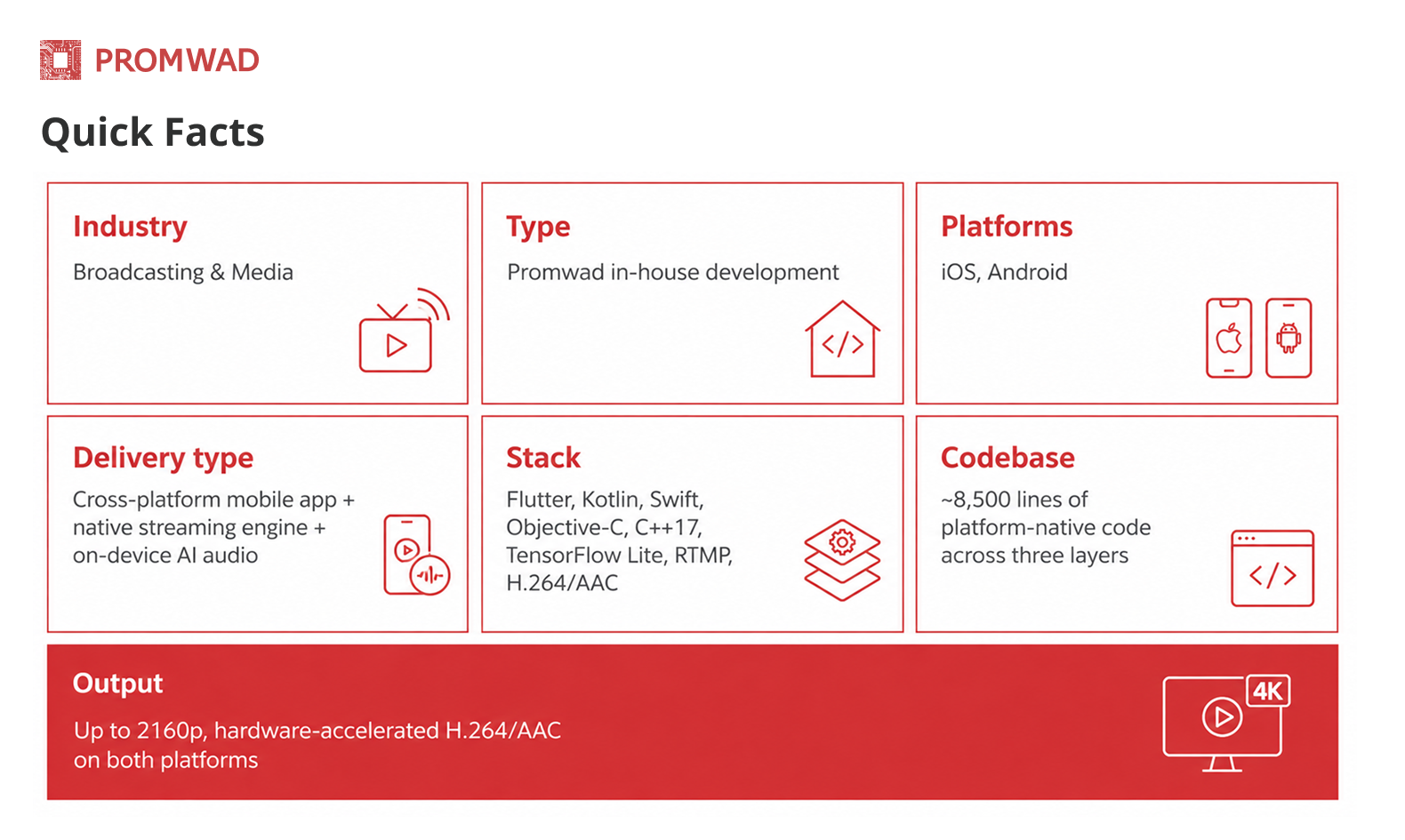
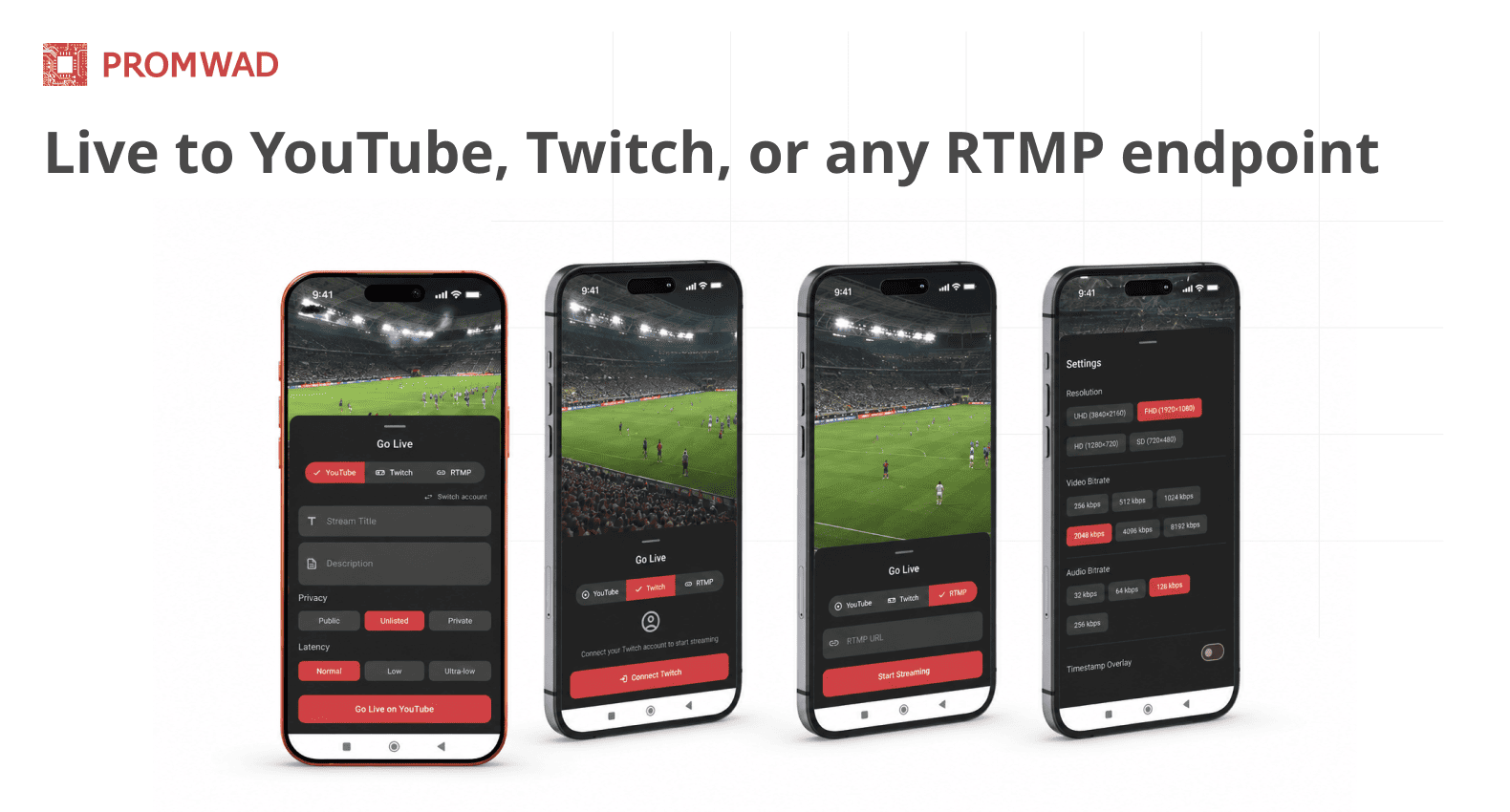
Project in a Nutshell: Promwad's in-house R&D team built a cross-platform mobile application that turns a smartphone into a field-ready live broadcast camera for YouTube, Twitch, or any RTMP endpoint. Everything happens on the device: the broadcast setup is fully automated so going live takes one tap, the stream survives the interruptions of real phone use that break naive implementations, and a neural network suppresses ambient noise locally, so the audio reaches broadcast quality. Verified in real broadcasts against live YouTube and Twitch, it is a practical starting point for broadcasters and media companies that want a branded field production tool of their own.
We're demonstrating this application at IBC 2026.
Amsterdam, September 11-14, Hall 8, Stand C32c, German Pavilion.
What broadcasters get
A newsroom that ships reports faster and cheaper
Sending a reporter into the field usually means a camera operator, a sound engineer, and an encoder rig. This application replaces all of that with a phone that produces broadcast-grade audio and holds the stream through real field conditions. A newsroom cuts the cost per story, sends more reporters to more locations, and stops losing breaking moments to setup time.
A broadcast production with more contributor feeds and fewer failure points
Contributor feeds from the crowd, the sidelines, or backstage give the main broadcast more angles and more editorial choice. But every extra feed today is an extra risk: another connection to drop, another audio track to reject on quality. This application turns any phone in the venue into a reliable contributor source that meets the audio bar of the main broadcast, so a producer can add more feeds without adding more risk.
A media platform that owns its mobile experience instead of renting it
Platforms that route their creators to a generic streaming app lose control over the interface, the ingest path, and the user data. This application becomes the mobile side of the platform: adapted to the platform's brand, connected to the platform's own ingest and identity, and shipped as part of the platform's product rather than a third-party workaround.
How Promwad delivers this
Promwad delivers the solution in several formats depending on the client's product and workflow:
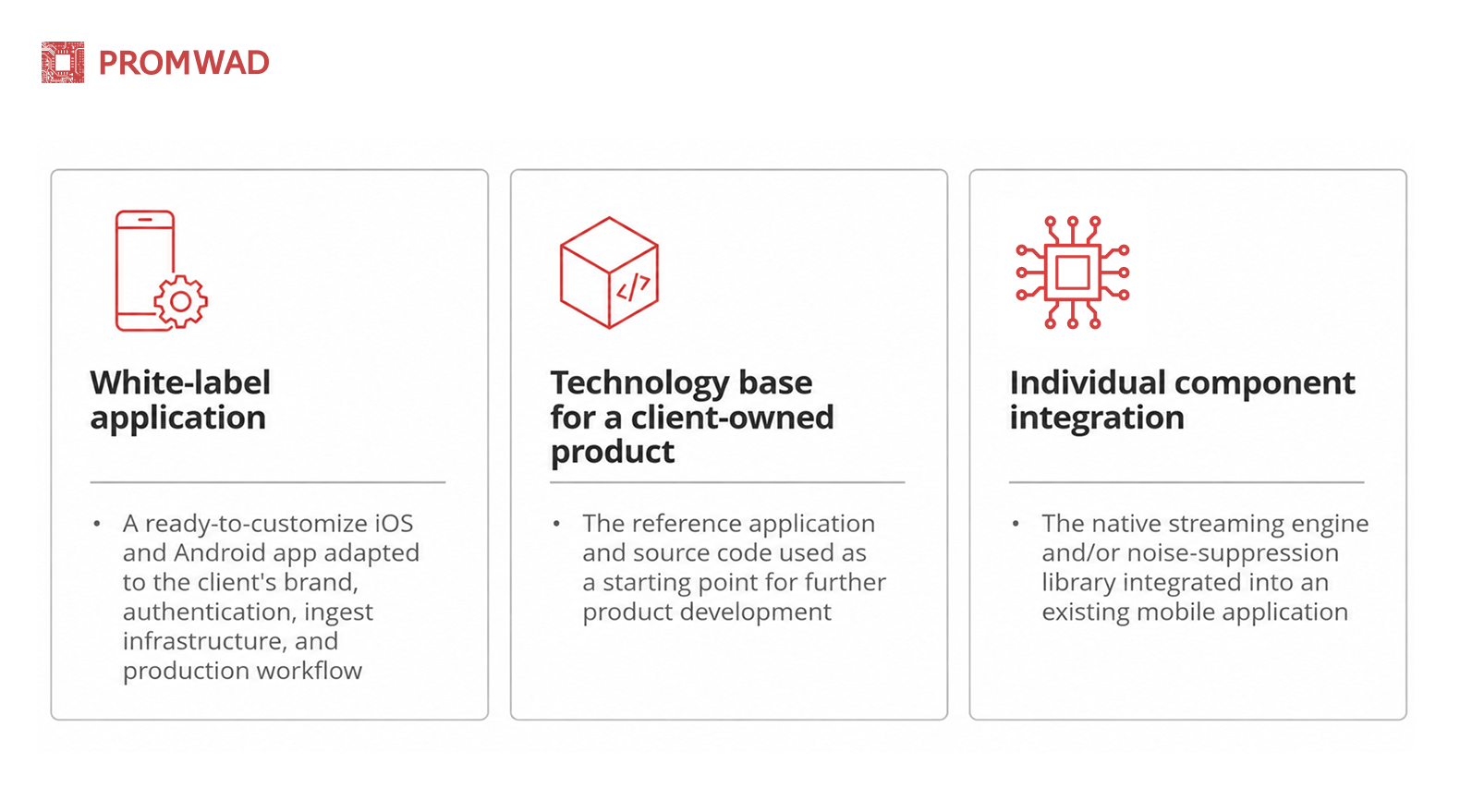
The application is a working, verified starting point rather than a from-scratch development. This allows clients to move to a production-ready solution in weeks rather than months.
The same engineering team that built the reference solution performs the client integration and customization, bringing together four capability areas rarely coordinated in one team: mobile development, native platform internals, real-time audio processing integration, and broadcast protocols.
How the application is built
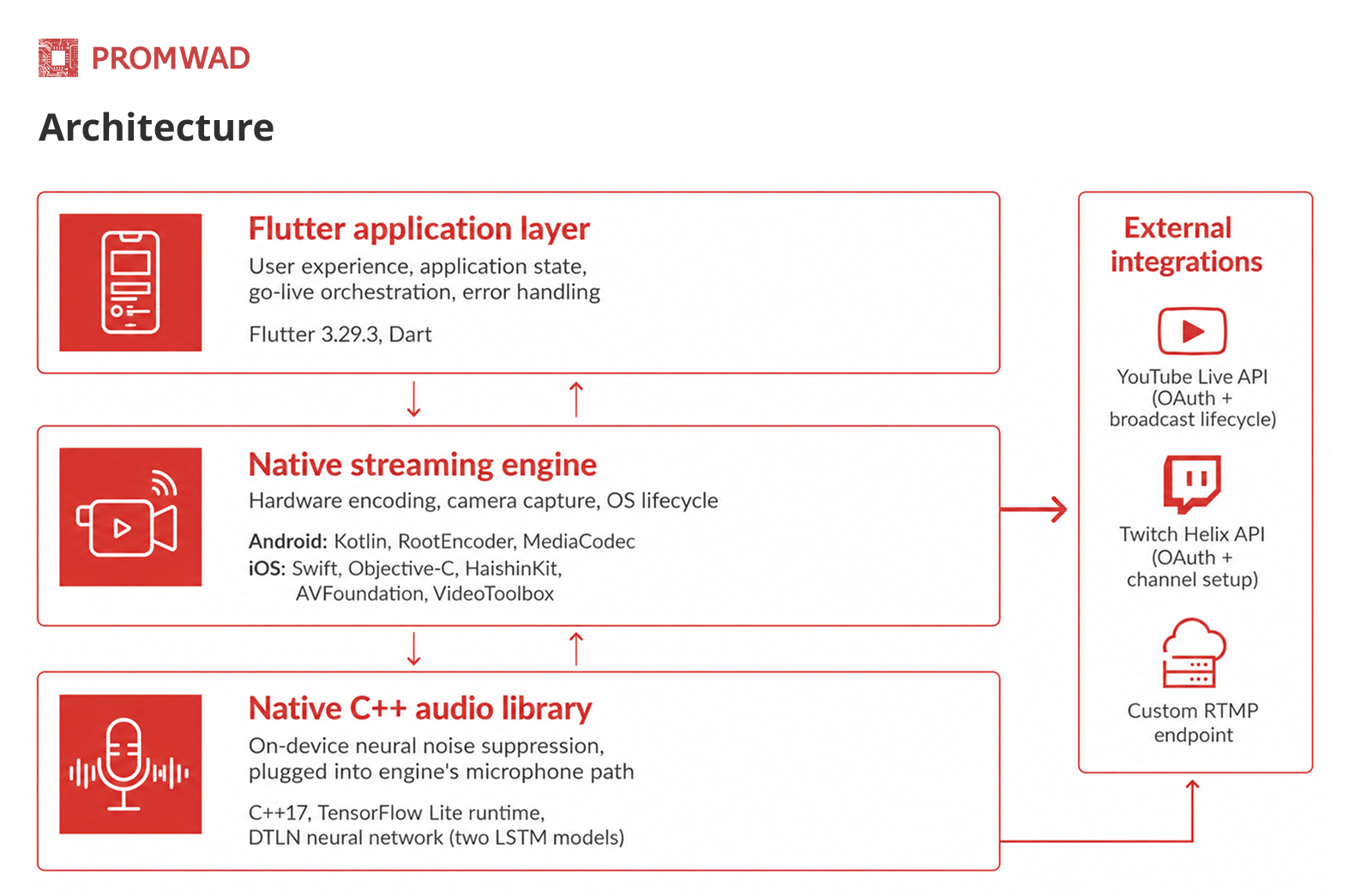
Three layers, each owning a different class of problem:
- A Flutter layer handles the user experience and the go-live logic from a single codebase shared across iOS and Android, with a central failure-mapping layer that turns any internal fault into a message the operator can act on.
- A native streaming engine owns hardware encoding, camera capture, and the operating-system lifecycle.
- A native C++ audio library performs the noise suppression, plugged into the engine's microphone path so audio is cleaned before it is ever encoded.
Two decisions shaped everything else:
- The first was to own the streaming engine outright: no off-the-shelf Flutter plugin exposed the encoder-level control the product needed, and that control is what made the reliability work possible.
- The second was to run without a backend. Sign-in, broadcast setup, noise suppression, and streaming all happen on the device, including Twitch's browser-based OAuth, handled by a short-lived local server on the phone. For a company adopting this design, that means no cloud infrastructure to run and no user credentials leaving the device.
Verified in the field
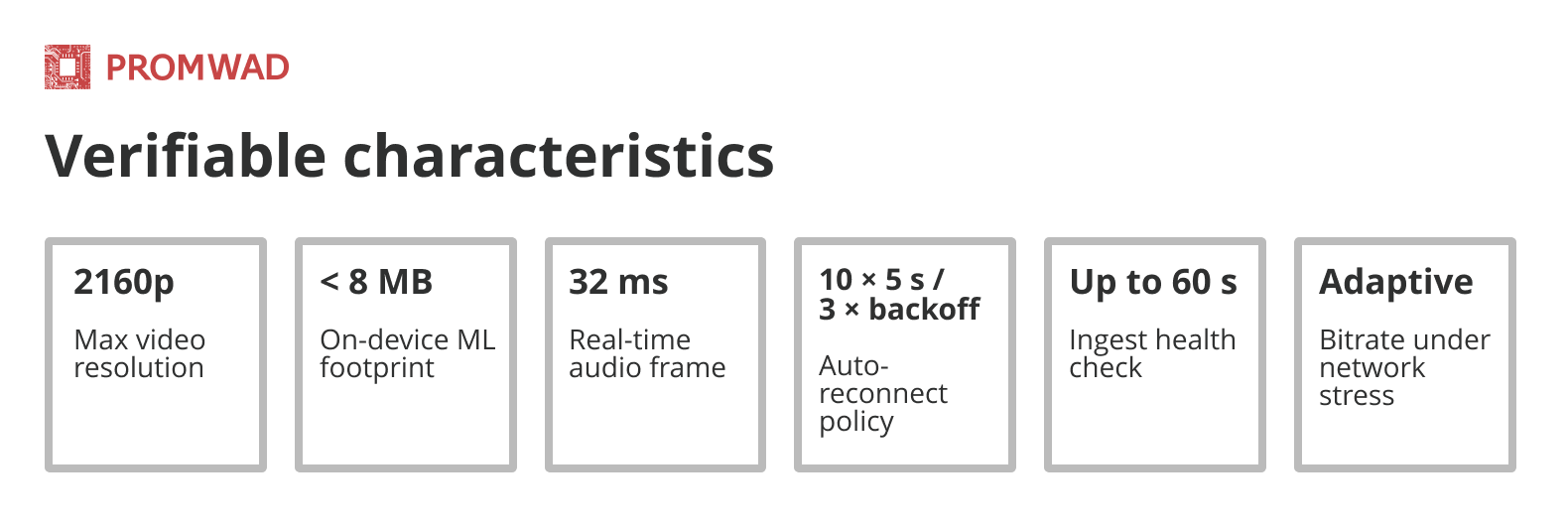
Live streaming behavior cannot be reproduced in a simulator, so the application was verified as real broadcasts on real devices against live YouTube and Twitch, run deliberately through the conditions that break streams: mid-stream minimizing, screen locks, network loss and recovery.
Licensing and reuse
The application is built on open-source components, all under permissive licenses that allow commercial use with attribution.
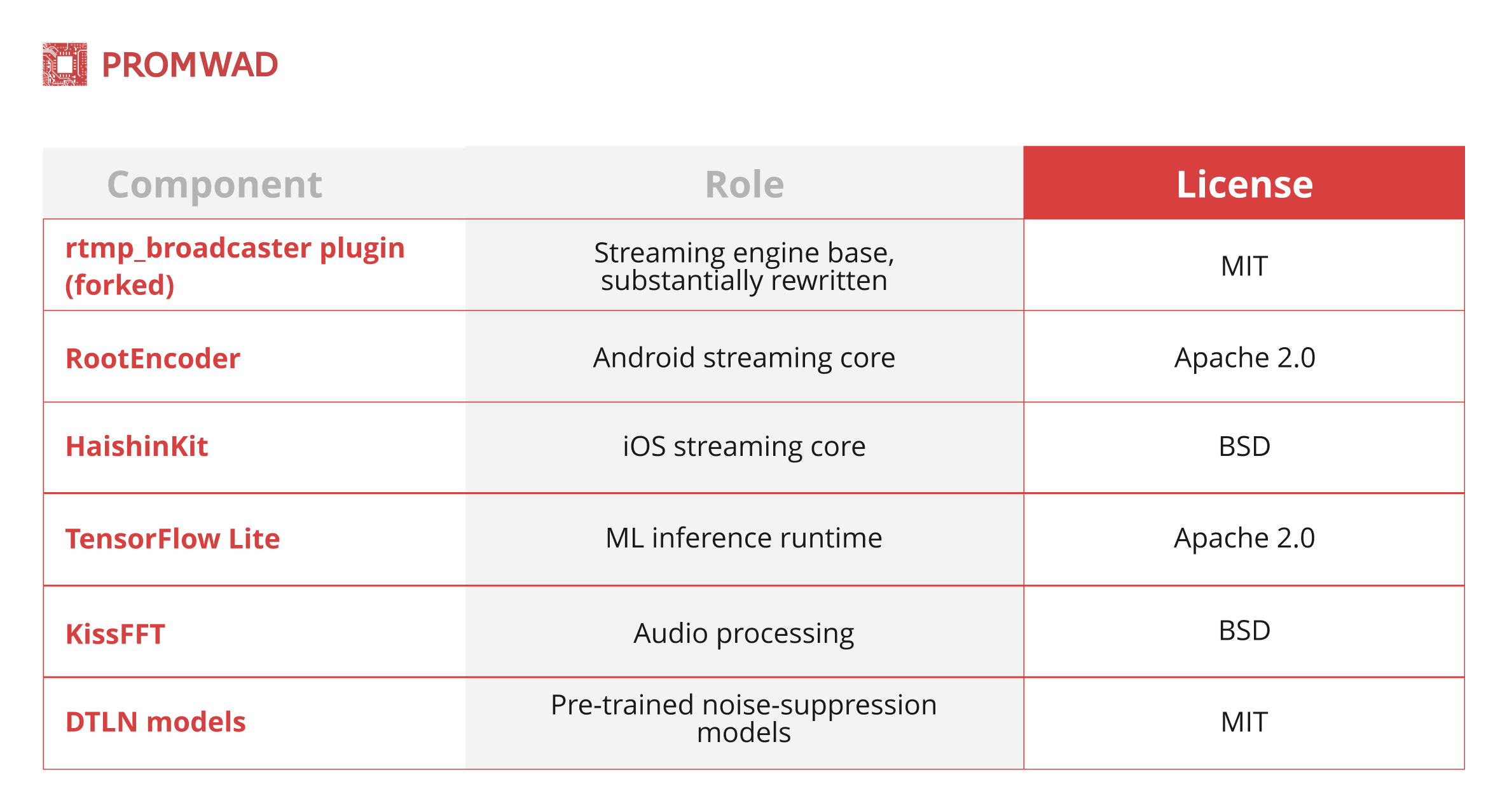
The noise-suppression stack was packaged as a standalone native library rather than wired into the application, so it can be lifted into a different product on its own. Platform requirements are enforced in the code, including Twitch encoding presets, YouTube Live API policies, and the Android 14 foreground service rules, so a client inherits compliance rather than rebuilding it.
The application is a working, verified starting point rather than a finished product. The exact configuration, integrations, brand, and additional workflows are shaped around the client's use case during scoping, and the team that built the reference is the same team available to build the client product on top of it.
More of What We Do for Live Broadcasting
-
Real-Time Streaming Solutions: explore our full-cycle engineering for low-latency streaming platforms across broadcast, contribution, and interactive workflows.
-
Cross-Platform Mobile TV App for Heaven TV7: check out this case study of a Flutter-based mobile TV app delivering live video to audiences in 90 countries.
FAQ
Do you support professional broadcast IP standards like SMPTE ST 2110, NMOS, SRT, or RIST?
Yes. Beyond RTMP used in this application, Promwad's broadcast practice covers SMPTE ST 2110, AES67, NMOS (IS-04 / IS-05), IPMX, SRT, RIST, PTP timing, and IP media ecosystems including NDI. → See our Broadcasting & Media expertise
Can you help migrate an existing SDI-based workflow to IP?
Yes. SDI-to-IP migration is one of Promwad's core competencies in broadcast, with practical transition strategies that minimize disruption to existing production chains.
Does Promwad also work with broadcast hardware and FPGA, not only software?
Yes. Promwad delivers end-to-end engineering under one roof: hardware and FPGA-based video and audio processing, embedded software, device applications, and cloud components.
How does Promwad handle ultra-low latency requirements in live broadcast?
Latency-driven design is a defining principle of Promwad's broadcast work: defined latency budgets and performance validation under load ensure deterministic behavior in real-world environments. For contribution beyond RTMP, the streaming engine in this application extends to SRT and RIST.