


Thermal Design Under Continuous Load: Steady-State Limits, Junction Temperature, and Failure Mechanisms

Thermal design under continuous load is not about peak events. It is about equilibrium. Once a system runs long enough at a given power level, it reaches a steady-state where heat generation equals heat dissipation, and temperatures stop changing. That steady-state defines whether the system will survive 10,000 hours or fail in months.
In industrial electronics, this condition is not an edge case. Motor drives, power converters, edge AI nodes, telecom units, and control systems routinely operate at high utilization for extended periods. Under these conditions, transient thermal margins become irrelevant. What matters is the final stabilized junction temperature of each critical component and how close it is to the degradation threshold.
Most thermal failures in production systems are not caused by exceeding absolute maximum ratings. They are caused by operating too close to them for too long.
Steady-State Thermal Model — From Power to Junction Temperature
At steady-state, the thermal system behaves as a resistive network. The key relationship is linear: temperature rise is proportional to power dissipation and total thermal resistance from junction to ambient.
The practical calculation is:
Tj = Ta + P × RθJA
Where junction temperature is the sum of ambient temperature and the product of dissipated power and total thermal resistance.
In real systems, RθJA is not a single number. It is a series of resistances:
RθJA = RθJC + RθCS + RθSA
Junction-to-case, case-to-sink, and sink-to-ambient resistances form the full path. Each element is physically different and must be engineered separately.
For example, consider a 25 W power stage in an industrial enclosure with 45 °C ambient. If the total thermal resistance is 3.5 °C/W, the junction temperature rises by 87.5 °C, reaching 132.5 °C. That may still be below the absolute maximum, but it is already in the region where lifetime degradation accelerates significantly.
The key engineering insight is that small changes in resistance have large effects. Increasing total resistance from 3.5 to 4.2 °C/W raises junction temperature by 17.5 °C at the same power level. That difference alone can reduce lifetime by more than half.
Where Thermal Resistance Actually Comes From in Real Systems
Datasheet values rarely reflect system reality. RθJC is defined under controlled conditions, but RθCS and RθSA depend entirely on implementation.
Case-to-sink resistance is dominated by thermal interface quality. A poorly applied thermal pad or degraded TIM can double this resistance. Aging, pump-out, and mechanical stress further increase it over time.
Sink-to-ambient resistance is controlled by airflow and geometry. In natural convection, effective heat transfer coefficients are low, typically below 10 W/m²K. This limits power density severely. In forced airflow, coefficients can exceed 50–100 W/m²K, but only if airflow is well-distributed.
PCB-level resistance is often underestimated. Heat spreads through copper planes, vias, and dielectric layers before reaching the heatsink. A high-power IC on a poorly designed PCB can have an effective thermal resistance far higher than predicted by package specifications.
In dense systems, thermal coupling between components becomes dominant. One component’s heat raises the local ambient for neighboring components, effectively increasing their thermal resistance. This is why hotspot analysis is more important than average temperature.
Continuous Load vs Transient Design — Why Lab Validation Fails
A common failure pattern is validating thermal performance under short-duration tests. Engineers apply load, measure temperature rise for a few minutes, and assume compliance. This misses steady-state behavior.
Thermal time constants in industrial systems can be long. Large heatsinks, enclosures, and internal air volumes delay equilibrium. It may take 30–90 minutes for temperatures to stabilize. Systems that pass short tests often exceed limits after extended operation.
Another issue is unrealistic boundary conditions. Lab environments assume clean airflow, nominal ambient temperature, and new thermal interfaces. In real deployment, airflow is restricted, ambient temperatures are higher, and dust accumulates.
A system designed for 40 °C ambient in lab conditions may operate at 55–60 °C in the field. Combined with degraded airflow, this can increase junction temperature by 20–30 °C beyond design expectations.
Derating Is Not Optional — It Is the Design Target
Absolute maximum ratings are not operating points. They are failure thresholds. Continuous operation near these limits leads to accelerated degradation.
Thermal derating defines safe operating margins. For most industrial systems, junction temperature targets are kept below 100–110 °C even if the device is rated for 150 °C.
The reason is exponential failure acceleration. Reliability models show that failure rates double approximately every 10 °C increase in temperature. This applies to semiconductors, capacitors, and interconnects.
Derating must be applied at system level, not component level. It includes worst-case ambient temperature, reduced airflow, aging of thermal interfaces, and manufacturing variability.
Ignoring derating leads to systems that meet specifications on paper but fail prematurely in operation.
Cooling Architecture Under Continuous Load
Cooling strategy must be selected based on steady-state requirements, not peak load.
Passive cooling relies on conduction and natural convection. It is inherently reliable but limited in capacity. Systems relying on passive cooling must maximize surface area, optimize orientation, and ensure unobstructed airflow paths.
Active cooling introduces forced airflow, significantly reducing thermal resistance. However, it introduces failure modes. Fan performance degrades over time due to bearing wear and dust accumulation. Designing with nominal fan performance is insufficient; degraded performance must be considered.
In high-power systems, liquid cooling is used to remove heat efficiently. It provides low thermal resistance but introduces complexity and risk. Leakage, pump failure, and maintenance requirements must be accounted for.
Hybrid approaches are common. Heat is conducted to a chassis or cold plate, and airflow is used to remove heat from that structure. This reduces reliance on high airflow rates while maintaining efficiency.
PCB Thermal Design — Where Many Designs Break
PCB design determines how heat is distributed before it reaches external cooling structures.
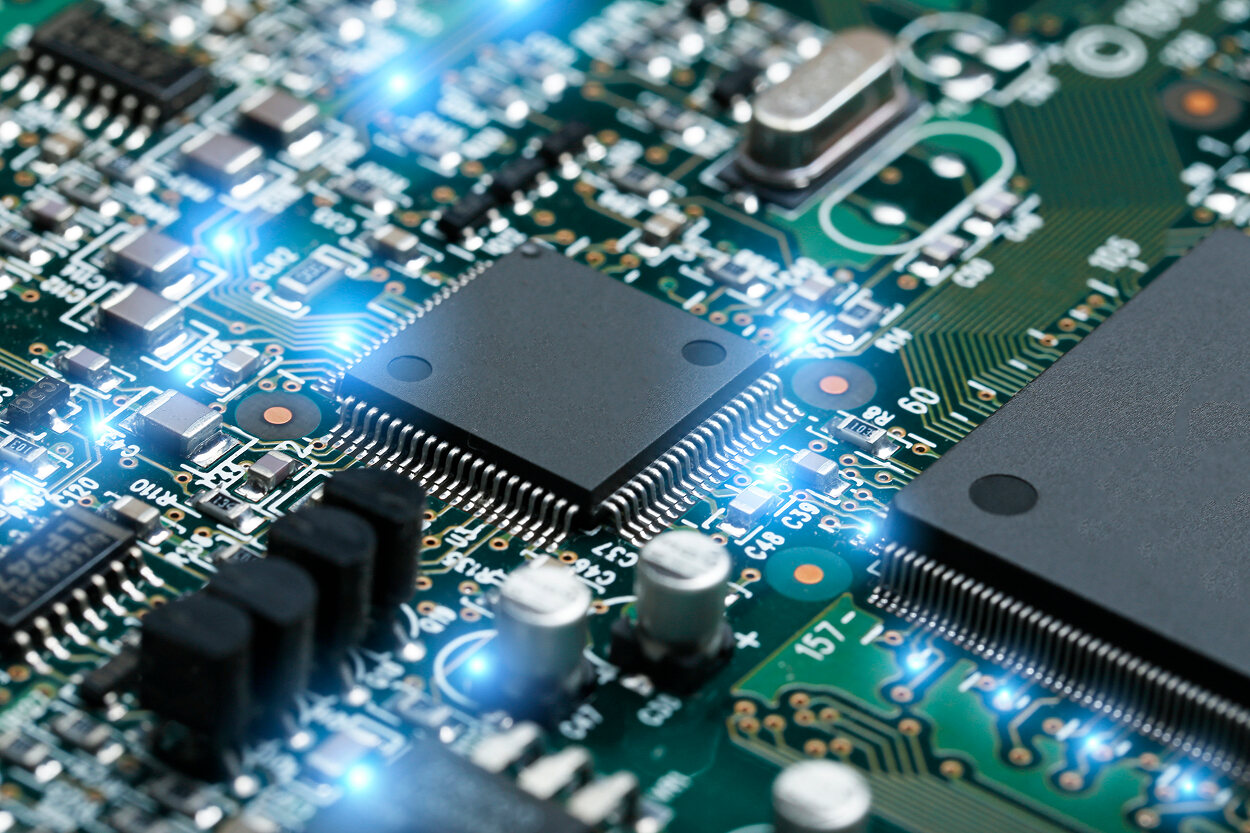
High-power components must be connected to large copper areas. Thermal vias are used to transfer heat to internal layers or opposite sides of the board. The effectiveness of these vias depends on their number, diameter, and placement.
Component placement affects thermal interaction. Clustering high-power components creates hotspots that exceed local cooling capacity. Spreading them reduces peak temperatures even if total power remains unchanged.
Material properties also matter. FR-4 has low thermal conductivity, limiting heat spreading. In high-power designs, metal-core PCBs or insulated metal substrates may be required.
Ignoring PCB thermal design leads to localized overheating that cannot be fixed by external cooling alone.
Airflow and Enclosure Effects
Airflow is often the dominant factor in system-level thermal performance.
In forced-air systems, airflow must be directed. Simply adding a fan does not guarantee effective cooling. Air follows the path of least resistance, creating bypass regions and dead zones.
CFD analysis is required to identify airflow distribution, pressure drops, and recirculation zones. Without it, designs rely on assumptions that often prove incorrect.
Enclosures introduce additional constraints. Sealed industrial enclosures limit airflow and increase internal temperature. Heat must be conducted to external surfaces or dissipated through heat exchangers.
Dust accumulation reduces airflow and increases thermal resistance over time. Filters mitigate this but introduce pressure drop, reducing effective airflow.
Design must account for end-of-life conditions, not initial performance.
Failure Mechanisms Under Continuous Thermal Stress
Continuous high temperature accelerates multiple degradation mechanisms.
Electromigration causes metal interconnects to degrade under sustained current and temperature. This leads to increased resistance and eventual failure.
Dielectric breakdown in semiconductors accelerates with temperature, reducing device lifetime.
Electrolytic capacitors are particularly sensitive. Their lifetime decreases exponentially with temperature, often specified as a function of operating temperature.
Solder joints experience creep under constant thermal stress. Unlike cyclic fatigue, this is a slow deformation process that eventually leads to mechanical failure.
These mechanisms are not theoretical. They define real field failure rates in industrial systems.
Simulation and Validation — From Model to Reality
Thermal simulation is required to model complex systems, but it must be used correctly.
CFD tools model airflow and heat transfer, while FEA tools model conduction and material behavior. Accurate simulation requires realistic boundary conditions: fan curves, material properties, and environmental conditions.
Validation requires long-duration testing. Systems must be operated at full load until thermal equilibrium is reached. Measurements must be taken at critical points: junction temperature, heatsink temperature, and ambient.
Thermal imaging helps identify hotspots, but sensor-based measurements are required for accuracy.
A common mistake is relying on simulation without validation, or validating under unrealistic conditions.
Engineering Trade-offs in Continuous Load Design
Thermal design is a trade-off between performance, size, cost, and reliability.
Reducing thermal resistance improves performance but increases cost and size. Increasing airflow improves cooling but reduces reliability. Lowering power reduces heat but may impact system functionality.
These trade-offs must be resolved based on application requirements. Safety-critical systems require conservative margins. Cost-sensitive systems may operate closer to limits but must still meet reliability targets.
The correct approach is not minimizing temperature at any cost, but optimizing the system within constraints while maintaining reliability.
Decision Criteria for Continuous Load Systems
Design decisions must be based on worst-case steady-state conditions.
Key criteria include maximum junction temperature under worst-case ambient, total thermal resistance of the system, airflow reliability over time, and degradation of thermal interfaces.
Systems must be validated under worst-case conditions, not nominal ones.
Failure to do so results in systems that pass initial testing but fail in real-world operation.
Quick Overview
Thermal design under continuous load focuses on steady-state temperature and long-term reliability.
Key Applications
Industrial electronics, power systems, telecom, robotics, and embedded computing.
Benefits
Improved reliability and predictable lifetime.
Challenges
Heat dissipation limits, airflow constraints, and environmental variability.
Outlook
As power density increases, steady-state thermal design becomes the primary constraint in industrial systems.
Related Terms
junction temperature, thermal resistance, heatsink, CFD, derating, electromigration
Our Case Studies








FAQ
What is thermal design under continuous load?
How do you calculate junction temperature?
Why is derating important?
What is the biggest mistake in thermal design?
What cooling method is best?
What should I store as evidence from automated runs?