Unified Yocto-Based Software Platform for Passenger Information Systems
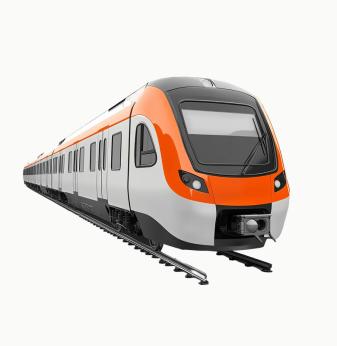
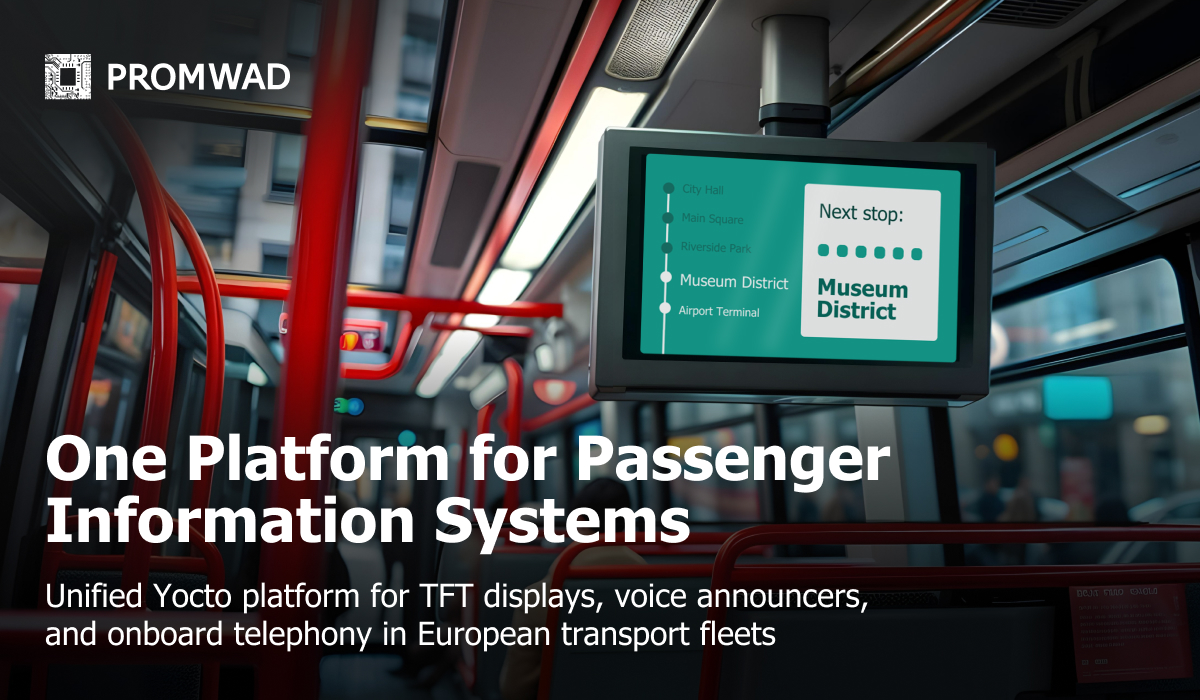
Project in a Nutshell: Promwad built a unified Yocto-based Linux platform for a European supplier of passenger information systems. We split the legacy monolithic codebase, created compact Linux images for each device and brought up a new NXP-based TFT controller with smooth video playback and reliable peripherals. The platform now provides unified configuration, OTA updates, and automated image and update package builds. As a result, the client restored serial production and reduced TFT image build time from a full day to roughly two hours.
Client & Challenge
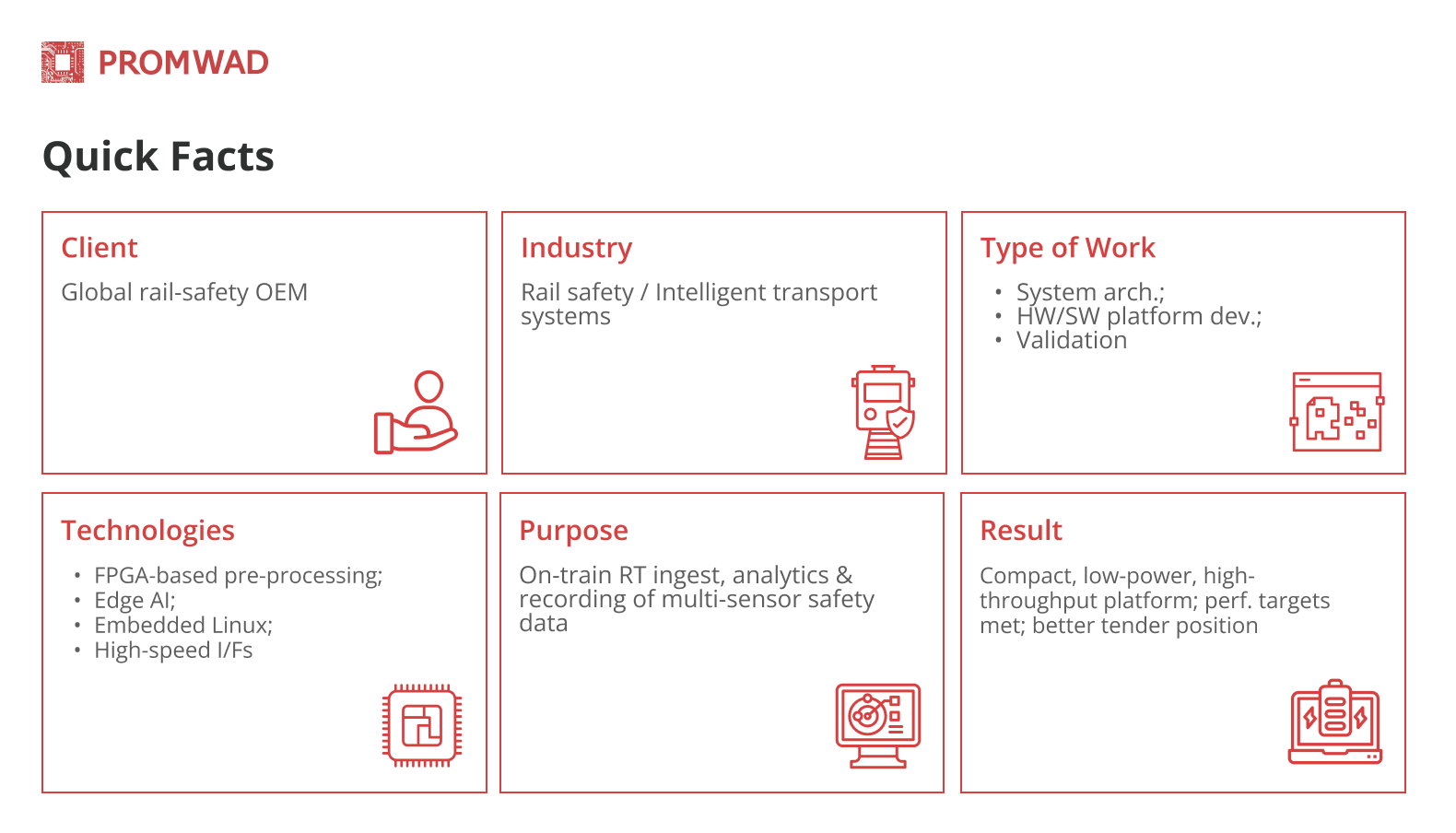
Our client is a company that develops railway safety solutions. They needed a compact, energy-efficient, and highly productive onboard platform: new generations of radars and other sensors generate massive data flows that must be received, filtered, classified, and reliably recorded in real time on the train.
Their existing architecture was approaching its limits in terms of performance, size, and scalability, which could slow down future deployments and make it harder to compete in new tenders. Together with the client, we clarified the business goals and risks and defined the target platform profile for the next generation of their solution.
Solution
In HMI systems for public transport, updates are not just a delivery task — they directly affect live passenger information, door-status alerts, and audio announcements. That is why we used a unified Yocto platform with dual-partition OTA and tag-based CI/CD to keep rollouts predictable across all device types.
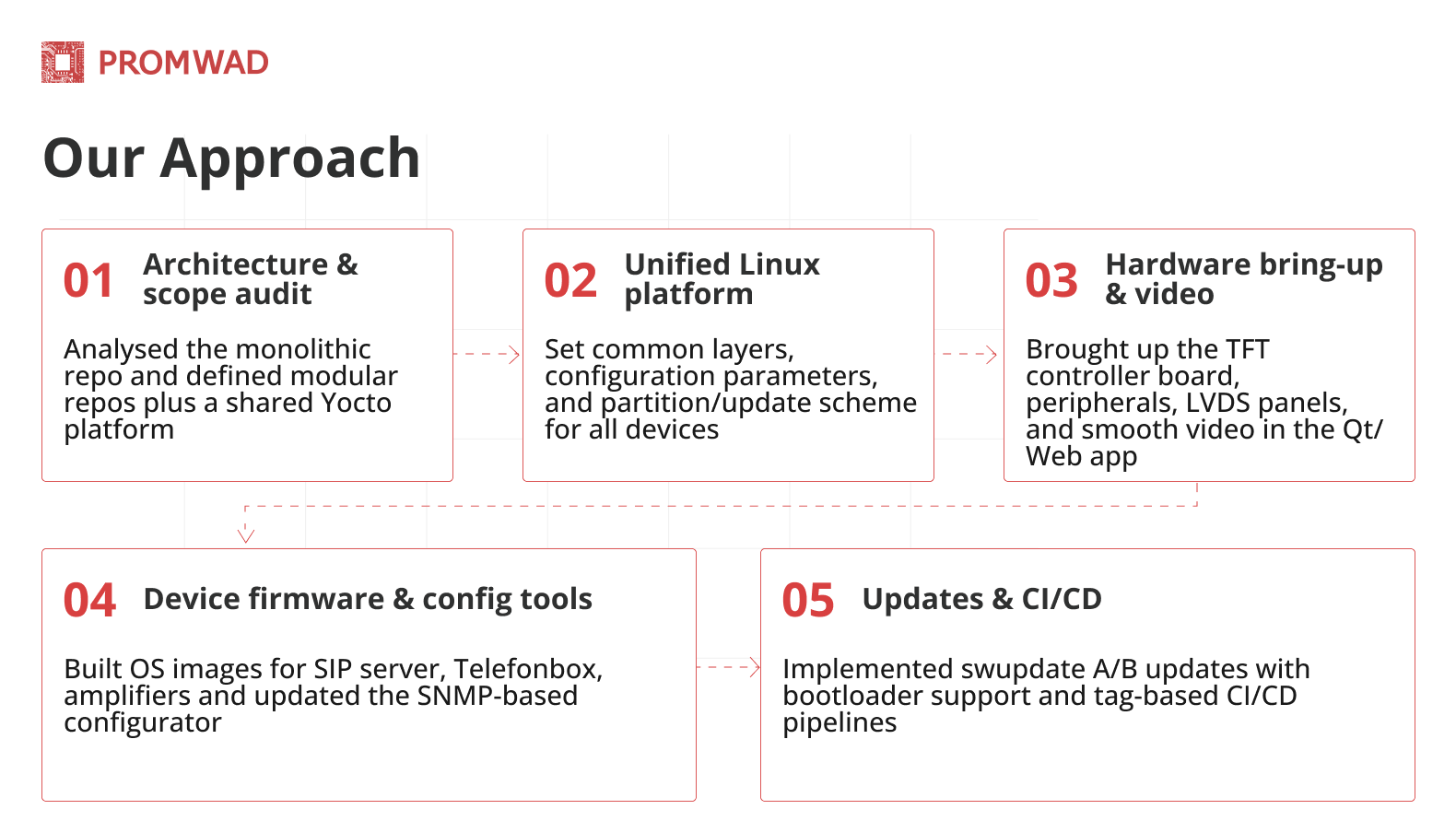
The team carried out a complete reorganisation of the client’s software environment and built a unified embedded Linux platform for all passenger information devices — displays, voice announcers, and onboard telephony:
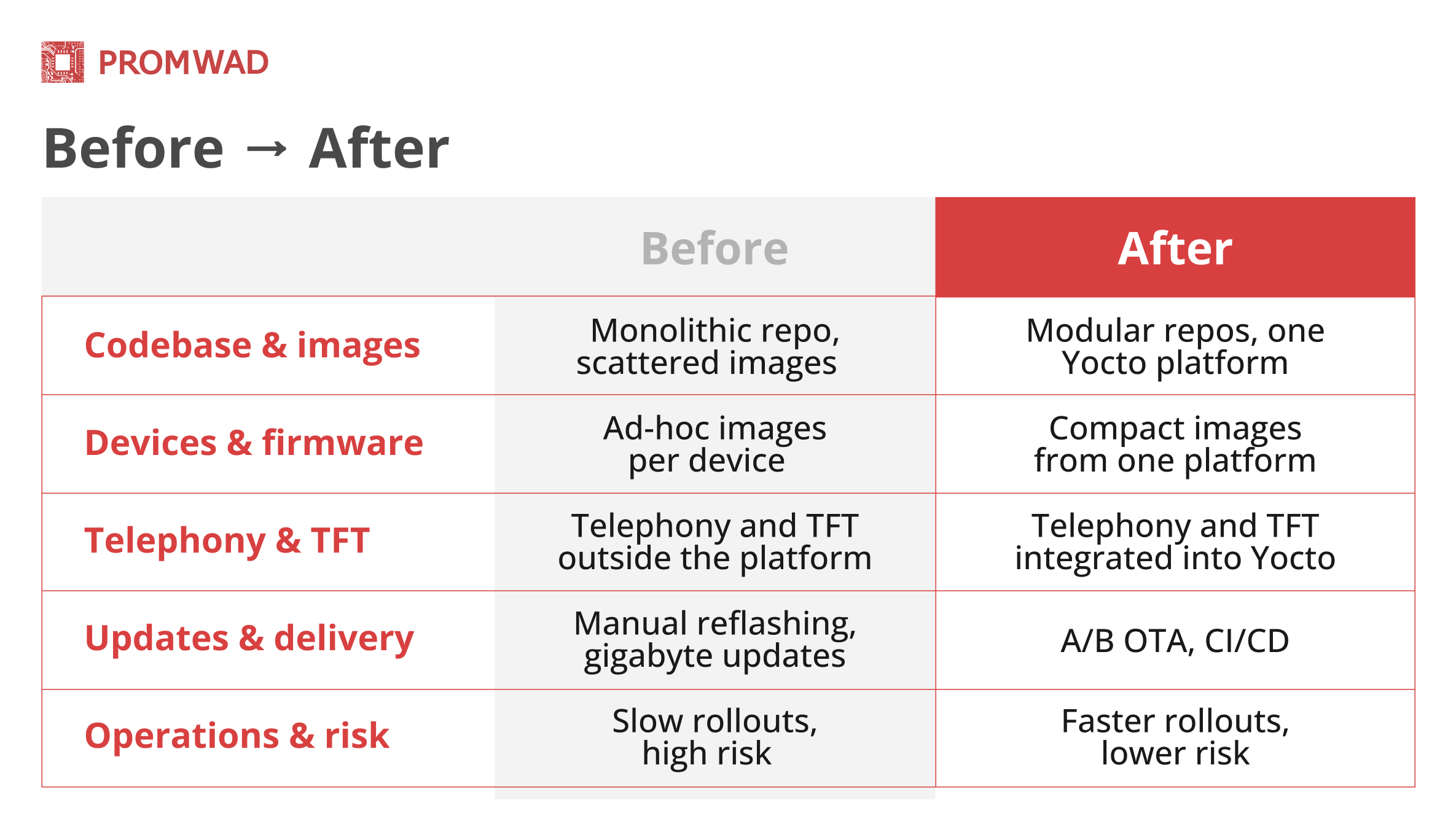
- One platform for all devices. Compact Linux images now power the SIP telephony server, TFT display controller, audio amplifiers, and the telefonbox unit. Each image fits strict storage limits and matches the hardware configuration of its device.
- Telephony server ready for deployment. Our engineers created a Yocto-based image that bundles the telephony application and the FreeSWITCH stack, with integration and codecs implemented from scratch. This image provides the customer with a dedicated, production-ready server for onboarding voice calls and announcements.
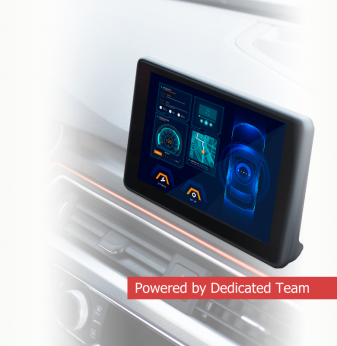
- Modern display and audio controller. The new NXP-based TFT controller board drives multiple display panels, touch, audio, and other peripherals while playing video smoothly inside the client’s Qt/Web application. Custom OS images for audio amplifiers and the telefonbox communicate reliably with their SOM modules and on-board microcontrollers.
- Unified configuration, updates, and releases. A shared configuration tool now manages all devices, and dual-partition software updates keep data and settings safe. CI/CD pipelines build new images and update packages from tagged releases in the client’s Git repositories.
Business Value
More of What We Do for Public Transport
- Urban Mobility: explore our expertise in the development of embedded systems and software applications for urban mobility.
- Transport Monitoring System: a case study of the development of a modern transport monitoring platform that improves accessibility for people with disabilities and optimises energy consumption.
- Connected Cars: our research into how V2X technology is transforming the automotive industry, with a particular focus on its impact on public transport.
FAQ
What HMI devices and building blocks do you engineer for public transport?
Passenger displays, onboard LED/LCD destination signs, onboard infotainment & multimedia platforms, driver terminals and control interfaces, ticketing & POS systems, and real-time passenger information systems (PIS).
Which transport domains do you cover with these HMI solutions?
Buses and coaches, trams and light rail, railways and metro, airports (FIDS, baggage claim monitors, kiosks), smart cities (VMS, parking guidance, urban totems), and highways & traffic (lane control and tolling displays).
What hardware expertise do you bring for transport-grade HMIs?
We design railway-grade embedded platforms tested for temperature extremes, vibration, humidity, and electrical immunity.
Can you help with subsystem integration and data flow engineering?
Yes — we engineer passenger information display systems and related data flows, including GPS-triggered announcements, CCTV feeds, predictive analytics, and modular POS architectures.
What software and connectivity technologies do you work with?
Embedded software with RTOS and Linux, plus IoT/5G/Wi-Fi/mesh communications for real-time data exchange.