WebAssembly in SDV Platforms — Experimental Applications

In the last few years, WebAssembly has quietly stepped out of the browser and into places where you would normally expect C, C++, or tightly controlled RTOS code: embedded devices, industrial controllers, gateways, and now early software-defined vehicle (SDV) platforms.
For SDV architects, WebAssembly (Wasm) is interesting for one simple reason: it promises a safe, portable way to run third-party or fast-changing code on top of long-lived, safety-critical platforms. Instead of shipping a new firmware or container image for every small change, you push a small Wasm module that runs in a sandbox with clearly defined capabilities.
The technology is still experimental in automotive. Nobody is replacing safety-critical AUTOSAR code with Wasm modules tomorrow. But OEMs, Tier-1s, and platform vendors are already testing WebAssembly in SDV prototypes, dev sandboxes for vehicle APIs, and edge analytics workloads.
In this article, we’ll look at why WebAssembly is on the SDV radar, the experimental use cases people are exploring, and the architectural questions you need to answer before putting Wasm anywhere near a production vehicle. We’ll also touch on how engineering partners like Promwad can help turn these experiments into something robust enough for real deployments.
1. Why WebAssembly Even Shows Up in SDV Discussions
For years, embedded automotive software has been shaped by a few hard realities:
- ECUs live for a decade or more.
- Safety and security requirements are strict.
- Any “dynamic” behavior is heavily constrained.
- Toolchains and runtimes age quickly compared to vehicle lifetimes.
At the same time, SDV platforms are trying to behave more like cloud systems:
- frequent feature updates,
- dynamic deployment,
- third-party extensions,
- experimentation and A/B testing,
- common logic shared between cloud, edge, and vehicle.
WebAssembly sits right in this tension:
- It’s portable: compile once, run on any CPU where a Wasm runtime is available.
- It’s sandboxed: by default, modules can’t escape their runtime or touch the OS directly.
- It’s language-agnostic: you can write code in Rust, C/C++, Go, TinyGo, AssemblyScript, and other languages and compile to the same module format.
- It’s small: modules are compact, quick to download, and cheap to update over limited bandwidth.
For SDV architects, this combination looks like a plugin mechanism for the car: a way to run untrusted or semi-trusted code under strict control, while keeping the base platform stable and certifiable.
2. What WebAssembly Actually Brings to an SDV Platform
To understand why WebAssembly is interesting in SDV, it helps to reduce it to three core capabilities.
2.1 A sandboxed execution environment
Wasm runtimes execute bytecode in a sandbox. By default, the module:
- cannot access the file system,
- cannot open sockets,
- cannot touch hardware directly,
- cannot allocate arbitrary OS resources.
Everything it can do must be explicitly exposed by the host through an interface like WASI or a custom API layer.
In an SDV context, that means you can:
- define a small set of vehicle APIs (telemetry, climate control, media, etc.),
- expose them to a module in a controlled way,
- revoke or limit capabilities per module,
- track resource usage and enforce quotas.
This is much closer to a zero-trust model than simply letting third-party code link against your OS libraries.
2.2 Cross-platform, cross-domain portability
With WebAssembly, the same business logic can run:
- in the cloud (for back-office processing),
- on an edge node in the dealership or depot,
- in the vehicle (inside the SDV platform),
- and, in some cases, even in the browser for simulation or HMI.
This duality — same module on cloud and vehicle — is very attractive for SDV scenarios like:
- running the same personalization logic both in the backend and in-car,
- testing algorithms in the cloud before pushing them to vehicles,
- simulating vehicle behavior in digital twins with the same code you ship to the car.
2.3 A component model for modular SDV software
Work around the WebAssembly component model aims to make Wasm modules into reusable building blocks that can be composed, versioned, and type-checked across languages.
In SDV terms, that starts to look like:
- cross-language components for routing, pricing, recommendations, analytics,
- clear interface contracts between vehicle modules and OEM app ecosystems,
- more manageable ways to evolve APIs without rewriting everything.
None of this is finished yet, but the direction aligns well with SDV platform needs.
3. Experimental Use Case 1: In-Vehicle App Sandboxes
One of the most talked-about SDV ideas is an OEM developer sandbox: an environment where third parties can build add-on apps or micro-features for the car, using a stable set of vehicle APIs, without compromising safety or privacy.
WebAssembly is a natural candidate for this sandbox layer.
3.1 How a Wasm-based app sandbox might work
High-level picture:
- The SDV platform provides a vehicle SDK that targets WebAssembly.
- Apps are built as Wasm modules that use this SDK to:
- read non-critical vehicle signals,
- send limited commands (for example, HVAC presets or media settings),
- access user preferences with proper consent,
- request cloud data through a controlled proxy.
- read non-critical vehicle signals,
- Modules are signed, deployed, and updated through the OEM’s SDV backend.
- The runtime enforces:
- CPU and memory limits,
- API access policies,
- isolation between modules,
- strict logging and audit trails.
- CPU and memory limits,
This enables simple applications such as:
- personalized climate or seat settings per user profile,
- trip-aware recommendations (charging stops, breaks, points of interest),
- fleet-specific helpers (inspection checklists, delivery workflows).
These sit “above” the safety-critical stack: they don’t replace braking or steering logic; they complement the user experience and operational workflows.
3.2 Why not just use containers?
Containers are already popular in SDV reference architectures, especially for central compute and cloud-connected functions.
Compared with containers, WebAssembly modules:
- start faster,
- are smaller to distribute,
- require fewer dependencies,
- have a narrower, more explicit security surface,
- don’t bring their own OS image.
In practice, an SDV platform may end up using both:
- containers for long-running platform services and orchestrated workloads,
- WebAssembly modules for fine-grained, user- or fleet-specific logic that needs strong sandboxing and fast rollouts.
4. Experimental Use Case 2: Edge Analytics and Policy Engines
Another promising area is edge analytics — running small pieces of logic close to where data is produced, so you don’t stream everything to the cloud.
In an SDV, that might mean:
- processing sensor data in a gateway or zone controller,
- aggregating events for fleet reporting,
- applying per-market, per-fleet, or per-driver policies at the edge.
4.1 Why WebAssembly fits edge analytics in vehicles
WebAssembly is already being tested in IoT and industrial systems as an edge runtime because:
- it runs well on constrained devices with lean runtimes,
- the sandbox model is attractive when multiple stakeholders contribute logic to the same device,
- short-lived, event-driven workloads map nicely to function-style modules.
In automotive, you could imagine:
- a zone controller running base firmware plus Wasm modules that implement fleet-specific rules (e.g., extra logging for a pilot program, regional compliance logic, custom diagnostics),
- a connectivity ECU running Wasm modules that decide which data to upload, at what rate, and under which roaming or contract conditions.
4.2 Tying it back to SDV architecture
SDV reference architectures already assume:
- zonal gateways,
- Ethernet backbones,
- cloud-connected data pipelines.
WebAssembly doesn’t replace these elements; it provides a portable execution layer for small units of logic inside them. That’s a good match for OEMs and fleet operators who want to:
- iterate on data logic faster,
- test new analytics or upload policies on a subset of vehicles,
- keep more processing in the vehicle for privacy and bandwidth reasons.
5. Experimental Use Case 3: Digital Twins and SDV Simulation
Software-defined vehicles introduce another headache: how do you test complex changes safely, quickly, and realistically?
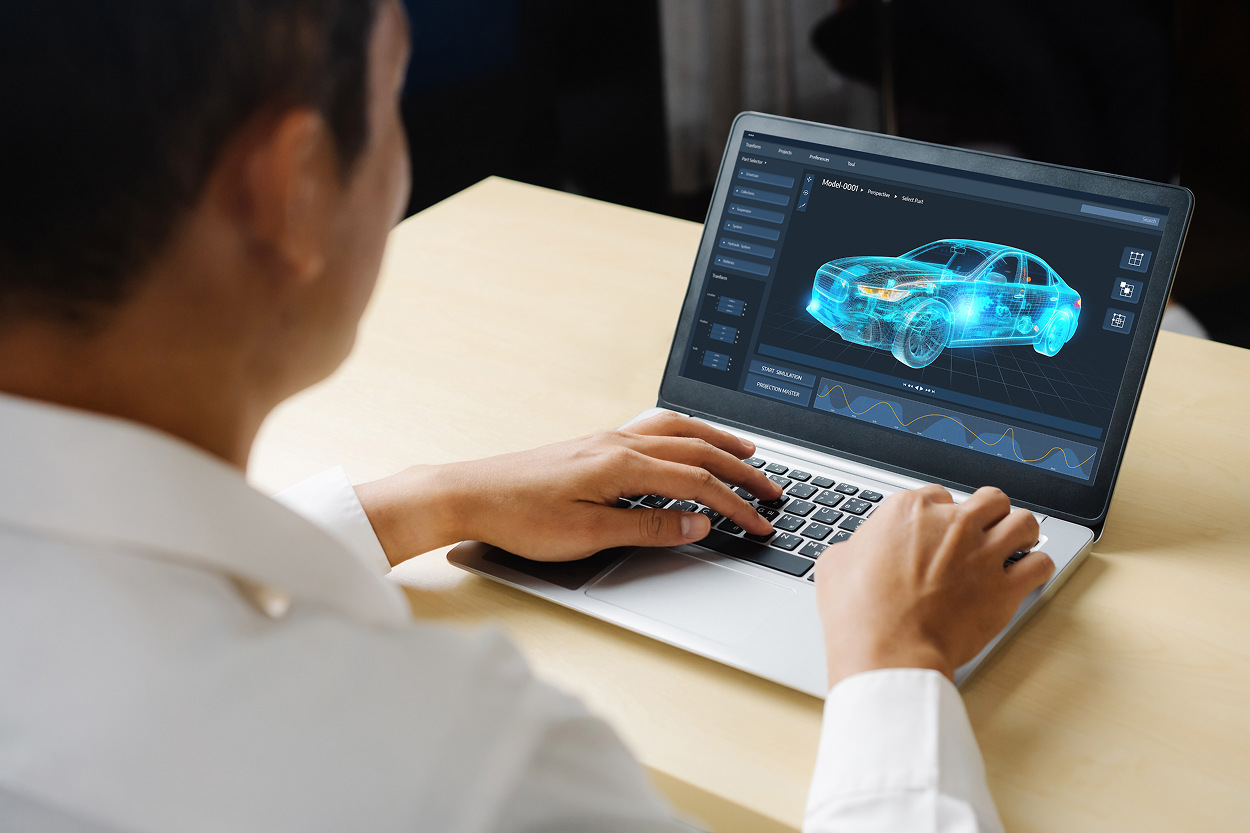
Digital twins and simulation platforms are one answer. They let you run SDV software against simulated vehicles, roads, and users, long before anything reaches production. WebAssembly naturally fits here as a bridge between development, simulation, and in-car runtime.
5.1 Same module, three environments
Imagine writing a module for:
- energy-aware route recommendations,
- comfort profiles for different drivers,
- dynamic pricing for in-car services.
With a Wasm-based architecture, you could:
- run the module in a cloud simulator for large-scale testing,
- embed it into a desktop or browser-based twin of vehicle behavior,
- deploy the same compiled module into the SDV platform in real vehicles.
Because the module is sandboxed and talks to its environment through stable interfaces, most of the complexity lives in the host implementation, not the module itself. That makes it easier to reuse the same logic across environments.
5.2 Better experimentation and A/B testing in vehicles
There is growing interest in bringing A/B testing and controlled experimentation into automotive software for non-safety-critical features.
WebAssembly offers a convenient way to:
- ship multiple variants of a feature as separate modules,
- assign different vehicles or driver cohorts to different variants via configuration,
- gather behavior and engagement metrics,
- roll back by disabling or replacing a module instead of reflashing firmware or rebuilding an entire container image.
This pattern is still early in automotive, but it leverages practices that are already well-understood in web and cloud development.
6. Experimental Use Case 4: Privacy-Preserving In-Car Experiences
Another line of experimentation combines WebAssembly with privacy-preserving analytics. The idea is to push more logic into the vehicle so that sensitive data never leaves the car in raw form.
6.1 Local processing, restricted data egress
A Wasm-based SDV setup might:
- collect raw sensor data (location, video, voice, biometrics) within protected domains,
- expose only filtered, aggregated, or anonymized views to WebAssembly modules through host APIs,
- enforce strict limits on what data modules can send back to the cloud,
- rotate or revoke modules if they misbehave or become obsolete.
In this model, the OEM or platform provider controls:
- the WebAssembly runtime,
- the host APIs,
- the outbound communication channels,
- the audit trail and observability.
Third-party or internal feature teams can implement personalized experiences with less risk of leaking raw data.
6.2 Combining Wasm with secure hardware
Some experimental architectures also look at combining WebAssembly runtimes with Trusted Execution Environments (TEEs) or other hardware security features, treating WebAssembly as a portable execution format inside a hardware-rooted security boundary.
For SDV, this could one day support:
- highly sensitive in-car analytics based on protected signals,
- secure, auditable “skills” or “agents” that run locally,
- verifiable execution of third-party logic without exposing secrets.
We’re still early here, but the building blocks are appearing in other industries, and SDV platforms are well positioned to reuse them.
7. What’s Not Ready Yet: Challenges and Open Questions
All of this sounds promising, but WebAssembly in SDV platforms is still experimental for good reasons.
7.1 Real-time and performance constraints
Most current WebAssembly runtimes are optimized for:
- throughput,
- portability,
- startup time.
They are not built for hard real-time determinism. Benchmarks on embedded devices show that Wasm can be fast for many workloads, but there is still overhead compared to native code, especially if you don’t fine-tune the runtime.
For now, that keeps WebAssembly in the non-safety-critical, soft real-time domain: app logic, UX, analytics, policies — not core control functions.
7.2 Certification, safety, and tool qualification
Regulations and standards such as ISO 26262 and ISO 21434 were not written with WebAssembly in mind. Toolchains, runtimes, and component models need:
- safety arguments,
- security assessments,
- maturity in the supply chain,
- long-term support commitments.
Until the ecosystem offers safety-qualified WebAssembly runtimes and toolchains, SDV teams will likely keep Wasm away from anything ASIL-classified and focus on non-critical features and experiments.
7.3 Standardizing automotive APIs for WebAssembly
WASI gives a portable, modular API surface for interacting with the host environment, but it is generic: files, sockets, clocks, and so on.
SDV platforms need something more specific:
- access to selected vehicle signals,
- control of non-critical actuators,
- secure communication with IVI and cloud components,
- exposure of configuration and identity.
The industry is only starting to discuss what a common “automotive WASI” or standard vehicle API for WebAssembly modules might look like. Without that, each OEM may design its own flavor, which hurts portability and third-party adoption.
7.4 Developer experience and debugging
Onboarding developers into WebAssembly for SDV involves several layers:
- learning the language toolchain (for example, Rust or C++ to Wasm),
- understanding the platform’s host APIs and security model,
- dealing with limited debugging visibility inside a sandbox,
- working with new component and interface description tools.
Compared to traditional embedded development, this is both an opportunity (modern tooling, polyglot options) and a hurdle (new concepts and workflows).
8. How Engineering Partners Like Promwad Fit Into This Picture
For most OEMs and Tier-1s, WebAssembly will not replace their existing embedded stack. It will add a new layer on top of it — a dynamic, sandboxed extension mechanism for SDV platforms.
An engineering partner like Promwad can help in several ways:
- Platform experiments
Designing and prototyping WebAssembly-capable SDV edge nodes, IVI components, or gateways that can host Wasm modules alongside traditional automotive software.
- Runtime integration
Integrating lightweight WebAssembly runtimes into Linux-based ECUs, IVI systems, or zonal controllers, and binding them to well-defined vehicle APIs.
- Security and sandbox design
Defining capability models, resource limits, update flows, and audit requirements for in-vehicle modules.
- Tooling and developer experience
Building SDKs, example modules, and dev sandboxes that let OEM or third-party developers experiment safely with WebAssembly-based features.
- From proof of concept to production
Taking early WebAssembly experiments and turning them into maintainable components inside a broader SDV architecture, with clear boundaries relative to safety-critical subsystems.
The underlying SDV stack — AUTOSAR, Linux, hypervisors, connectivity, cloud integration — remains essential. WebAssembly simply adds a new, more flexible way to extend it.
AI Overview — WebAssembly in SDV Platforms
Key Applications
In-vehicle app sandboxes for OEM and third-party features; edge analytics and policy engines in gateways and zonal controllers; shared logic between cloud, digital twins, and vehicle; privacy-preserving in-car personalization; experimental A/B testing and rapid feature iteration in non-critical domains.
Benefits
Strong isolation and a zero-trust execution model; portability of modules across cloud, edge, and in-vehicle runtimes; smaller update payloads compared to full containers or firmware; polyglot development with modern languages; a path towards more modular, contract-based SDV software.
Challenges
Runtime overhead and limited suitability for hard real-time workloads; immature certification story for safety-critical automotive systems; absence of standardized automotive APIs for WebAssembly; evolving tooling and debugging workflows; need for careful security and resource governance in multi-tenant SDV platforms.
Outlook
In the near term, WebAssembly in SDVs will stay focused on experimental and value-added features: UX, analytics, personalization, and data policies. Over time, as runtimes, component models, and standards mature, Wasm is likely to become a standard mechanism for extending SDV platforms with safe, portable plugins, while the core safety stack remains in proven native technologies.
Related Terms
WebAssembly (Wasm), WASI, SDV platform, edge computing, in-vehicle app sandbox, OEM developer sandbox, component model, automotive IoT, software-defined vehicle architecture.
Our Case Studies