5G Edge Demo Platform for Mobile World Congress, Built in 30 Days
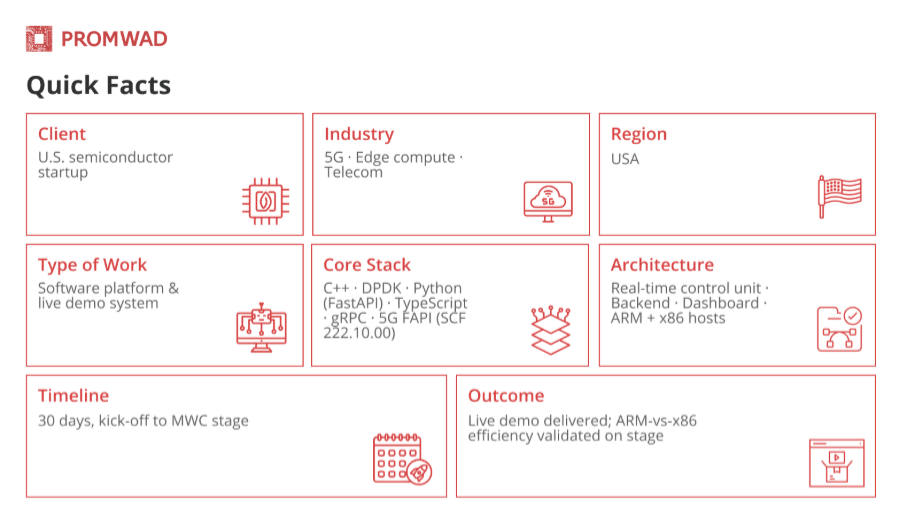
Project in a Nutshell: Promwad delivered the full software stack: the layer that talks to the client's 5G L1 datapath, the backend that coordinates both servers, and the dashboard the audience actually saw. The whole thing ran live at Mobile World Congress and validated the client's core architectural claim with measured numbers.
Client & Challenge
Our client is a U.S. semiconductor company developing a chiplet-based edge compute platform: ARM CPU chiplets paired with a dedicated processing unit, built for the AI and 5G workloads that telecom operators are pushing to the network edge. The pitch is cloud-grade performance at a fraction of the power draw of conventional server hardware.
We had worked with them once before, on a short DPDK consulting engagement that helped resolve a few architectural questions before they went back to refining the concept internally.
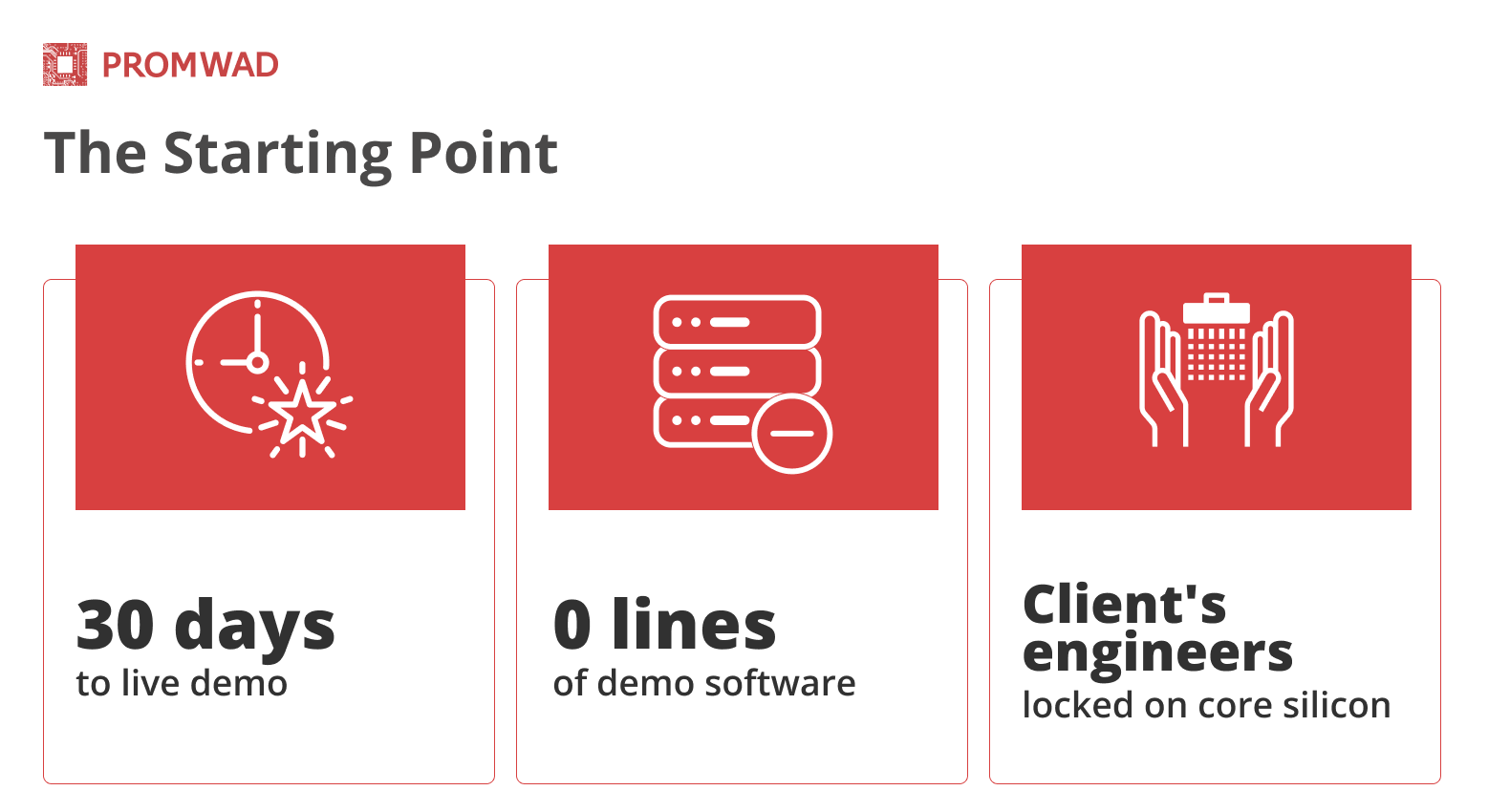
Several months later they returned with a harder request: a live demo at Mobile World Congress in 30 days. Their engineering team was deep in the computational core, a complete implementation of a 5G L1 datapath, so they brought Promwad in to own the surrounding stack entirely.
Solution
Promwad took ownership of everything around the client's computational core: the software that runs it and gets its output in front of an audience. The system is three layers working together.
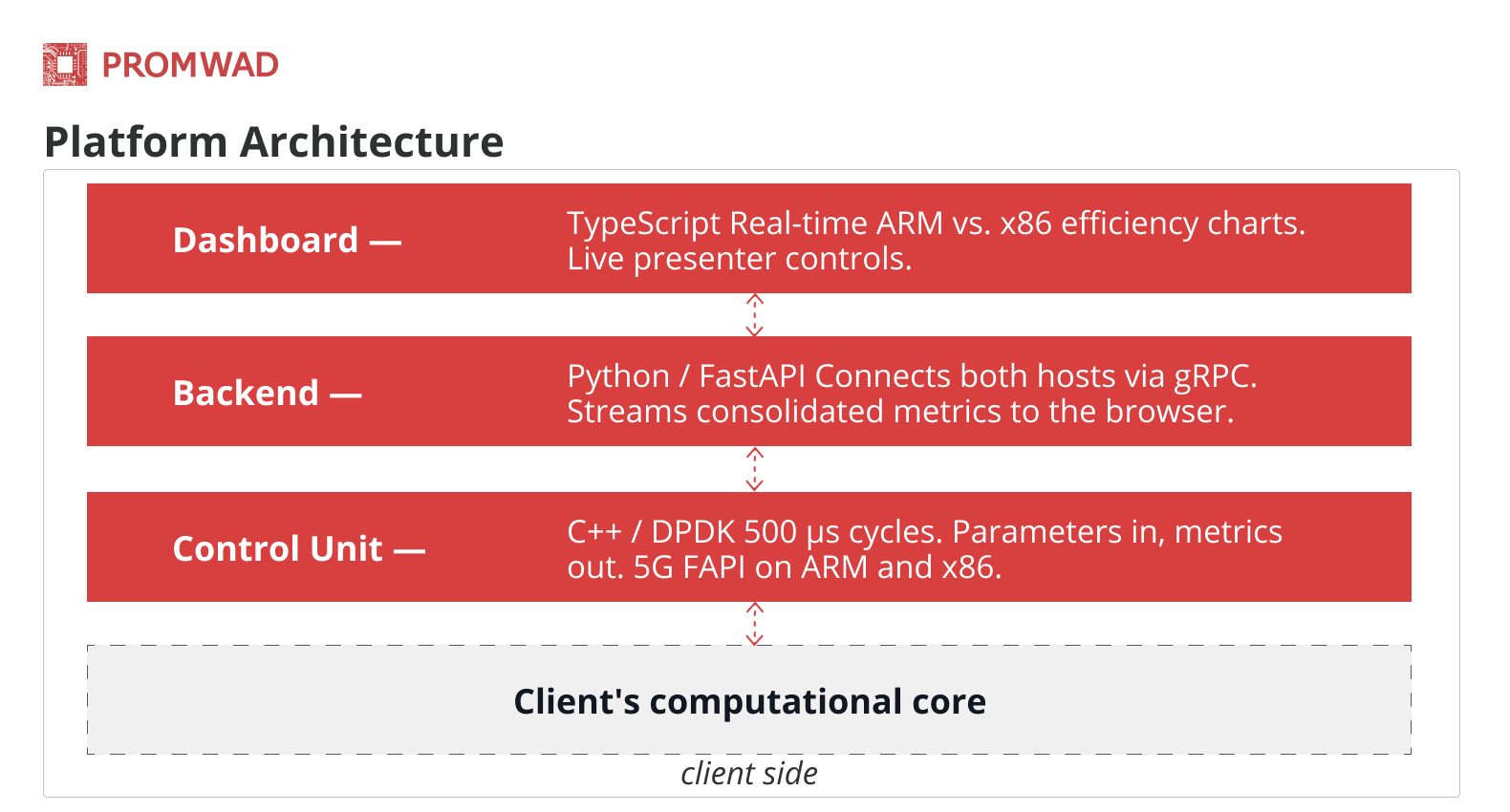
The lowest layer is the Control Unit, written in C++ on top of DPDK. Every 500 µs it pushes a fresh batch of parameters into the client's 5G L1 datapath, a full real-time implementation of the physical layer processing stack, then collects metrics back. Every message is serialised to the 5G FAPI standard (SCF 222.10.00). Multiple instances run in parallel across both hosts, ARM and x86. This is the layer that determines whether the demo holds up under live load.
Sitting above it is the backend, built in Python on FastAPI. It connects to both Control Units over gRPC, coordinates execution across both platforms and routes commands coming from the dashboard, consolidates metrics from both architectures into a single live feed, and streams everything to the browser over WebSocket.
The top layer is the dashboard the audience actually saw. It is a TypeScript-based web interface featuring real-time graphs that compare the energy efficiency of ARM and x86 architectures side by side, as well as interactive controls that allow the presenter to adjust workload parameters during the demonstration. The goal was to let viewers test the hypothesis for themselves, rather than just watch a pre-recorded animation.
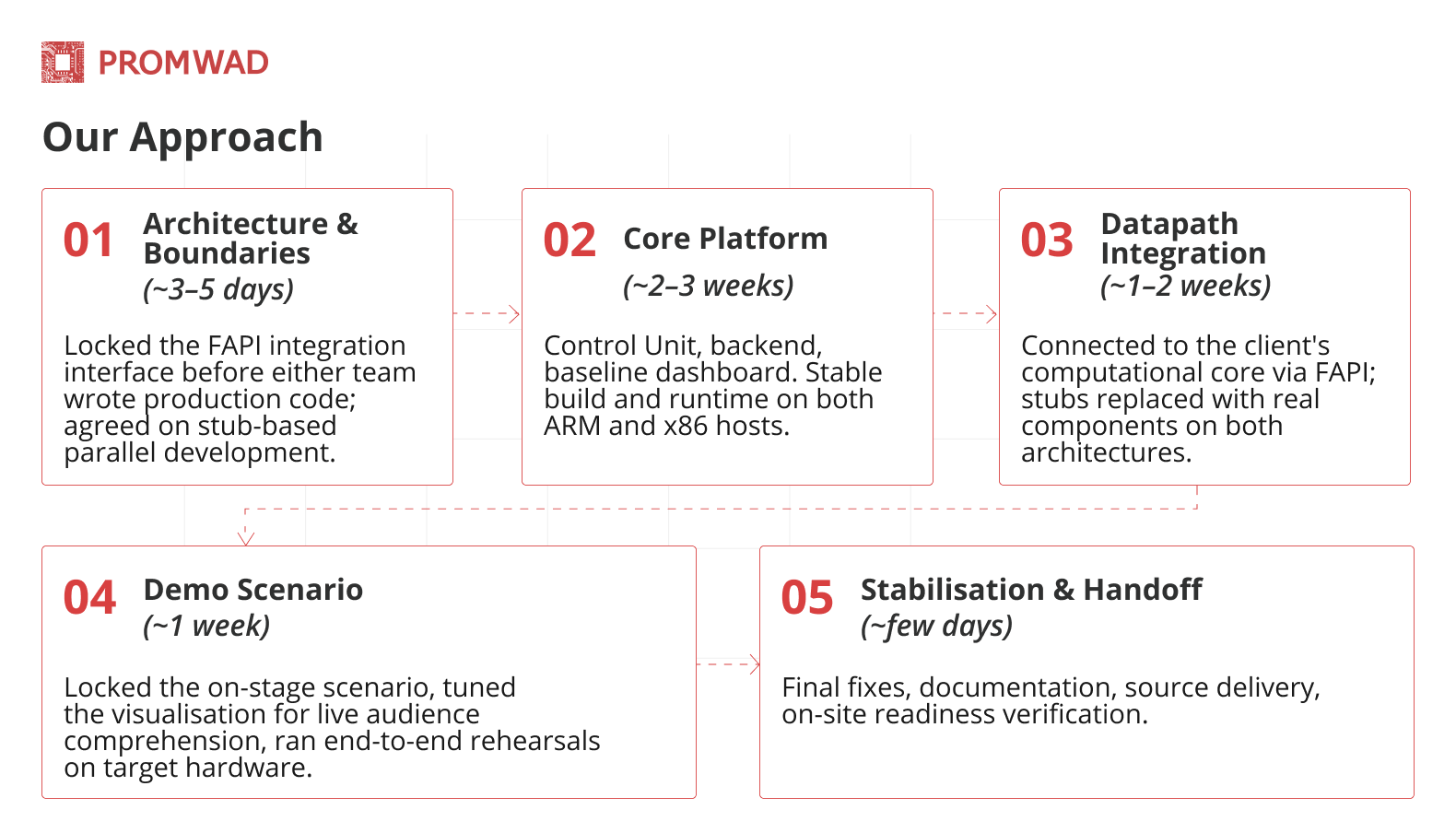
The team was small and built without role overlap: a project manager, a frontend developer, and a backend group covering the Control Unit and orchestration layer. Decisions with the client's engineers were made in regular working calls and locked in with written follow-ups, which is the only mode that holds when two engineering teams are building adjacent components against the same hard deadline.
Business Value
The client left the event with a measured result rather than a promise: the energy-efficiency advantage of their ARM-based architecture over x86 was demonstrated live and under representative workload conditions. The platform we built remains their demonstration foundation as they prepare the next funding round and begin the move toward dedicated silicon.
More of What We Do for DPDK
- SPDK & DPDK Solutions: our expertise in high-performance packet processing for telecom, edge computing, and 5G applications.
- TCP PEP and QoS Modules for HTS Satellite Communication: how we used DPDK to handle TCP traffic and bandwidth limits in a geostationary satellite network.
- How Promwad Maximizes Network Speed with DPDK: what DPDK actually does and how we use it to reduce latency in production systems.
FAQ
Why use DPDK for a 5G edge demo instead of the standard Linux network stack?
The Linux kernel network stack adds overhead and latency that breaks down under high packet rates. DPDK bypasses the kernel, runs in user space, and writes directly to the network interface card, delivering up to 10x faster packet processing. For a 5G edge workload running 500 µs slot cycles across multiple parallel datapath instances, that difference is the gap between a working demo and a stalled one.
Can Promwad work with DPDK across multiple hardware platforms?
Yes. DPDK was originally Intel-focused but now supports hardware from many vendors. In this project the same software stack ran on ARM (AArch64) and x86 server hosts side by side, with identical performance characteristics on both — which is how the energy-efficiency comparison became possible in the first place.
Where does DPDK fit in modern 5G architecture?
DPDK is one of the building blocks for 5G core networks, network slicing, and NFV. In edge deployments it enables real-time packet and frame processing close to the data source — which is exactly the scenario this demo platform was built to validate.
What's the difference between DPDK and kernel-based approaches like eBPF/XDP?
DPDK runs in user space and bypasses the Linux kernel entirely, giving the application full control over packet flow with the lowest latency and highest throughput. eBPF/XDP run inside the kernel and integrate tightly with the existing network stack. DPDK fits better when you need maximum performance and custom packet handling, like a 5G L1 datapath. eBPF/XDP fit better when you want kernel integration for monitoring, security, or tracing.
Do you have other DPDK case studies we can review?
Telecom service providers, network equipment manufacturers, cloud and data centre operators, finance and trading firms, cybersecurity companies, and businesses running high-traffic CDNs. The common thread is workloads that don't tolerate the overhead of a standard network stack.