Debugging and Adding New Functionality to DSP Based on TI Sitara MCU
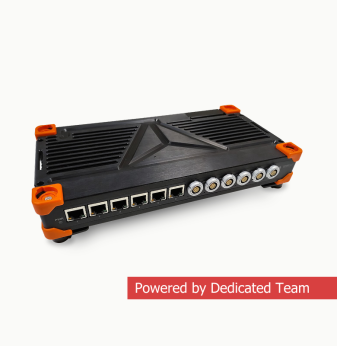
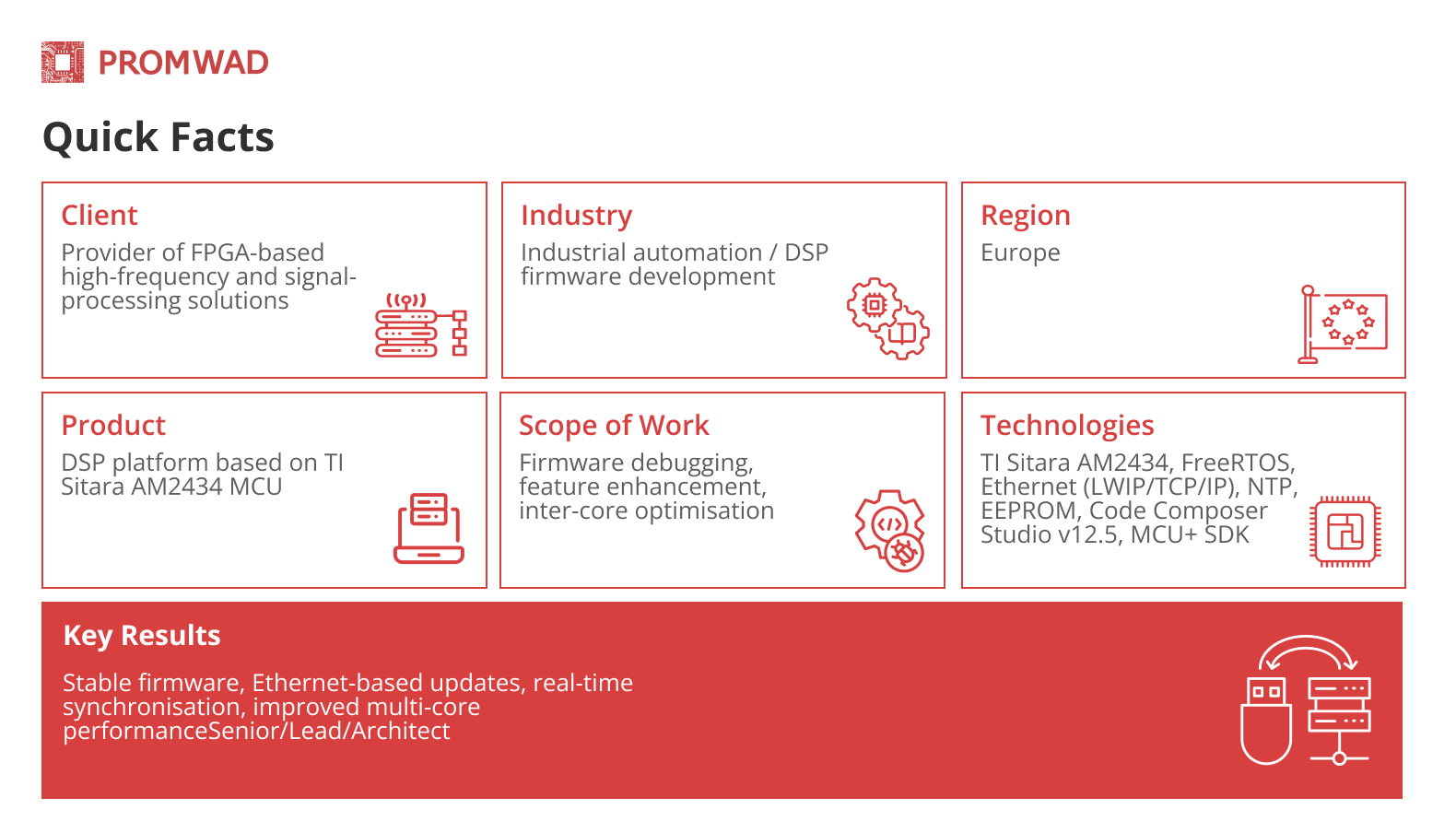
Project in Nutshell: We debugged and added new features to our client's firmware for the digital signal processor based on the Sitara AM2434 MCU from TI. Updates included setting up network time protocol service (NTP) for time synchronisation, updating the firmware over Ethernet, and implementing an inter-core communication mechanism to improve the DSP performance.
Client & Challenge
A leading provider of innovative FPGA-based solutions in high-frequency technology and signal processing approached us for assistance in bridging up, debugging, and adding new features to their firmware.
Solution
1. Software development
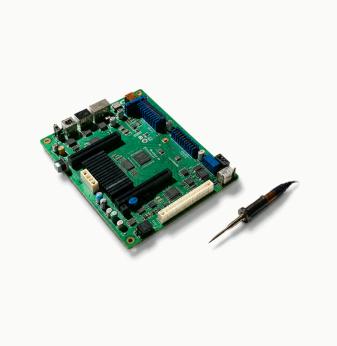
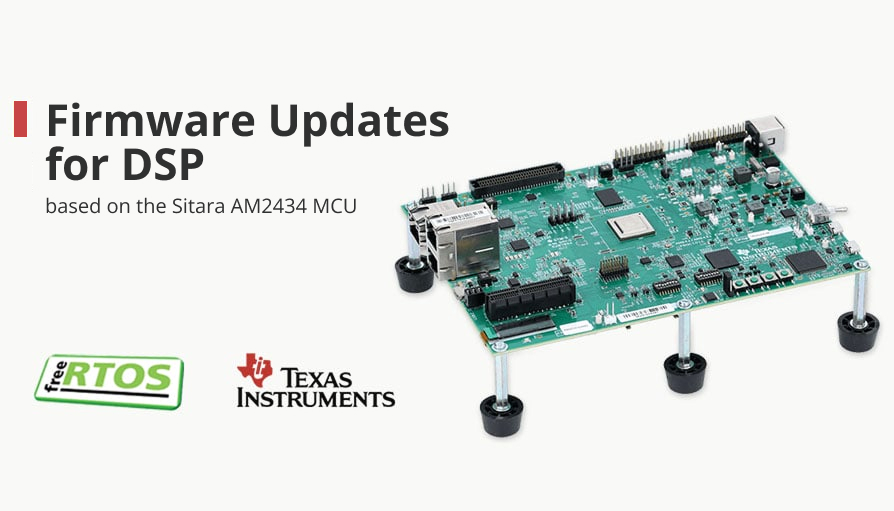
The development was conducted on the AM243x Evaluation Module TMDS243EVM by Texas Instruments with the Sitara ARM processor on board.
The client's software works as follows:
- FreeRTOS, a real-time operating system, runs the multi-thread application;
- each thread processes commands received through UDP and TCP connections;
- commands trigger operations: controlling external peripherals or writing to memory;
- after executing commands, the application sends responses in JSON format back to the sender;
- threads are executed on different cores using the inter-processor communication (IPC) mechanism.
Promwad engineers fixed the existing issues and added new features:
- Fixed application crashes and hangs by debugging RTOS synchronisation mechanisms to control access to shared resources for restructuring command processing tasks.
- Configured network time protocol (NTP) to synchronise the device in real-time.
- Upgraded software over Ethernet without shutting down or rebooting the device.
- Ensured storing of non-volatile parameters such as device IP, serial number, and firmware version on an embedded electrically erasable programmable read-only memory (EEPROM).
- Arranged interaction between cores of the device and ported tasks to other cores.
Technology stack: Ethernet, LWIP, TCP/IP, Code Composer Studio v12.5, MCU-PLUS-SDK-AM243X.
Business Value
Firmware debugging and the introduction of new functions have resulted in our client receiving a correctly working application, which will ultimately improve the DSP's performance and reliability.
More of What We Do for Firmware Development
- MCU Firmware: explore our microcontroller firmware development services, including board support packages, device drivers, middleware, and more.
- Firmware Development for Industrial Protocols: check out this practical example of interface module modernisation and Modbus RTU and HART integration for Euromisure WIKA Italia.
- Promwad Joins NXP’s S32K Ecosystem: our research on the S32K ecosystem as a platform for embedded automotive solutions.
FAQ
How do you onboard an existing RTOS codebase without disrupting timelines?
We start with a focused audit and stabilisation sprint: crash/race analysis, priority & scheduling review, IPC/queue/mutex hygiene, and a risked, time-boxed fix plan. You get a ranked issue list, patch set, test matrix, and clear “green release” criteria, tracked via a weekly/biweekly cadence and a shared change/risk log.
How do you ensure real-time behaviour on multi-core MCUs?
By designing for determinism: priority schemes with bounded critical sections, ISR budgeting, lock-free queues where feasible, and well-defined IPC (mailboxes/RPMsg). We profile latency and jitter under load, set acceptance thresholds (e.g., max wake-up/response times), and prevent regressions with automated tests.
What does a secure, low-downtime Ethernet update look like on MCUs?
Dual-bank images with signature and integrity checks, watchdog-supervised apply, and rollback on failure; configuration (EEPROM/NVRAM) is versioned and preserved. The update service (lwIP/TCP/UDP) logs events for full traceability and can be staged to avoid disrupting real-time tasks.
How do you choose time-sync (NTP vs PTP/IEEE 1588) for industrial networks?
We apply NTP where second-level accuracy suffices; for sub-millisecond alignment across nodes, we enable PTP (and TSN where available), validating jitter, asymmetry, and recovery after link loss. Tests are run on evaluation boards and target hardware to confirm end-to-end behaviour.
Which industrial stacks and platforms can you integrate?
EtherCAT, PROFINET, EtherNet/IP, Modbus (RTU/TCP), OPC UA, CANopen, IO-Link and more — on platforms such as TI Sitara/AMIC (PRU-ICSS), Hilscher netX, and FPGA-based options. Selection is driven by required cycle times, device role (master/slave), and target conformance tests.