
Studio-Grade Turntable Built to Verify Itself
Project in a Nutshell: A US high-end audio manufacturer needed a direct-drive turntable that could prove its precision, not just claim it. Promwad designed the whole device, from mechanics to electronics to firmware, and built the turntable so it measures its own performance in real time, without external analog analyzers needed on the production floor. The design package is ready for prototyping, and firmware development will continue during prototype validation.
Client & Challenge
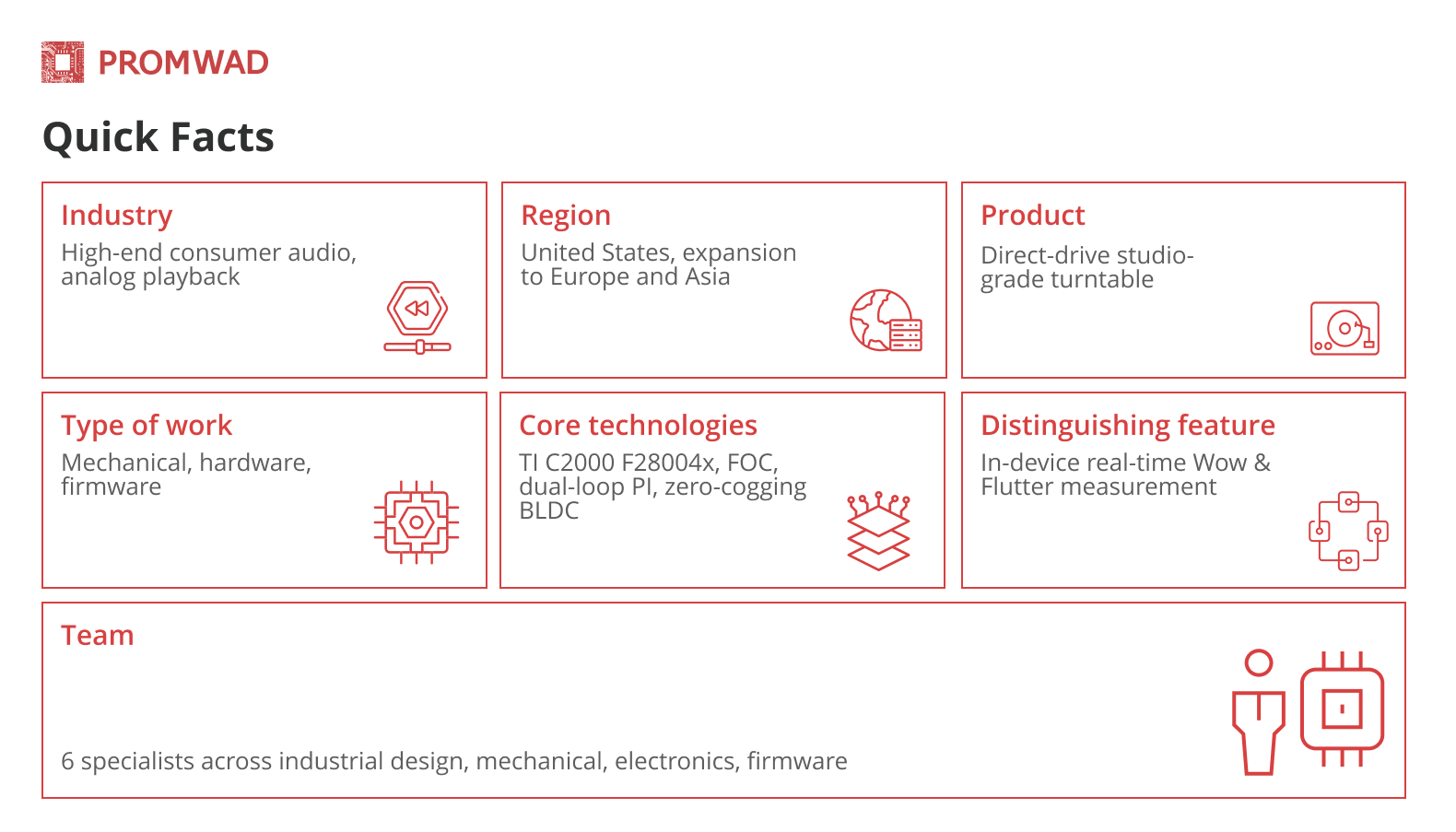
Our client is a US-based manufacturer of high-end direct-drive turntables scaling production across North America, Europe, and Asia. In the studio-grade segment, buyers pay premium prices for precision, and, as the client put it, most manufacturers claim these specifications, but few can back them with measurable data. The client wanted their new product to close that gap: buyers should see the measurements, not take them on faith.
Their internal demo stand could not reach the required precision, and it was unclear whether the cause was mechanical, electronic, or in the control loop. The client asked Promwad for a diagnosis.
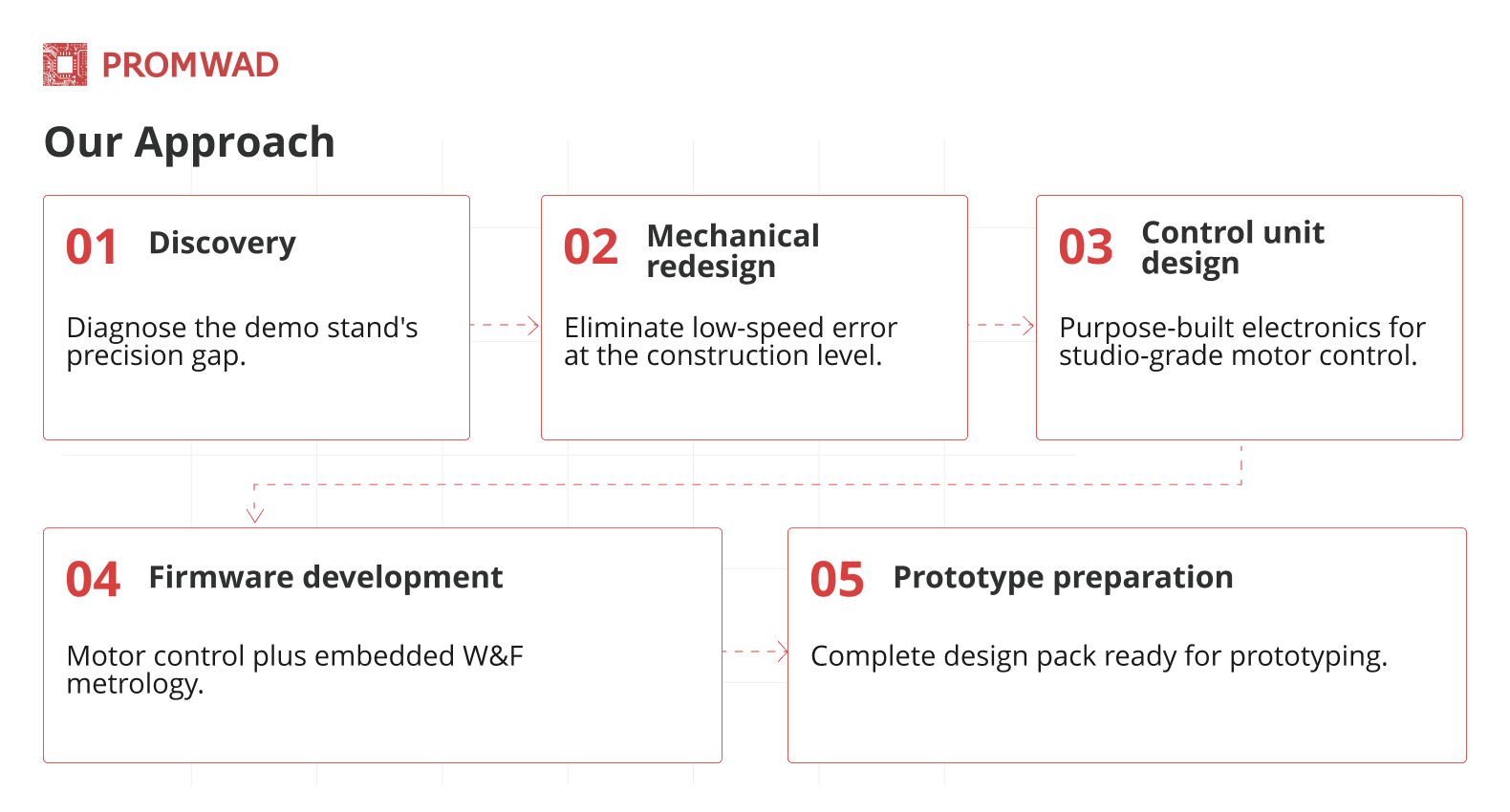
Our discovery phase produced a detailed report separating the causes, and the conclusion was structural: firmware tuning alone could not compensate for what the mechanical construction was doing to the signal. On that basis, the client asked Promwad to take on the complete development cycle.
Solution
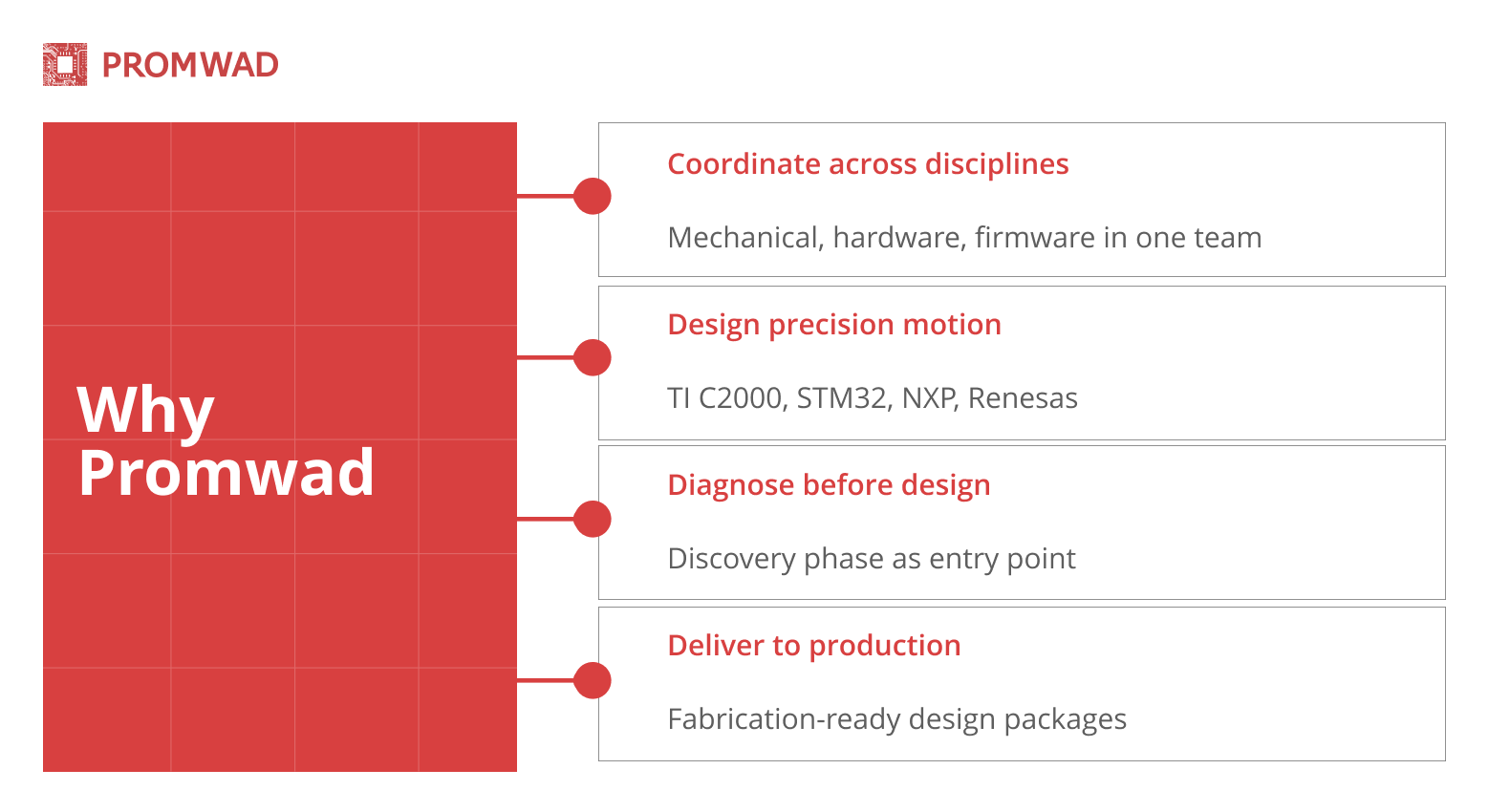
Promwad organized a cross-disciplinary team:
- an industrial designer;
- two mechanical engineers;
- a schematic engineer;
- a PCB designer;
- a firmware engineer.
Work proceeded as one integrated turnkey engagement, with weekly syncs and joint reviews of every key design decision.
The mechanical redesign addressed the sources of low-speed error at the physical level. The control unit was built around the Texas Instruments C2000 platform, a microcontroller family purpose-built for motor control. The firmware handles motor control and, in parallel, measures the device's own rotational performance in real time.
Architecture and Key Decisions
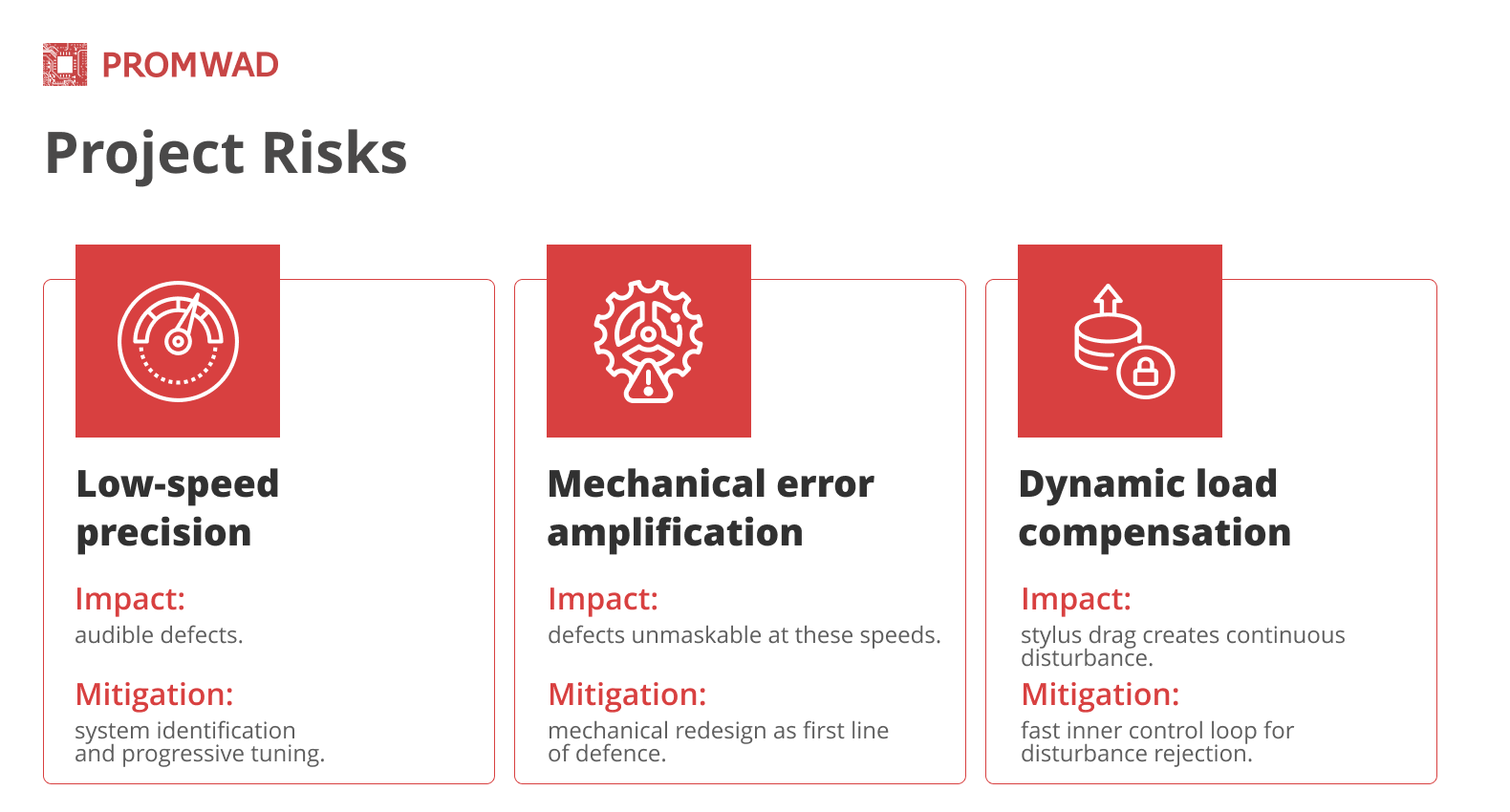
Zero-cogging BLDC as the foundation. Conventional brushless motors produce cogging torque that shows up as periodic speed variation. At vinyl playback speeds of 0.56 to 1.3 Hz, that variation sits in the audible range, so no downstream filter can remove it. A zero-cogging motor cuts the problem at the source.
Field-Oriented Control on TI C2000. FOC decouples torque from flux and delivers smooth motor operation with minimal ripple, which matters because stylus drag creates small continuous load changes across every rotation. The TI F28004x provides the hardware peripherals needed to run FOC at the required update rate: high-speed PWM, encoder interfaces, real-time computation.
Dual-loop PI regulation. The inner loop maintains constant motor current, the outer loop regulates speed. Nested loops are standard practice in precision servo design; the tuning is not. At ultra-low rotational speeds, aggressive gains reduce Wow & Flutter but risk hunting behavior, while conservative gains stay stable at the cost of larger deviations. Final tuning will come from system identification on the prototypes.
Embedded metrology. The firmware processes encoder data in real time to extract slow variations (wow, below 4 Hz) and faster fluctuations (flutter, above 4 Hz), with frequency weighting aligned to industry practice for W&F measurement. That gives the client two things at once: verification upstream on the production floor, and a device that continues to prove itself in the buyer's hands.
Results & Business Value
The client now holds a complete design package ready for prototyping: STEP files for mechanical fabrication and Gerber files for PCBA. Firmware development will continue on the prototypes once they are available, with system identification driving the final tuning of the control loop.
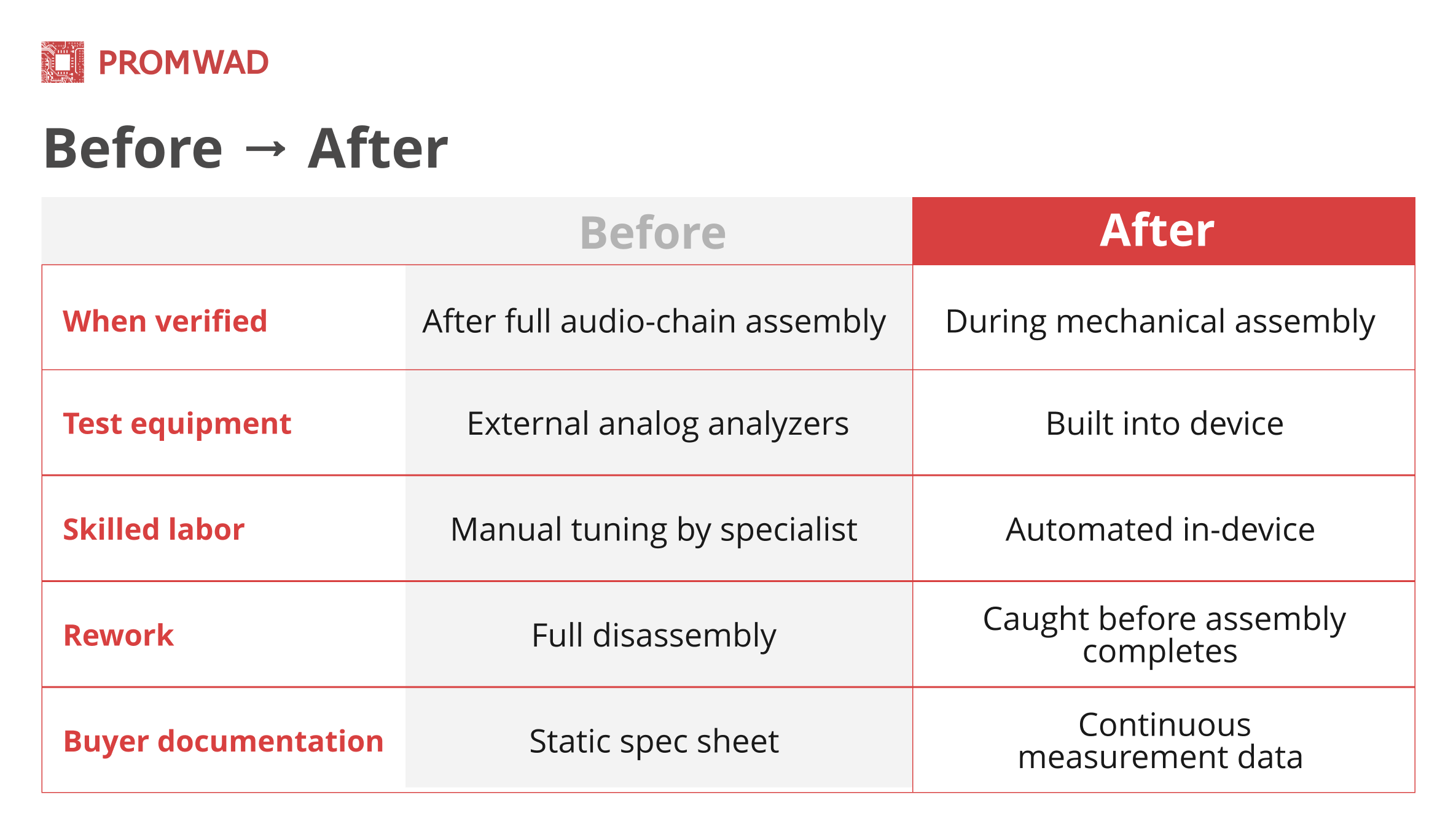
The architecture gives the client two forms of business leverage. Embedded Wow & Flutter measurement moves verification from the end of the assembly line to the mechanical stage, eliminating the traditional loop of full assembly, manual tuning, external verification, and rework on failure. And a device that continuously logs its own performance becomes a differentiator against competitors who ship a static specification sheet, which supports both pricing and expansion across the three regional markets.
Design targets: Wow & Flutter ≤0.02% and speed accuracy ±0.01% across all playback speeds. These will be validated once prototype testing begins.
More of What We Do for Embedded Firmware
- MCU Firmware Development Services: motor-control firmware, board support packages, drivers, and real-time algorithms across TI, STM32, NXP, and Renesas platforms.
- Reusable Robotics Software Platform:how we combined real-time motion control, ROS 2, and 5G on a single embedded controller for a portable robotics stack.
FAQ
Do you develop firmware for motor control and precision signal processing, or only general MCU applications?
Yes. Alongside board support packages, device drivers, and middleware, we develop DSP algorithms optimised for hardware platforms using vendor-provided libraries. This covers demanding signal-processing applications including audio processing and motor control. Our team works across mathematical and DSP algorithm development to meet the requirements of these applications.
Which microcontroller platforms and chip vendors do you work with?
We collaborate with leading chip vendors including Texas Instruments, STMicroelectronics, Microchip, Infineon, Renesas, Analog Devices, NXP, Espressif, Nordic Semiconductor, and Silicon Labs. Our firmware spans a wide range of MCU architectures, from ARM Cortex-M and Cortex-R families to RISC-V, AVR, MSP430, and others. Our tech stack includes vendor toolchains such as TI's Code Composer Studio and CMSIS-DSP libraries.
Can you build firmware on both bare-metal and RTOS, and how do you choose?
Both. We develop bare-metal firmware for devices that perform specific tasks without external control, such as capturing and processing data in real time. We also develop RTOS-based solutions on kernels including FreeRTOS, TI-RTOS, RTEMS, and others, delivering device drivers, middleware, and applications on top. The choice depends on your device's real-time and complexity requirements.
We already have an existing product. Can you add features, fix issues, or migrate it to a new MCU?
Yes. We update existing products with new functionality, fix bugs, and implement modifications. When you provide access to the existing source code, our team analyses it and recommends the best approach for your updates. We also handle legacy firmware migration from one MCU vendor to another with minimal disruption, including PCB re-layout where portability requires it.
How do you help select the right MCU when moving toward production and scaling?
Our experts help you select an appropriate MCU based on your project's specifics and budget. We work closely with global chip vendors to propose several options, outlining the pros and cons of each so you can weigh performance requirements, power consumption, available resources, and engineering costs. Our services cover the entire project cycle, from initial concept through to a market-ready solution and post-launch maintenance.