Edge AI Visual Defect Detection on Videology SCAiLX
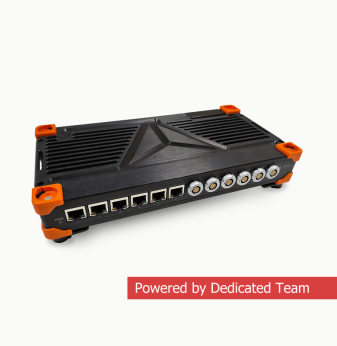
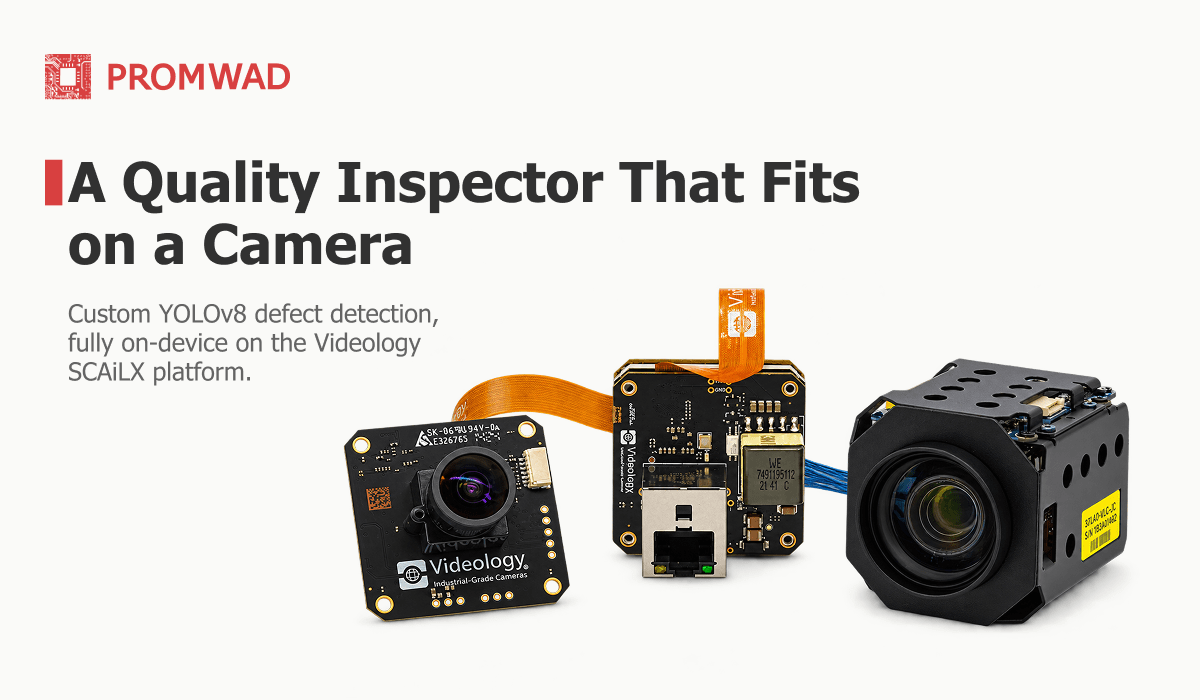
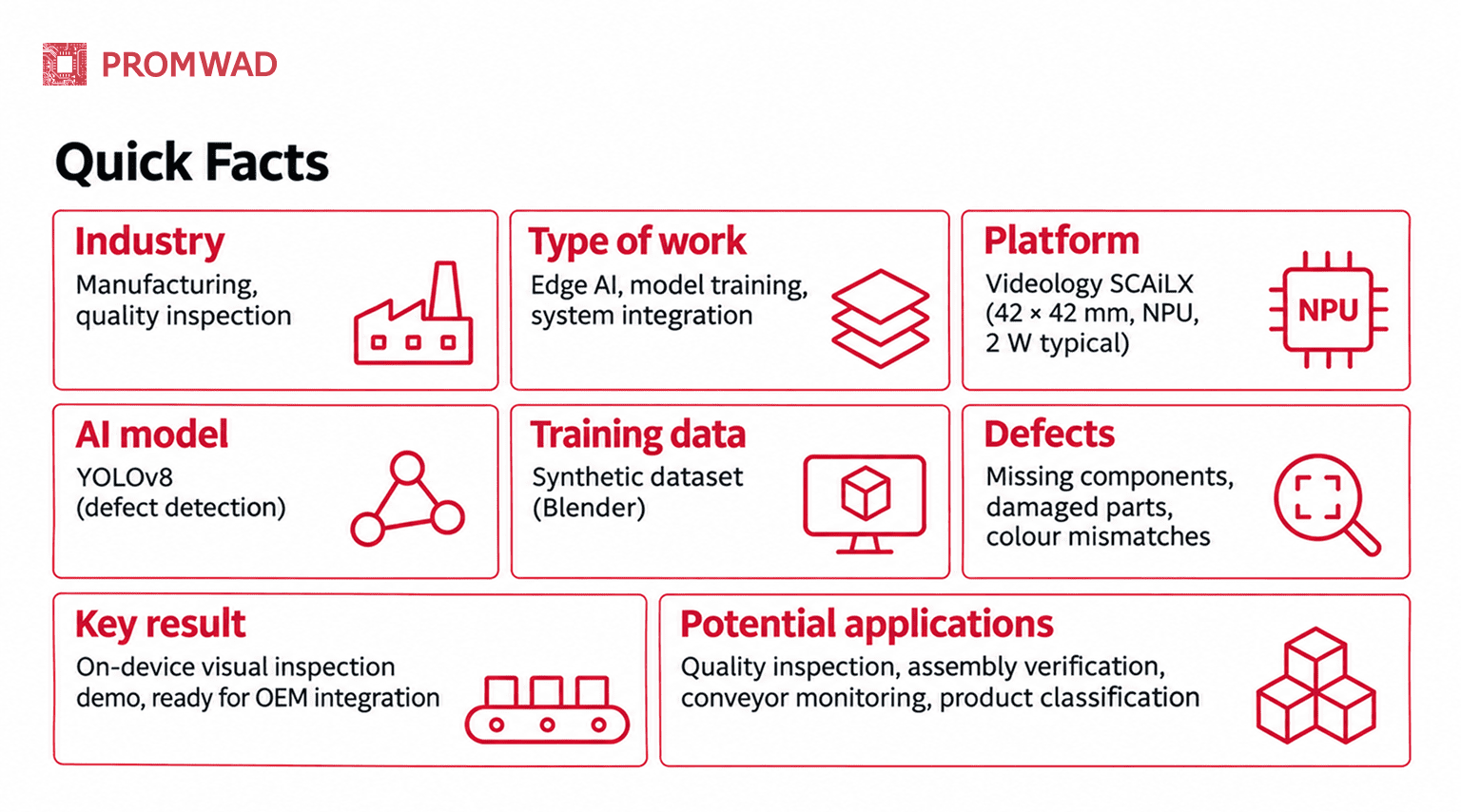
Project in a Nutshell: Videology and Promwad built a joint demo that runs automated visual quality inspection on a single embedded camera. A Promwad-trained YOLOv8 model runs on Videology's SCAiLX platform, a 42 × 42 mm system-on-module with an integrated NPU and a 2 W typical power budget. It identifies missing components, damaged parts and colour mismatches on a simulated production line. All processing happens on the device, so no video is sent to a server. We trained the model on synthetic data rendered in Blender, which gave us a labelled dataset for a product line that does not physically exist. Visitors to electronica 2026 can race the model and try to spot the defect first.
Challenge
Visual inspection is one of the most common machine vision tasks on a production line. Wherever parts move on a conveyor, a camera has to decide whether a part is complete, undamaged and the right colour, in the time it takes the part to pass.
Most systems send the video to a server to make that decision. The cost of doing so grows with every inspection point. One Full HD stream consumes up to 10 Mbps, so a plant with dozens of cameras pays for bandwidth, server hardware and a network that never drops a frame. Production footage also leaves the line, which many manufacturers do not allow.
Training data is a separate problem. A model needs thousands of labelled examples of each defect, but a working line produces mostly good parts, and making defective ones on purpose costs money. This demo added one more constraint. The product line is simulated, so no footage of it exists.
Solution
The demo combines Videology's SCAiLX platform with a detection model that Promwad trained for these parts and defects.
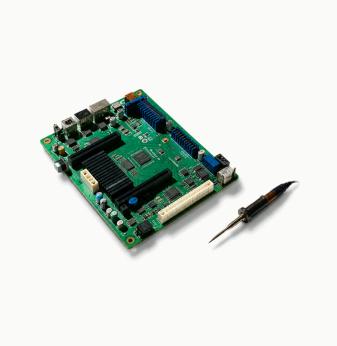
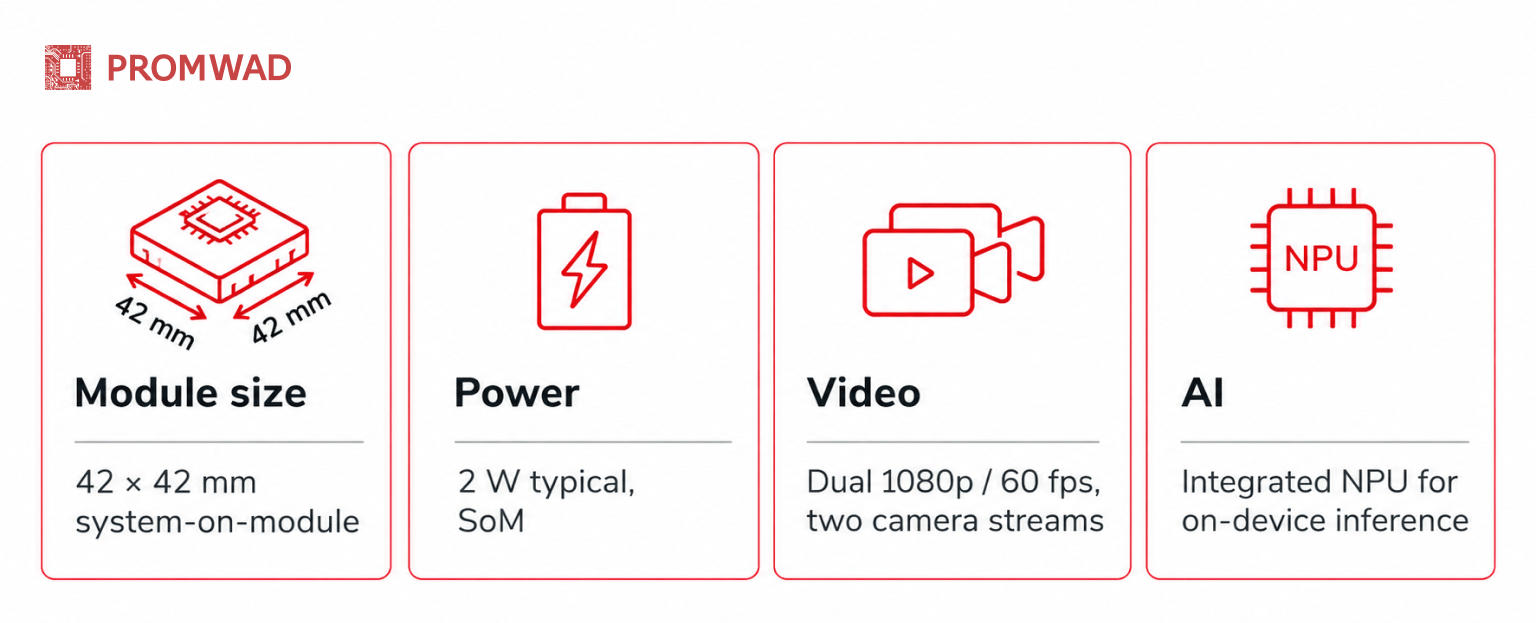
The platform. SCAiLX is a modular embedded vision platform built for OEM systems. It combines flexible camera integration, dual-camera video processing and on-device AI inference in a compact module.
The model. Promwad trained a YOLOv8 detector on three defect classes: missing components, damaged parts and colour mismatches. We picked YOLOv8 because it is one of the fastest detection architectures that still holds accuracy on a small compute budget.
The training data. The line in this demo does not exist, so there was no footage to train on. We rendered it in Blender and trained the model on the generated frames. Rendering gave us exact labels for every defect and control over lighting, camera angle and how often defects appear. On a customer's own line we would build the dataset from their parts on their conveyor.
How It Works
- Simulated production line. Parts move past a fixed inspection point, some of them defective, at a set interval.
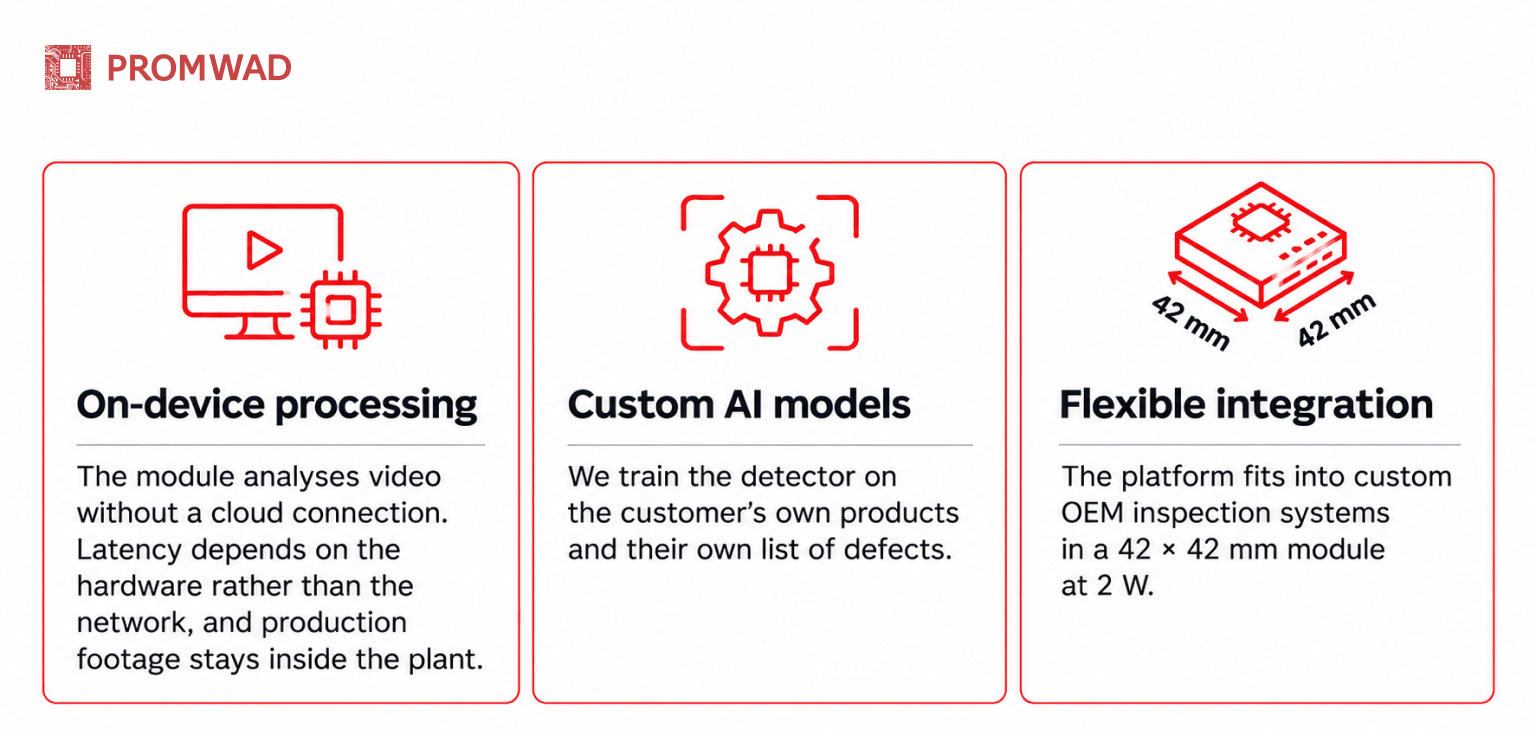
- SCAiLX camera. The camera captures the stream and passes frames straight to the on-board NPU. The video never leaves the module.
- Promwad AI model. The YOLOv8 detector runs on every frame and returns a class and a confidence score for each defect it finds.
- Defect detection output. The part is marked OK or DEFECT on screen, with the defect boxed.
At electronica 2026 this runs as a game. A visitor watches the same stream the model sees and presses a button when they spot a defect, and the scoreboard compares the two.
Key Benefits and Results
Scalability and Potential Applications
The parts on the simulated line stand in for whatever a customer makes. The approach can be adapted to different products: a manufacturer brings their product and their defect list, we build the dataset and train a model for those parts, and the same SCAiLX hardware ships with a different model on it.
The detector can be retrained for new classes and new operating conditions. The same stack covers:
- automated quality inspection;
- assembly and component verification;
- conveyor-line monitoring;
- product sorting and classification.
Videology's imaging and Promwad's edge AI together cover the range the partnership targets: detect, inspect, classify, monitor, automate.
More of What We Do for Industrial Vision
-
Machine Vision Engineering: explore our hardware and software services for industrial vision, from AI defect detection and quality inspection to part traceability.
-
Training a Neural Network for Counting People: read how our engineers build and train a detection model for a specific task, from dataset to deployment.
-
On-Device Conversational Edge AI: check out this case study of multi-camera analytics and a local LLM agent running entirely on NXP silicon, with no cloud.
FAQ
What does Promwad’s machine vision engineering cover?
Both sides of the system. On hardware: sensor integration, multi-camera integration and synchronisation, interface development, hardware acceleration for video processing, and ToF, LiDAR and hyperspectral imaging. On software: custom AI-powered applications and algorithms for process control and production stability.
Can Promwad build a defect detection system for our own production line?
Yes. AI-powered defect detection and quality control is a core line of our machine vision work, alongside quality inspection systems that verify component alignment, assembly accuracy, print quality, labels and closures. We also build camera-based sorting systems that identify and remove defective or wrongly oriented parts before final assembly.
Which AI chips and frameworks does Promwad work with?
We build on edge AI SoCs from NVIDIA, Ambarella and Renesas, and consult on AMD, Intel and Hailo silicon as well. The toolchain side covers TensorFlow, PyTorch, Renesas DPR-AI, Intel Myriad VPU and OpenVINO, NVIDIA Jetson and TAO, Lattice senseAI and Google Coral.
Our line already uses GigE Vision or USB cameras. Can you work with those?
Yes. We work with both protocols: GigE Vision for high-speed, long-distance transmission over Ethernet, and USB Vision where simple integration and high transfer rates matter more. Multi-camera integration and synchronisation and interface development are part of our hardware scope.
Can the system do more than detect defects, such as read codes or track parts?
Yes. We integrate 1D/2D code reading including QR codes and barcodes, OCR for text in varied fonts, pattern matching, region of interest, coordinate transformation, circle, edge and blob finders, and brightness and colour checks. This supports end-to-end part traceability in regulated sectors such as automotive, pharmaceutical and food.