


TSN Solutions
TSN Solutions
TSN solutions offered by Promwad help solve complex real-time and mission-critical tasks, making them well-suited for various sectors, including industrial automation, audio/video streaming, and automotive.
Time-sensitive network (TSN) is a set of standards for real-time data transmission in deterministic Ethernet networks. It is a Layer 2 technology developed by IEEE under the 802.1 working group.
Introduction to TSN
Key Features of TSN
TSN introduces a range of key features that set it apart from traditional Ethernet solutions. Central to TSN is time synchronisation, which ensures all devices on the network operate with a unified sense of time, crucial for coordinating time sensitive applications. Traffic shaping mechanisms, such as time aware shapers and credit based shapers, manage network traffic by allocating bandwidth and prioritising high priority traffic, resulting in very low latency and bounded latency for time critical communication. TSN also incorporates packet and link redundancy, stream reservation protocol, and support for multiple paths, providing robust fault tolerance and guaranteed bandwidth for reserved traffic. The use of time slots allows for efficient link utilisation, ensuring that both reserved and best effort traffic can coexist without compromising the performance of time sensitive streams. These features collectively enable TSN networks to deliver deterministic performance for demanding industrial and real-time environments.
Existing Methods and Limitations
Traditional Ethernet communication relies on a best-effort approach, which does not guarantee timely or reliable delivery of data—an issue for time sensitive applications in industrial automation. Existing methods, such as proprietary fieldbuses, often suffer from limited scalability, restricted bandwidth, and a lack of vendor neutrality, making integration and expansion challenging. These limitations can lead to dropped packets, increased latency, and unpredictable network performance, which are unacceptable in environments where real time critical data must be delivered without fail. Time sensitive networking addresses these shortcomings by providing a standardised, deterministic approach to Ethernet communication, enabling seamless convergence of IT and OT networks and supporting the stringent requirements of modern industrial systems.
TSN Standards and Specifications
Ethernet Network Infrastructure for TSN
Building a TSN-capable Ethernet network infrastructure requires careful selection and configuration of network components, such as switches and routers that support TSN standards. Effective network configuration is essential to achieve low latency, guaranteed bandwidth, and optimal link utilisation for time sensitive applications like industrial automation and motion control. Advanced network management engines and Yang data models play a crucial role in monitoring and managing TSN networks, ensuring fault tolerance and consistent performance. By leveraging TSN technology within Ethernet infrastructure, industries can achieve real time communication, improved efficiency, and robust support for both time critical and best effort traffic, paving the way for the next generation of converged, high-performance network systems.
Time Sensitive Networking Solutions
TSN solutions offered by Promwad help solve complex real-time and mission-critical tasks, making them well-suited for various sectors, including industrial automation, audio/video streaming, and automotive.
Time-sensitive network (TSN) is a set of standards for real-time data transmission in deterministic Ethernet networks. It is a Layer 2 technology developed by IEEE under the 802.1 working group.
Most industrial automation networks leverage Ethernet for real-time communication at the physical level. They implement data transmission methods and time synchronisation to guarantee timing, latency, and jitter stabilisation. Scheduled traffic and frame preemption mechanisms in TSN allow the network to prioritise high-priority and urgent traffic, efficiently manage low priority traffic, and handle mixed traffic types to ensure optimal performance and minimal packet loss. But there is a particular limitation to such an approach, as it leads to vendor lock-in and less-than-optimal use of network infrastructure.
Initially, the Ethernet standard wasn’t designed for real-time network needs. TSN introduces ethernet deterministic capabilities by providing guarantees on latency, throughput, and precise timing, making Ethernet suitable for time-sensitive and critical applications.
In recent years, the IEEE 802.1 TSN Task Group has introduced Time-Sensitive Networking Ethernet sub-standards to specifically address these requirements for real-time and deterministic networks. TSN leverages standard ethernet networks to enable deterministic and low-latency communication, supporting applications that require precise timing, such as industrial automation, automotive, and aerospace systems.
The IEEE 802.1Q standards operate at Layer 2 of the OSI model. TSN is not an internet protocol standard, it focuses on Ethernet technology. In a time-sensitive network, routing and forwarding decisions are based on the contents of the Ethernet header rather than the IP address. Within a TSN network, communication streams are defined and managed using specifications such as IEEE 802.1Qcc, which configure bandwidth, timing, and prioritisation, and use the destination MAC address to route data between devices like Talkers and Listeners. TSN enables devices to transmit data reliably and deterministically across control networks in industrial environments, ensuring precise, real-time data exchange and network performance.
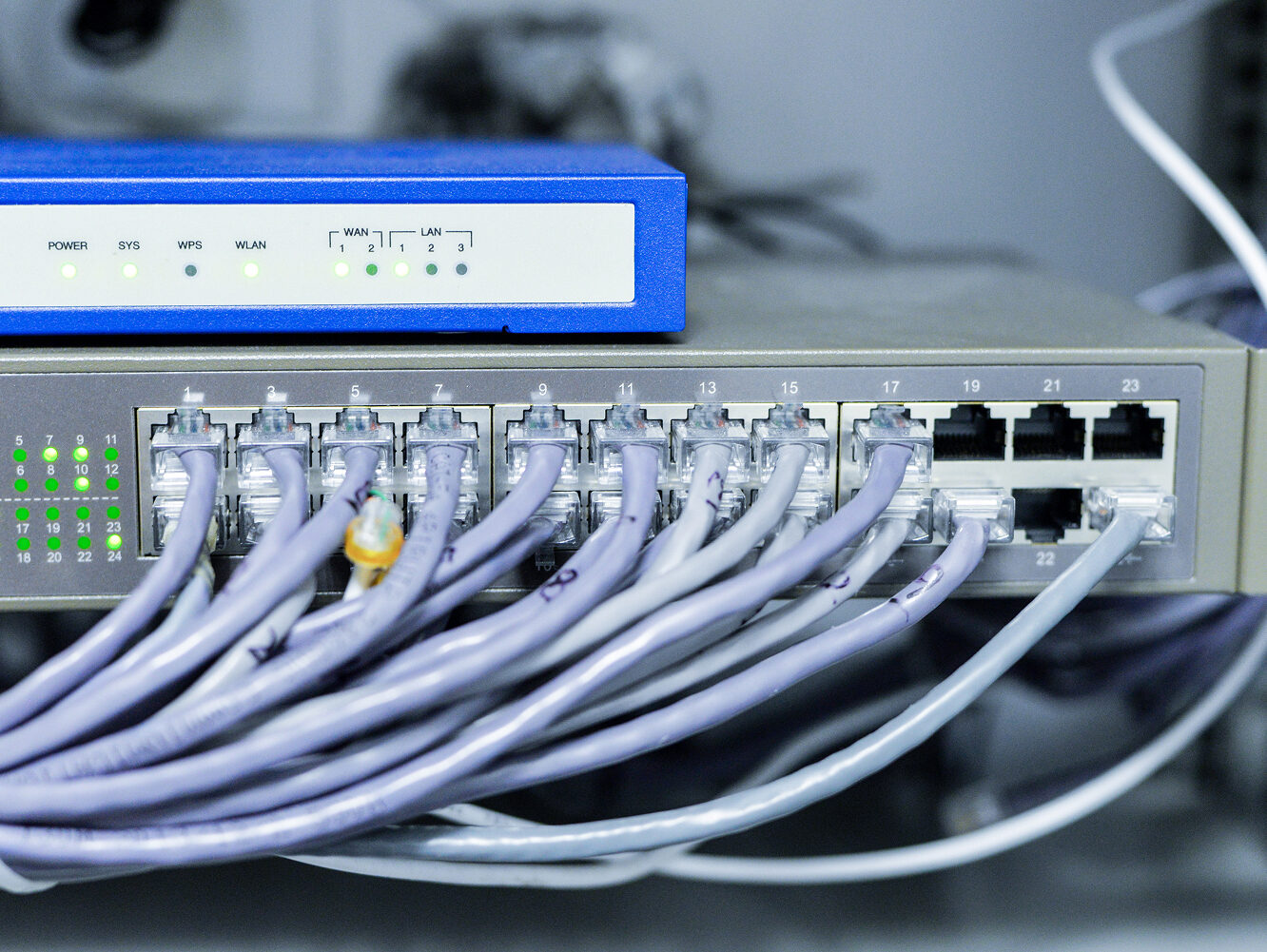
How Promwad Drives TSN Switch Development
Through close collaboration with Microchip Technology, Promwad’s TSN Ethernet switch solution offers customers a reliable way to strengthen and expand a network infrastructure that’s used for critical and non-critical data transmissions. Clients that utilise TSN-based solutions can converge numerous services over a single physical network.

TSN enables converged networks that support real-time control, multimedia streaming, and the integration of various communication standards within a single, scalable infrastructure. A network management engine is responsible for configuring and maintaining TSN domain characteristics, such as stream paths, VLANs, and network topology, automating setup and ongoing adjustments.
TSN enables converged networks that support real-time control, multimedia streaming, and the integration of various communication standards within a single, scalable infrastructure. A network management engine is responsible for configuring and maintaining TSN domain characteristics, such as stream paths, VLANs, and network topology, automating setup and ongoing adjustments.
TSN Time Synchronization: The Foundation of Deterministic Networking
Every TSN mechanism, from time-aware shaping (IEEE 802.1Qbv) to scheduled traffic and frame preemption, relies on one condition: all nodes in the network share the same time. IEEE 802.1AS (gPTP) provides that common time base. A traffic schedule is only as precise as the synchronization behind it.
For TSN switch vendors, timing is often where development slows down:
- TSN-capable silicon comes with 802.1AS support. Turning that support into a stable time-aware bridge with tuned servo behavior and verified accuracy is separate engineering work.
- One switch platform is expected to serve both factory floors, where PTP-only profiles such as IEEE 802.1AS and ITU-T G.8275.2 are enough, and critical infrastructure such as utility substations and railways, where SyncE with ITU-T G.8275.1 and boundary clocks are required.
- TSN equipment entering power utility networks must support IEC 62439-3 redundant networks and interoperate with legacy SONET/SDH timing still in the field during migration.
- Industrial networks converging with private 5G bring telecom-grade requirements, including boundary clocks that meet ITU-T G.8273.2 Class D.
Promwad closes this gap as a timing design partner. We take ownership of the synchronization layer in your TSN switch or router, on your silicon and within your architecture:
- IEEE 802.1AS time-aware bridge implementation with hardware timestamping and servo tuning
- Additional PTP profiles: ITU-T G.8265.1, G.8275.1, G.8275.2 and IEC 62439-3
- SyncE per ITU-T G.8262 and enhanced G.8262.1 for physical-layer frequency distribution
- Boundary clock performance from Class A to Class D (ITU-T G.8273.2)
- Interworking with legacy SONET/SDH (G.813) and PDH (G.812) clocks
- Custom architectures for distributing reference time and frequency to end nodes
Why is TSN Suitable for All Industrial Applications?
Ethernet frames are not limited to IP and can be used in any environment.
The number of industries that require deterministic communication is countless: automotive and transportation, manufacturing, industrial automation, and more. TSN supports integrated vehicle network infrastructure, including climate control, infotainment, body electronics, and driver assistance systems, by enabling unified and reliable communication. TSN also enables precise control loop processing in machine control systems by ensuring timely data exchange and deterministic operation.
In industrial automation, it is crucial to perform control loop processing with predictable timing and low latency to maintain system reliability and efficiency. TSN prioritises time critical traffic, ensuring reliable and timely delivery in demanding industrial environments. The primary reason for this flexibility is the high optimisation and connectivity levels, which ultimately results in cost reduction.
Our Chip Vendors Offering TSN Feature




Our Case Studies in Industrial Applications


Do you need a quote for your TSN-based project?
Drop us a line about your project! We will contact you today or the next business day. All submitted information will be kept confidential.